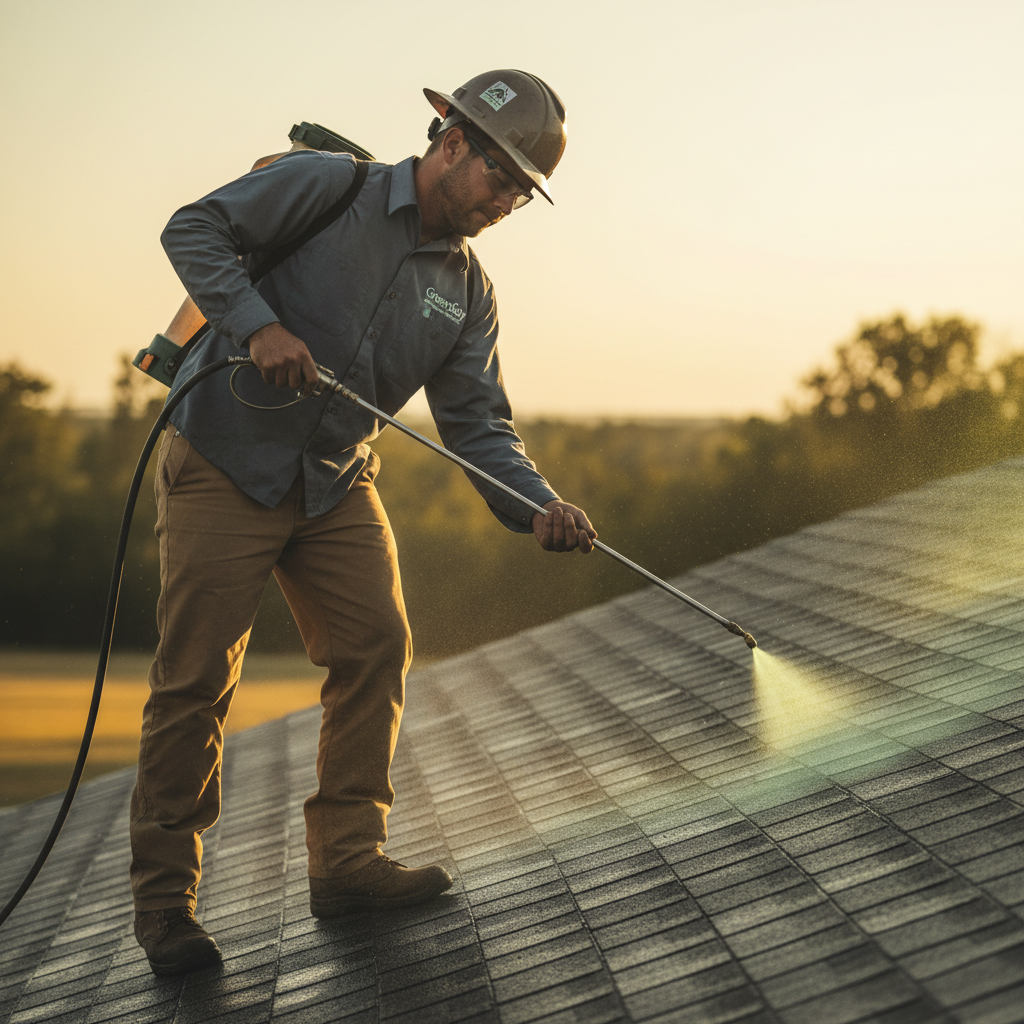
You’re looking at GreenSoy roof treatment because replacement quotes are brutal, and your roof still looks “fine.” It’s a soy-based spray meant to condition aging asphalt shingles and slow brittleness, not a new roof.
What makes this decision hard is that most info you’ll find is sales copy, while what decides outcomes is your roof’s current condition and the provider’s process and paperwork. In this guide, you’ll get a clear explanation of what GreenSoy is and isn’t, why “added life” claims range so widely, and what to ask for so you can judge the product and the warranty based on more than a promise.
Greensoy Roof Treatment: What It Is

GreenSoy roof treatment is a spray-applied asphalt shingle rejuvenator (GreenSoy roof rejuvenation) that uses soybean-oil-derived chemistry to put flexibility back into aging shingles. In simple terms, it aims to replace oily components that weathering drives out of asphalt (often described more specifically as restoring “maltenes” through a soy-based ester chemistry) to help shingles stay flexible and age at a slower rate.
It’s not a new layer of shingles, not a waterproof “roof coating,” and it won’t fix the reasons roofs usually leak (failed flashing or bad pipe boots). Anyone pitching it as a roof “sealant” or a way to make worn shingles like-new is raising a red flag. A practical way to think about it is a roof conditioner for shingles that are still structurally intact, and you should still have the roof checked first.
In practice, you’re paying for the service, which is applying the rejuvenator to the shingle surface as a maintenance-style visit. When you get quotes, ask what product is being applied and how it’s described in writing (look for language about maltenes/soy ester rejuvenation, not vague “oil treatment” claims).
What ‘Credible’ Evidence Looks Like
You pick the “rejuvenation” route, relax for a season, and then a leak shows up and everyone points to exclusions and missing documentation. The only way to avoid that trap is to treat proof like part of the product you’re buying.
If most of what you’re finding is vendor content, evaluate the service the way you would any major roof job: insist on documentation, not reassurance. Many homeowners get comfortable because the brand sounds legit and the “soy-based” angle feels lower-risk. That isn’t enough, and Better Business Bureau (BBB) ratings won’t prove the material was tested or applied under warranty conditions.
Look for proof in three places: testing, documentation, and roof rejuvenation warranty language.
A reputable provider should be able to show pre- and post-treatment photos plus written proof of roof condition, coverage rate, and what was (and wasn’t) included. Read more in our article: Roof Restoration Documentation For instance, if a provider says “adds up to 6 years,” you should be able to see where that number comes from and what it excludes, not just hear it repeated.
| Decision step | What to check/ask | Good sign | Red flag |
|---|---|---|---|
| Proof of claims | Technical data sheet (TDS) and any independent/lab testing tied to performance claims | Specific documents provided that match the claims being made | Only brochure/sales copy; claims can’t be traced to testing |
| Product identity | Exact product name/manufacturer and confirmation of the specified formulation (not a diluted blend) | Clear product identification in writing | Vague “soy oil” language; unclear or changing product details |
| Scope & process | Written, line-item scope; prep/cleaning; dry-weather requirements; landscaping protection; defined coverage rate | Process controls and scope are documented | “Spray and go” approach; no coverage-rate/process details |
| Warranty reality | Warranty language and exclusions (especially what happens if water intrusion occurs) | Coverage and exclusions are clear and match real roof risks | Warranty focuses on “treatment performance” while leaks are broadly excluded |
| Roof condition screen | Granule retention and surface coverage | Shingles mostly full of granules; no obvious balding | Heavy granule loss (piles in gutters/downspouts); bald spots |
| Roof condition screen | Shingle integrity (curling/cracking/delamination/broken corners) | Shingles lie fairly flat; aging/stiffness or algae staining more than breakdown | Widespread curling/cracking/delamination; broken corners |
| Roof condition screen | Active leak sources and water-shedding details (pipe boots/flashing/exposed nails) | Details appear intact; no active leak sources identified | Failing pipe boots/flashing; exposed nails; active leak sources |
| Roof condition screen | Wind-related issues (lifted tabs/recurring wind lift) | No recurring wind-lifted tabs | Recurring wind-lifted tabs (treatment won’t correct underlying fastening/seal issues) |
Coastal NC Realities: Algae, Salt, Wind

In Wilmington-area neighborhoods, the biggest threat to your shingles often isn’t a dramatic leak. It’s steady algae growth and salt-laden air that speed up aging, and salt air can act like sandpaper on the roof over time. That means a GreenSoy roof treatment should feel like preventative maintenance for a still-sound roof, not a reset.
Wind matters too after a named storm or a week of strong gusts, so plan on a storm damage roof inspection. You can have lifted tabs or popped fasteners that no spray can fix, so get a second set of eyes on it. If you’re doing rejuvenation here, plan on an inspection cadence (especially post-storm) so the conditioning work doesn’t distract you from the details that actually let water in.
In coastal North Carolina, salt air and wind-driven grit can accelerate shingle wear, so inspections after storms and seasonal checks matter even when the roof “looks fine” from the yard. Read more in our article: Signs Salt Air Wind Damage Shingles
Roof Replacement vs Restoration: Cost per Added Year
Most GreenSoy marketing centers on a baseline promise of about ~6 years of added life per application, with some brands pitching 5+ and others claiming much higher ranges depending on roof condition. If you’re going to pay for time, the math has to start with the number you can actually defend.
Because the treatment is typically cheaper than replacement, a straightforward way to compare options is to calculate cost per added year. Many providers anchor a single application around “up to ~6 years” of added life, so you can do a rough check: treatment price ÷ expected added years. For instance, if you pay $2,400 and you realistically expect ~6 years, you’re buying time at about $400/year.
Now compare that to replacement as a timeline decision: a $25,000–$40,000 reroof spread over 20–30 years plus the mess and scheduling disruption—and whether the goal is to prevent roof replacement. Treating rejuvenation as “cheap” without proving the timeline shift is bad math, and it won’t pencil out for most homes when you check it against Consumer Reports home improvement guidance.
If you’re comparing rejuvenation to replacement, the clearest way to avoid sticker-shock decisions is to line up the real per-year cost and the situations where restoration math stops working. Read more in our article: Roof Rejuvenation Cost Vs Replacement
FAQ
When Should You Schedule a GreenSoy Roof Treatment?
You’ll usually get the best value when your shingles are aging but still intact, often in the mid-life window before heavy granule loss shows up. Plan it for a dry-weather stretch, and don’t book it as a substitute for a post-storm inspection if you’ve had recent wind events.
Does the Warranty Cover Leaks?
Often, no. Many warranties focus on the treatment’s performance, not water intrusion caused by flashing or pipe boots, so read the exclusions like you’re signing a long airline contract. This is not my first rodeo.
Will This Affect Homeowners Insurance or a Roof Claim?
Don’t assume it “resets” your roof age with insurance. Don’t expect it to replace documentation an insurer wants after a storm. If you’re treating to buy time before replacement, keep your inspection notes and receipts so you can show maintenance history if questions come up later.
Can You Reapply It, and How Often?
Reapplication is common in the rejuvenation category, but the right interval depends on your roof’s condition and what the provider can justify in writing. If someone implies you can keep extending a near end-of-life roof indefinitely, you’re being sold a story, not a maintenance plan.
What Prep and Cleanup Should You Expect?
A reputable crew will confirm the roof is dry, protect landscaping, and keep the application rate controlled instead of rushing a quick “spray and go.” Before they start, ask how they handle overspray on siding and windows, and what you should move or cover the day of service.
Roof not getting any younger? Contact us or call 703-673-6301 to find out where you stand.Before pricing a new roof, see what our bio-based roof rejuvenation in Wilmington can bring back. Most treatments take one day.