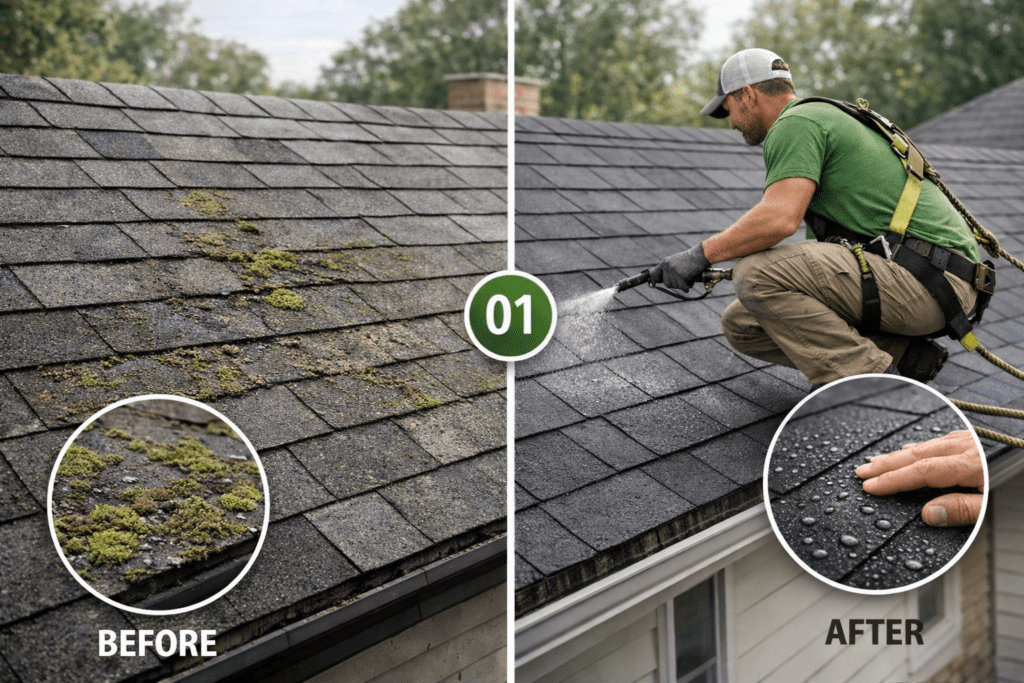
You’re looking at a roof that still looks “fine,” but someone’s telling you it’s near the end. Then you search GreenSoy roof treatment and mostly find sales pages and hot takes calling it either smart maintenance or snake oil.
This guide gives you a grounded way to evaluate it before you spend any money. It covers what a GreenSoy-style treatment is and isn’t, what results are realistic, when a Wilmington roof is a good candidate, and what details to get it in writing so you can compare quotes without getting upsold.
GreenSoy Roof Treatment: What It Does
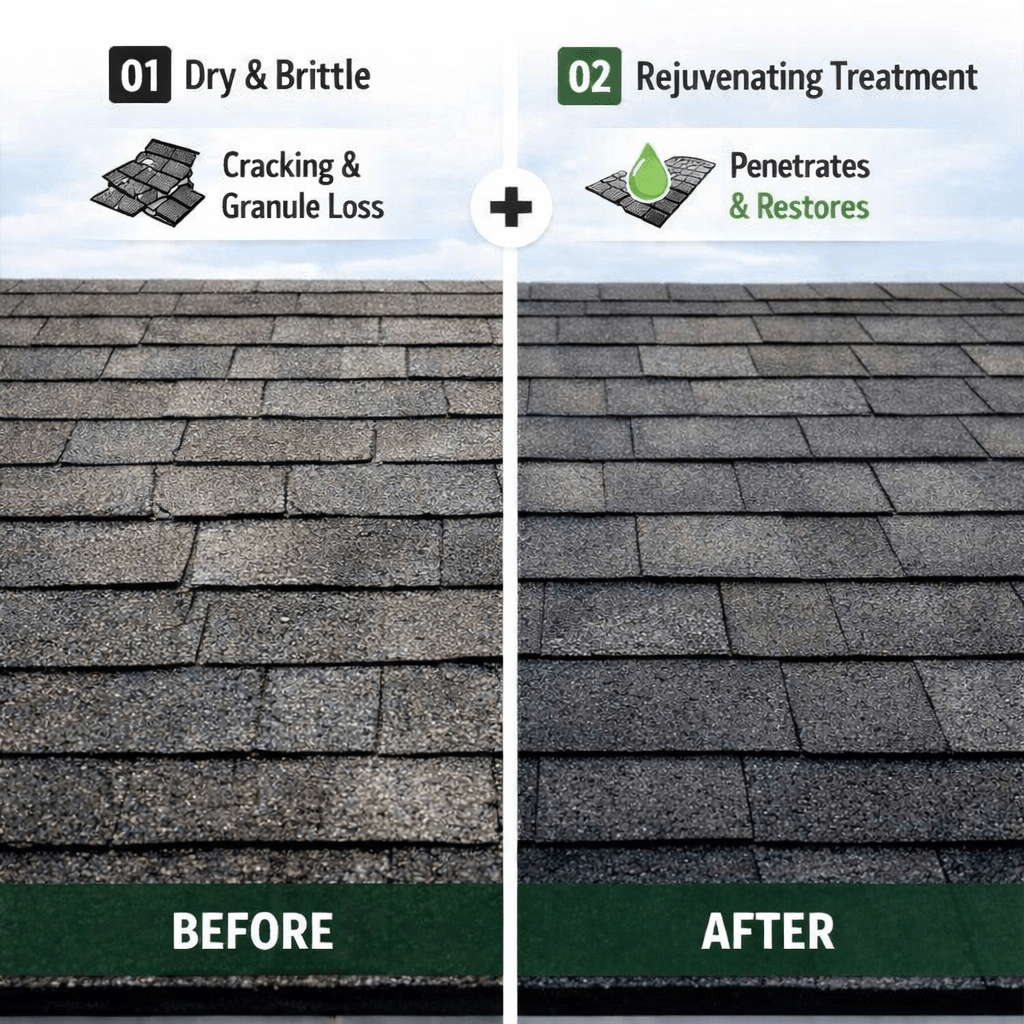
GreenSoy roof treatment is typically marketed as a penetrating rejuvenation for aging asphalt shingles, not a paint-on coating that creates a new waterproof layer. The idea is that as shingles age, they dry out and get brittle. A soy methyl ester-based emulsion is sprayed so it can soak in, helping restore some flexibility and slow the kind of wear that shows up as cracking and granule loss.
That matters because a lot of people expect a magic seal, and that’s the wrong expectation, like treating before/after photos in the neighborhood Facebook group as proof it fixed the roof. It can’t replace missing shingle material, and it won’t stop an active leak the way a proper repair can. To illustrate this, if your Wilmington roof has algae streaks and still sheds water fine, rejuvenation targets the shingle’s aging, not the stain itself. It won’t make a soft deck or lifted shingle edges disappear.
Branded GreenSoy-type system (not an unbranded “rejuvenator”)
Described as a penetrating treatment, not a coating
Planned application rate for full coverage
Mechanism explained beyond “it makes it like new”
Is Your Roof a Good Candidate?
You can spend money on a treatment and still end up budgeting for a replacement next storm season if the roof was already failing in ways a spray cannot touch.
A GreenSoy-style rejuvenation only makes sense if your shingles are intact enough and you’re trying to slow aging, not rescue a roof that’s already failing. The trap is thinking “it’s not leaking, so it must be fine” or “it’s old, so it must be done,” instead of checking it carefully, because a roof can look solid but still wash out like a sandcastle at high tide. In coastal North Carolina, you can have a roof that still sheds water most days but has wind-driven rain pathways at flashing or hidden deck softness that no spray will fix, especially when weighing roof rejuvenation coastal North Carolina options.
| Quick screen | Likely fit for rejuvenation | Likely not a fit (repair/replace first) |
|---|---|---|
| Leaks / interior staining | No active leaks; no growing stains | Active leak; growing stains; repeated “mystery drips” after wind-driven rain |
| Shingle condition | Tabs lie flat; shingles basically intact | Missing, creased, torn, or frequently lifting after storms |
| Aging signs | Even aging; dullness; algae staining may be present | Widespread cracking, brittle breakage when handled, or heavy granule loss at downspouts |
| Deck/substrate | Deck feels firm; no sagging lines | Soft/spongy areas or sagging lines suggesting substrate problems |
What you can do next: walk the perimeter with binoculars. Then ask an inspector to call out specific problems (wind damage, flashing breakdown, soft decking) versus generic “end of life” for roof rejuvenation Wilmington NC. If they can’t answer whether the roof is sound enough to maintain, any rejuvenation quote is guesswork.
What Results to Expect (and What Not)
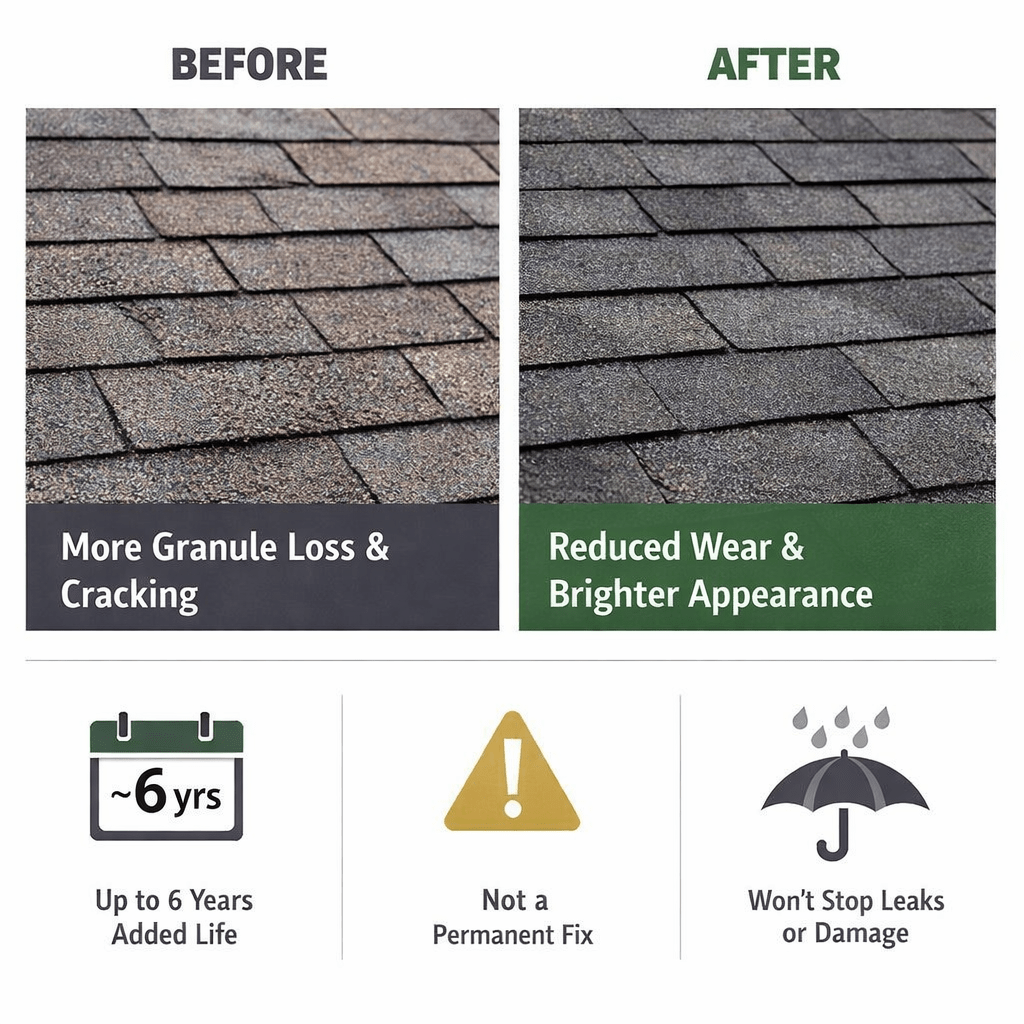
In one accelerated weathering comparison often cited by rejuvenation marketers, treated shingles were reported to have about 53% less granule loss than untreated shingles under the same test conditions (as summarized from a PRI Asphalt Technologies accelerated weathering comparison: PRI Asphalt Technologies).
Think of a GreenSoy-style treatment as a maintenance cycle, not a one-time rescue: the common promise is up to about 6 years of added service life per application (often paired with a 6-year warranty), consistent with consumer-facing GreenSoy™ Technology messaging from Fresh Roof. That can buy time if you’re delaying a tear-off, but it doesn’t reset the roof to “like new,” and some roofs still aren’t worth trying to extend.
Also, don’t confuse looks with performance. If you have ever owned a pressure washer, you know looking better is not the same as being safer. As an example, algae streaks may lighten or stay put, but the goal is slowing shingle aging, not restoring a clean, uniform color. And there’s a ceiling: repeat applications are sometimes marketed as getting you up to ~18 years total across multiple cycles, not indefinite extensions (a claim echoed in various Fresh Roof dealer/market pages).
The Tradeoffs Homeowners Must Check
Before you treat this like “just maintenance,” recognize you’re changing the surface chemistry of your shingles, and some major shingle makers have discouraged field-applied restorative treatments (see discussion of manufacturer guidance in GAF-related materials often cited in industry comparisons). That doesn’t automatically mean it’s a bad choice, but it does mean you should do it right the first time and ask how they handle manufacturer compatibility, because salt air will stress-test excuses like a cheap tarp in a nor’easter.
Active shingle or workmanship warranty, and whether treatment could complicate a claim
Insurer description for future storm claims (treated, repaired, or replaced)
Safety and overspray controls (pets, vegetable beds, sensitive landscaping near drip lines)
Product name, application rate, and basic precautions in writing
How to Compare Quotes and Decide
You want to look at two bids and know, in five minutes, whether they are actually proposing the same scope or just using the same buzzwords at different prices.
Compare as cost per year of life extension, not lump sum vs replacement
Treatment price ÷ 6 if the claim is “up to ~6 years”
Ask what the outcome looks like if it only delivers 3-4 years
Planned coverage/application rate in writing (often ~1 gal/100 sq ft; see treatment assumption examples in an OSU-branded document circulating online: Oregon State University Extension)
Replacement wins if you’ve got active leaks or widespread damage, and pretending otherwise is wishful thinking. Next, request an inspection or estimate that spells out the product name and the warranty term. Treat it like an HOA ARC submittal, because if it isn’t documented, it didn’t happen.
Contact us for a free inspection or call 703-673-6301 to find out where you stand.
For the broader call between treating shingles or replacing them, our rejuvenation vs replacement guide covers when GreenSoy makes sense and when a tear-off is the right answer.
Rather than guess, let our Wilmington roof rejuvenation document where your roof really stands.


