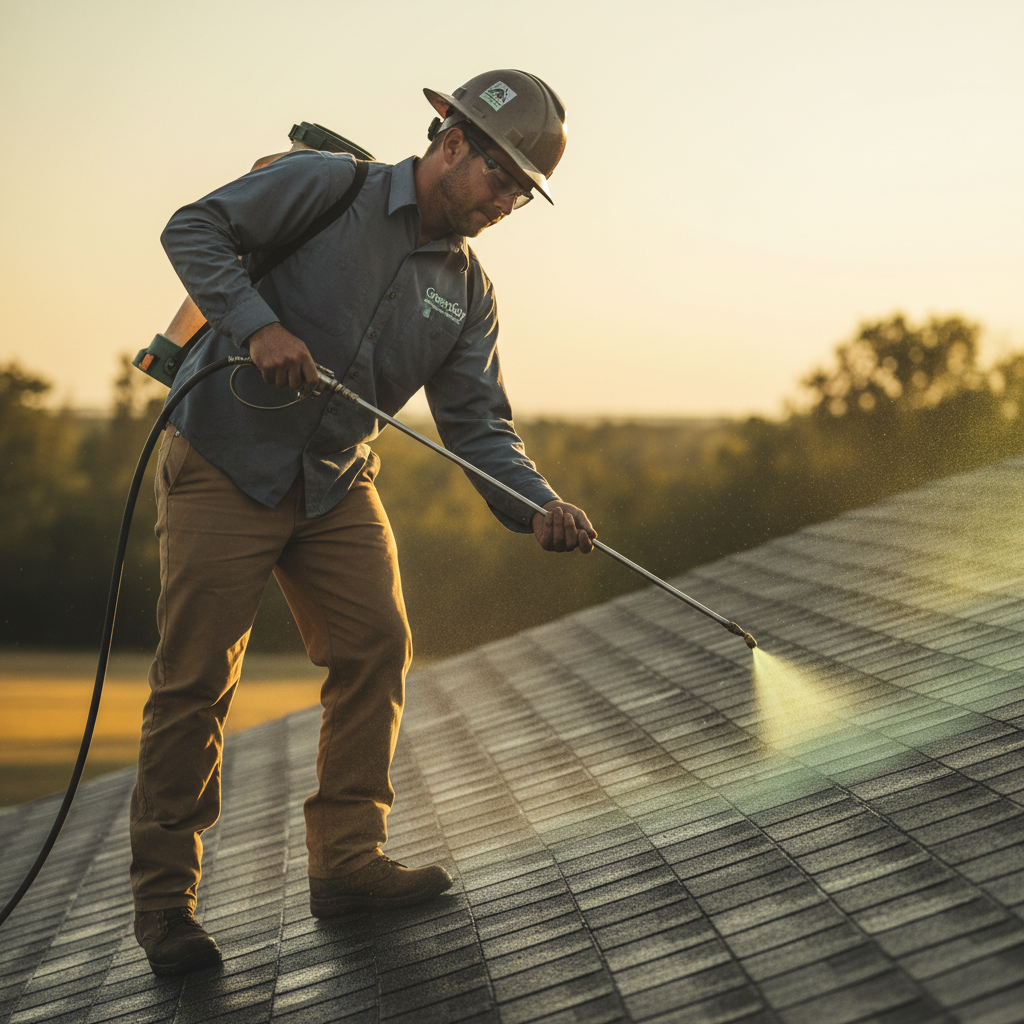
You’re asking whether GreenSoy roof spray is safe for your family. It’s marketed as plant-based and VOC-free. It’s safest when applied correctly and allowed to fully dry.
If you’ve got kids or pets you worry about, “soy-based” doesn’t answer the real question. Safety comes down to how you can be exposed while the product is wet and where overspray can land. So get the exact product name and the GreenSoy SDS before you book (see Fresh Roof’s GreenSoy-related claims and framing in its FAQ). After that, judge the contractor’s plan against Wilmington’s wind and pop-up rain.
What “Safe” Really Depends On
“Soy-based” can push you toward thinking this is basically cooking oil on your roof. That’s not how you judge safety, and Consumer Reports wouldn’t buy it either. In real life, “safe” is about exposure pathways: what happens while it’s wet and what it can reach during the job.
Most homeowner safety concerns with roof sprays come down to keeping kids and pets away from wet surfaces and controlling drift until everything is fully dry. Read more in our article: Roof Treatment Safety Kids Pets
| Safety factor (during the wet window) | What can go wrong | What a credible contractor does | What to ask/confirm |
|---|---|---|---|
| Wet contact (people/pets) | Kids/pets step onto treated surfaces; residue/drips at eaves | Sets a clear keep-off period; controls access; confirms “safe to re-enter” conditions | “What’s the keep-off time for kids/pets, and what counts as safe (fully dry, no tack, no dripping)?” |
| Overspray / drift | Mist lands on siding, windows, furniture, neighboring property | Avoids gusty conditions; uses nozzle/pressure that minimizes mist to reduce roof treatment overspray risk; shields adjacent areas | “How will you prevent drift onto siding/windows and nearby property, especially if it’s windy?” |
| Runoff / drips | Over-application or early rain causes flow-off into mulch beds, drains, stormwater, rain barrels | Applies at a controlled rate (no “shiny streams”); identifies downspouts/drip edges; has a drip/rain plan to prevent roof treatment runoff storm drains | “What’s your runoff plan around downspouts, foundation plantings, storm drains, and any rain barrel?” |
| Odor / nearby air pathways | Temporary smell near open windows, attic/soffit vents; sensitivity concerns | Times work to reduce exposure; provides SDS guidance; advises on windows/vent proximity during application | “Do you expect odor, and what does the SDS say about inhalation around wet product?” |
| Site prep & protection | Sensitive landscaping, outdoor items, and contact surfaces get incidental exposure | Pre-wets/covers landscaping; moves/protects outdoor items; maps contact routes (paths, patios) | “What will you cover or pre-wet, and what areas should we keep off during/after the job?” |
| Documentation & controls | Marketing claims substitute for verified precautions | Provides exact product name + SDS; explains training/authorization and application controls | “Can you email the product name and SDS ahead of time, and confirm you’re trained/authorized to apply it?” |
Questions to ask before you book

Fresh Roof’s own materials pair “non-toxic” language with big numbers: treatments averaging about 20% of replacement cost and claims of up to 6 years per treatment, or even 6 to 18 years depending on the page (see Fresh Roof’s safety-focused article). When the claims swing that wide, the safest move is to pin everything to the exact product and the on-site controls.
A good contractor can usually explain exactly what will be protected, what will be pre-wet, and how runoff will be kept out of beds and drains before spraying starts. Read more in our article: Protect Landscaping Cleanup
I want the plan and paperwork to match the claims. Treat “non-toxic” as something you confirm with the SDS and the on-site controls. A credible contractor will answer these quickly and back them up with documents like a roof treatment safety data sheet and a job plan that fits your yard.
-
What exact product are you spraying, and can you email me the SDS ahead of time?
-
What does the roof rejuvenation SDS say about skin/eye contact and inhalation while it’s wet, and what PPE will your crew use?
-
Do you expect any roof rejuvenation odor at all, and how long should I keep windows closed or avoid the attic/soffit vent area?
-
What’s your overspray and runoff prevention plan for my home, specifically around downspouts, foundation plantings, and nearby storm drains?
-
What’s your rain plan, and what happens if a pop-up shower hits before it dries?
-
What’s the keep-off time for kids and pets, and what counts as “safe to re-enter” (dry to the touch, no tack, no runoff)?
FAQ
When Can Kids And Pets Go Back Outside After A GreenSoy Treatment?
You let the dog out, and five minutes later you realize the drip line is still wet and you’re asking, is roof rejuvenation safe for pets, as the paws are headed straight for the patio. The easy way to avoid that spiral is to treat the “wet window” like a real jobsite boundary, not a suggestion.
Keep everyone off treated areas until everything is dry with no tack and no dripping at the eaves. Your contractor should give you a specific “keep-off” window based on weather and application rate, not a generic number.
Will It Hurt My Landscaping Or Vegetable Beds?
Most “safe for plants” claims are marketing fluff unless you stop overspray and runoff while it’s wet, and BBB ratings won’t change that. If you have foundation plantings or raised beds, ask exactly what they’ll cover or wet down and how they’ll stop drips.
Should I Expect Odor, And What If Someone Has Allergies?
Even when a product is marketed as low-odor or VOC-free, you might still notice a temporary smell near attic/soffit vents or open windows during application (typical SDS-style precautions for soy methyl ester illustrate why wet exposure is treated as a manageable hazard: SoyMESDS.pdf). If allergies or sensitivities are a concern, close nearby windows and ask the crew what the SDS says about inhalation around wet product.
What About Runoff Into Storm Drains Or A Rain Barrel?
Your main protection is controlling application rate and timing so the product soaks in instead of washing off. If your driveway slopes to a drain or you collect roof runoff, tell the contractor ahead of time and don’t use captured water until the roof is fully dry and any initial rinse risk has passed.
Is It OK To Do This In Wilmington’s Humidity Or If Rain Pops Up?
A crew starts at 10 a.m. under a clear sky, then a pop-up shower hits before the roof flashes dry and the downspouts start carrying milky runoff into the mulch. Weather timing is the difference between a tidy application and a mess you cannot unsee.
Humidity can slow drying, and pop-up showers can turn a normal job into a runoff problem if the timing’s wrong. That’s a deal-breaker for me unless you have a clear weather window.
Pop-up showers can turn a normal application into a runoff problem, so drying time and a clear rain plan matter as much as the product itself. Read more in our article: Roof Rejuvenation Rain Get a rain plan you can hold them to, like flashing that actually sheds water.
Roof not getting any younger? Contact us or call 703-673-6301 to find out where you stand.