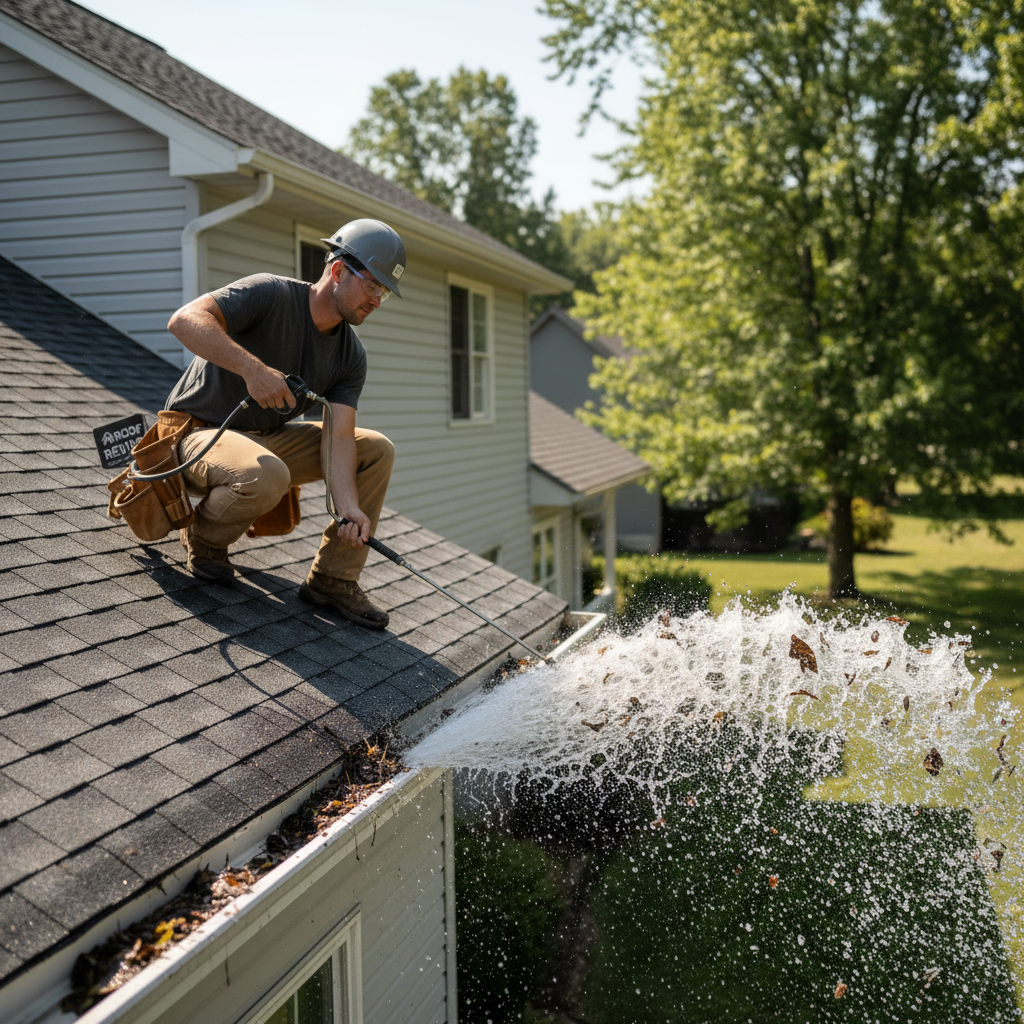
Yes, roof cleaning can void your roof warranty. It usually happens when cleaning causes damage or breaks written maintenance rules.
That’s why the question isn’t whether you can clean a roof. It’s whether the method gives a manufacturer or installer an easy “owner-caused damage” explanation later, so read the fine print and don’t hand them a pre-filled denial form. In coastal North Carolina, algae streaks and moss can push you to act fast, but one bad cleaning choice can turn routine maintenance into a coverage fight. In the sections below, you’ll see which warranty language matters. You’ll also learn why pressure washing is the quickest way to lose defensibility, and how to make any soft-wash plan match what your actual warranty allows.
| Cleaning choice / situation | Warranty risk (typical) | Why it gets denied | What to require to stay defensible |
|---|---|---|---|
| Pressure/power washing on shingles | High | Can be framed as owner-caused damage (granule loss, lifted tabs, water intrusion) | Avoid entirely; insist on “no pressure washing” in writing |
| Soft wash with disclosed chemicals & limits | Medium | Can violate exclusions if solution/strength/dwell time is prohibited | Get exact chemical(s), target strength, dwell time, and rinse plan in writing |
| Any coating/sealer/paint/“rejuvenator” | High | Often treated as a modification/coating that triggers exclusions | Require explicit “no coatings/sealers/rejuvenators” |
| Contractor won’t put method in writing | High | Leaves you unable to prove compliance with warranty PDF | Choose a contractor who will document process and materials |
| Existing leak or exposed/degraded shingles before cleaning | High | Easy for inspector to cite pre-existing damage or aggravated damage | Pause cleaning; get roofer inspection and document conditions first |
Can Roof Cleaning Void My Roof Warranty?

Yes, it can, but not every kind of roof cleaning voids a warranty. Warranties usually get denied when the manufacturer or installer can point to owner-caused damage or a maintenance method they warned against. Pressure washing is the clearest example: manufacturers caution that high-pressure spray can dislodge shingle granules or drive water where it shouldn’t go, which makes a later leak or premature wear easy to blame on cleaning (see CertainTeed’s guidance to avoid using a power washer on asphalt shingles).
Cleaning can also stay warranty-safe when you follow the written guidance for your shingle line, especially for algae staining, where some manufacturers publish approved approaches. Before anyone touches the roof, pull the actual warranty PDF and ask the contractor to put their method in writing (low-pressure process and what they’ll apply). If they won’t, you’re taking on their risk.
On asphalt shingles, a true soft-wash process relies on low pressure and controlled chemistry rather than blasting the surface with water. Read more in our article: Soft Wash Vs Pressure Washing
The Warranty Language That Matters
A homeowner in Wilmington thinks they did everything right until the claim comes back denied because the warranty PDF had one line their contractor never mentioned. The difference between “routine cleaning” and “owner-caused damage” is often a few searchable words.
You don’t need to read the entire warranty for manufacturer roof warranty cleaning requirements. You need the downloadable warranty PDF for your exact shingle line, then you need to find three buckets: maintenance guidance (what you’re expected to do or avoid), exclusions (words like “damage caused by” cleaning or pressure washing), and remedies (what they’ll do for issues like discoloration).
Open the PDF and use search for: clean, pressure/power wash, granules, algae, and exclusion. Skip this step and you’re relying on assumptions, even if your Angi (Angie’s List) contractor reviews and checklists look great. Then make your contractor’s written plan match what the PDF allows, not what their sales pitch claims is “standard.”
Pressure Washing: Why It’s the Easiest Way to Lose Coverage

With pressure washing, the argument writes itself: once you blast the roof, a later issue can get labeled “owner-caused,” so don’t hand the adjuster an easy narrative. High-pressure spray can strip granules (the gritty layer that protects asphalt shingles). It can lift shingle edges and push water up under laps. That damage doesn’t have to look dramatic to matter.
In Wilmington’s humid, windy storms, loosened granules or slightly lifted tabs can shorten roof life or lead to leaks, and an inspector can tie that back to washing. If you want coverage to be defensible, treat “high-pressure water on shingles” as the line you don’t cross.
Granules protect shingles from UV and weathering, so visible granules in gutters after washing can become evidence of cleaning-related damage in a claim dispute. Read more in our article: Roof Granules Coming Off
Soft Wash and Chemicals: When “Gentle” Still Counts as a Violation
You approve a “gentle” soft wash, and weeks later the roof looks fine, but when someone asks what was applied, nobody can produce a clear record. That’s when “we just used bleach” can turn into a coverage problem.
Soft wash swaps out mechanical damage for chemical risk, and it can still trigger exclusions if the cleaning solution is prohibited or used at the wrong strength or dwell time. Some manufacturers even spell out what they consider acceptable for algae staining, which should make you rethink the idea that “soft wash” is automatically compliant (for example, GAF’s algae-staining bulletin includes a specific cleaning mixture and process).
Before you approve the job, get the plan in writing: exactly what they’ll apply (and target strength, not “bleach”), how long it will dwell, and whether they’ll rinse. Anything less is sloppy, and This Old House (TV show/site) would call it out. Also ask how they’ll manage runoff, because a roof-safe mix that kills algae can still burn landscaping and create a mess you own.
Runoff control matters because even “roof-safe” mixes can damage plants and exterior materials if they aren’t pre-wet, protected, and rinsed correctly. Read more in our article: Protect Landscaping Cleanup
If your roof is in the Wilmington area, our soft-wash roof cleaning in Wilmington NC is built to be warranty-safe: documented process, no pressure washing, and everything in writing.
A Warranty-Safe Roof Cleaning Plan
If you ever have to defend the roof’s condition later, maintenance records are what carry the argument: photos, the saved PDF, and a contractor willing to document every step (since some warranties can even reference cleaning as a remedy in certain discoloration scenarios; see GAF’s warranty overview). You are not just paying for a cleaner roof, you are paying for a story that holds up under inspection.
To keep the cleaning defensible later, build the documentation the way an adjuster would expect to see it, and keep every step above board. Snap dated photos of every slope (close-ups of stains and any lifted tabs), save your warranty PDF, and only approve a method the contractor will describe in writing: low-pressure application, the exact chemical(s) and target strength, planned dwell time, and rinse plan.
Stop and call the manufacturer/installer (or a roofer for an inspection) if any of these show up: the company won’t put the plan in writing or they use “power wash” language. Not my first rodeo. Coverage usually gets lost when the work can’t be supported with documentation, not when algae shows up.
Roof not getting any younger? Contact us or call 703-673-6301 to find out where you stand.