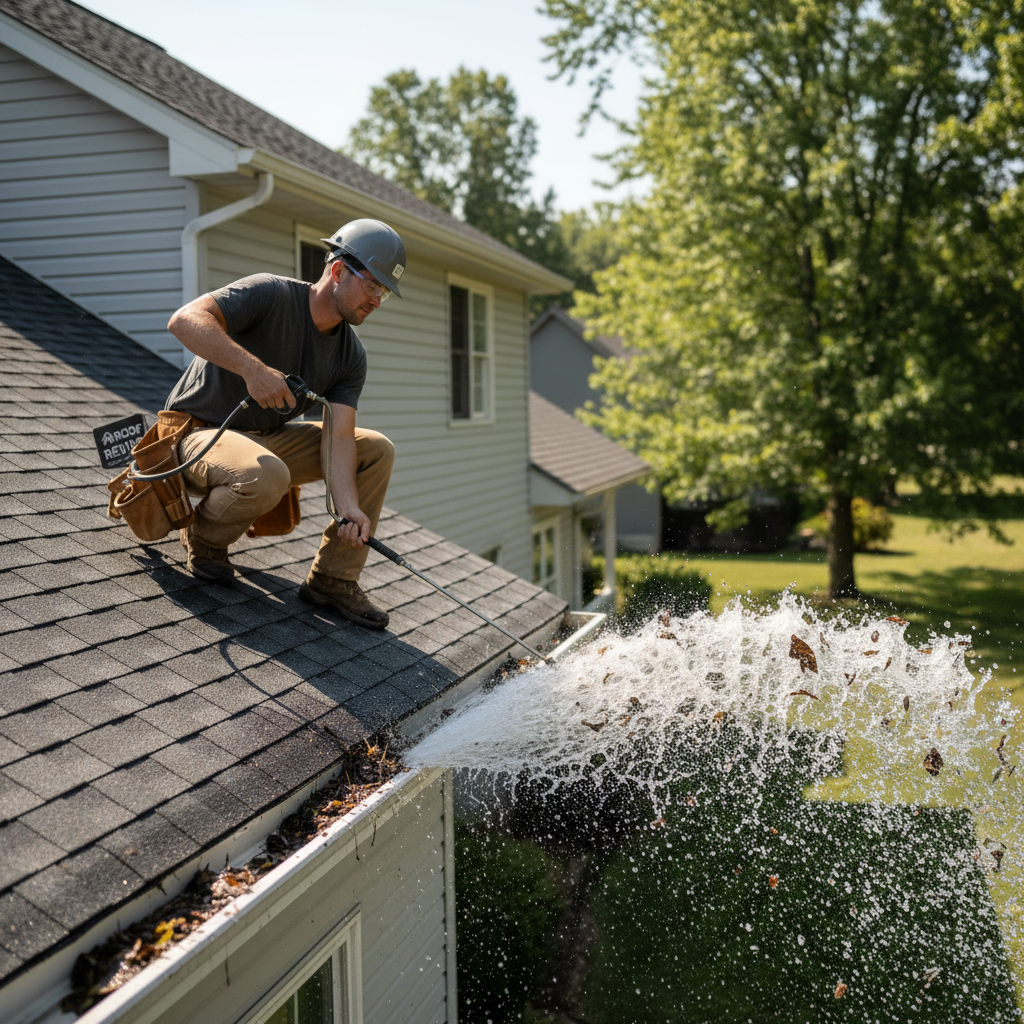
If your asphalt shingles already look worn or “bald,” soft-washing can be safe enough, but only when it stays truly low-pressure and chemical-based. The moment the job relies on blasting or scrubbing to “finish,” you risk stripping more granules. You shorten the roof’s remaining life.
You’re probably here because the streaks look like surface dirt, but the roof looks like it’s losing its protective skin and you don’t want one cosmetic decision to turn into a replacement. In the sections below, you’ll learn how to tell whether you’re being sold a true soft wash or pressure washing with a nicer name, and how to choose the least-risky next step if you’re dealing with algae or a roof that already looks tired.
The Real Risk on a Worn Roof

You approve a “quick clean,” and the roof looks brighter that afternoon. By the next heavy rain, the downspouts are spitting out sand-like granules you cannot put back.
On a roof that already looks “bald” or gritty, the black streaks themselves usually aren’t the thing that shortens roof life—the bigger issue is roof soft wash damage risk. What matters more is the method you pick, since it can strip away the last protection you have. It’s like sanding off the last gritty layer on a worn deck, and high pressure or even “gentle” scrubbing can dislodge more granules and rough up the shingle surface.
If you’re seeing concentrated granule loss in valleys or below vents, those are already stressed zones; blasting there can turn a cosmetic problem into premature wear or even water getting pushed where it doesn’t belong. If cleaning is your plan, your first decision should be whether the method is less risky than leaving the stains alone.
Granules collecting at downspouts after normal rain is one of the clearest signs the roof surface is actively shedding its protective layer. Read more in our article: Leftover Granules Gutters
When Soft-Washing Is Still Safe
Soft-washing can be “safe enough” on a worn asphalt roof when it stays a chemical treatment and not a force-based cleaning. That means low application pressure (think garden-hose range, under about 100 PSI), no scrubbing, and no high-pressure “rinse to finish” for low pressure roof cleaning asphalt shingles (see National Softwash Authority guidance). You may need to rethink the idea that a cleaner-looking roof is automatically a healthier roof. Mike Holmes would call it what it is: if the method removes more granules than the algae ever would, you just paid to shorten the roof’s remaining life.
| Decision bucket | What it usually looks like | What to do |
|---|---|---|
| Safe-enough signs (proceed cautiously) | Shingles still feel bonded down (no lifting edges) | Proceed cautiously, but only with a chemical treatment applied at truly low pressure and no brushing or rinse-to-finish. |
| Safe-enough signs (proceed cautiously) | Mainly algae streaks rather than thick moss mats | Proceed cautiously, and keep hands-off techniques only so you don’t dislodge granules. |
| Safe-enough signs (proceed cautiously) | Not finding piles of fresh granules at downspouts after normal rain | Proceed cautiously, and expect improvement, not a like-new finish. |
| Stop signs (skip cleaning; evaluate first) | Widespread “bald” tabs where the asphalt looks shiny or exposed | Don’t clean it yet; get the roof evaluated first. |
| Stop signs (skip cleaning; evaluate first) | Cracking/curling that suggests the shingle surface is brittle | Don’t clean it yet; get the roof evaluated first. |
| Stop signs (skip cleaning; evaluate first) | Soft spots or past leak staining in the attic | Don’t clean it yet; get the roof evaluated first. |
| Stop signs (skip cleaning; evaluate first) | Localized heavy granule loss in high-flow areas like valleys and below vents | Don’t clean it until it’s evaluated first, since these zones are easiest to damage with added agitation. |
If you’re hiring it out, ask one question that gets past the marketing: “What PSI will you apply at the roof, and will you do any brushing or pressure rinsing?” If they won’t answer directly, or they propose scrubbing or any kind of power washing, treat that as your cue to stop, not to negotiate.
If a contractor can’t clearly explain their process, comparing soft-wash chemistry versus rinse pressure is the fastest way to spot “pressure washing with a nicer name.” Read more in our article: Soft Wash Vs Pressure Washing
What Makes a “Soft Wash” Unsafe

A homeowner hears “soft wash” and pictures a gentle spray, not a high-PSI rinse or a broom on brittle tabs. That mismatch is where most of the damage stories start.
Once the plan relies on friction or pressure to “finish,” it’s not soft-washing anymore. If a quote includes a high-PSI rinse (or anyone says they’ll “blast the stains off”), you’re back in the damage zone of pressure washing asphalt shingles damage that ARMA warns against. The same goes for any plan that involves scrubbing with a broom/brush to speed results.
Also watch for avoidable foot traffic. On a worn, granule-thin roof, repeated walking to “agitate” algae or scrape moss can scuff off more granules. The spray pressure stays low. If the pitch sounds like “we’ll make it look new,” that is nonsense, and you’re probably paying for aggression, not care. That line shows up all the time on the Nextdoor neighborhood feed.
If You Shouldn’t Wash, Do This Next

You can leave the stains and still buy yourself time, if you stop treating the roof like a cosmetic project and start treating it like a weather barrier that needs fewer insults.
If you’re already seeing widespread granule loss or bald spots, stop trying to reset the look and move to triage that protects what’s left (asphalt shingle granules missing what to do), so you don’t waste money on a roof you can’t bring back to health with cleaning. A roof can look “dirty” from algae and still be serviceable, but a roof that’s shedding granules into gutters is telling you the surface is failing and cleaning won’t reverse that.
Use this order of operations: 1) Get a roof-condition inspection first (photos of valleys, vents, and flashing, plus a quick attic check for staining). 2) Handle safety and water-entry risks next: small flashing repairs, popped nails, and sealed penetrations beat any cleaning. 3) If you must address growth, do spot treatment only (kill the algae/moss with minimal disturbance, then let weather do the removal). 4) Consider roof rejuvenation only if the roof still has structural life and you’re trying to slow brittleness, not “restore” missing granules. 5) Plan for replacement when you see widespread bald areas, persistent leaks, or large sections that feel brittle or curl.
A photo-based roof-condition inspection is the simplest way to separate normal aging from damage that needs repairs before you spend money on any cleaning or treatment. Read more in our article: Typical Roof Inspection
FAQ
Will Soft-Washing Void My Shingle Warranty?
One detail can decide whether a future claim turns into a yes or an instant no: whether the roof was power washed or scrubbed.
Yes—if the method contradicts the manufacturer’s care guidance. Major manufacturers explicitly warn against power washing shingles (for example, GAF’s algae-staining technical bulletin), so if a contractor uses pressure or scrubbing and you later have a claim, you have basically gift-wrapped the denial, even on a roof as common as GAF Timberline.
Are the Chemicals Going to Kill My Plants or Mess Up My Landscaping?
They can if runoff isn’t controlled and diluted fast, especially with chlorine-based mixes. You should expect pre-wetting and a thorough post-rinse of plants and soil. Treat it like a Lowe’s / The Home Depot weekend project run checklist, plus a plan for where the downspouts discharge.
In Coastal North Carolina, How Long Until the Streaks Come Back?
A Wilmington homeowner pays for a careful clean in spring, then a humid summer rolls through and the north-facing slope starts darkening again. It feels like the job “didn’t work,” but it is often just the climate doing what it does.
In Wilmington’s humidity and shade, regrowth is normal. “Safe” cleaning doesn’t magically make it a long-term fix. If you don’t change the conditions that feed growth, you can see discoloration start returning within a year or two, sometimes sooner on north-facing slopes.
What Results Should I Expect If My Roof Is Already Worn or Losing Granules?
You can often lighten algae staining, but you shouldn’t expect a like-new look, and you shouldn’t chase perfection with extra rinsing or agitation. On a granule-thin roof, the right outcome is “cleaner without accelerating wear,” not “every stain erased.”
Can I DIY a Soft Wash on an Older Shingle Roof?
You can, but the biggest risks are overdosing the mix or creating uncontrolled runoff. If your roof already looks brittle, bald, or sheds granules after normal rain, you’re better off spending that effort on an inspection and targeted repairs instead of trying to clean it yourself.
Roof not getting any younger? Contact us at Contact us or call 910-241-1152 to find out where you stand.