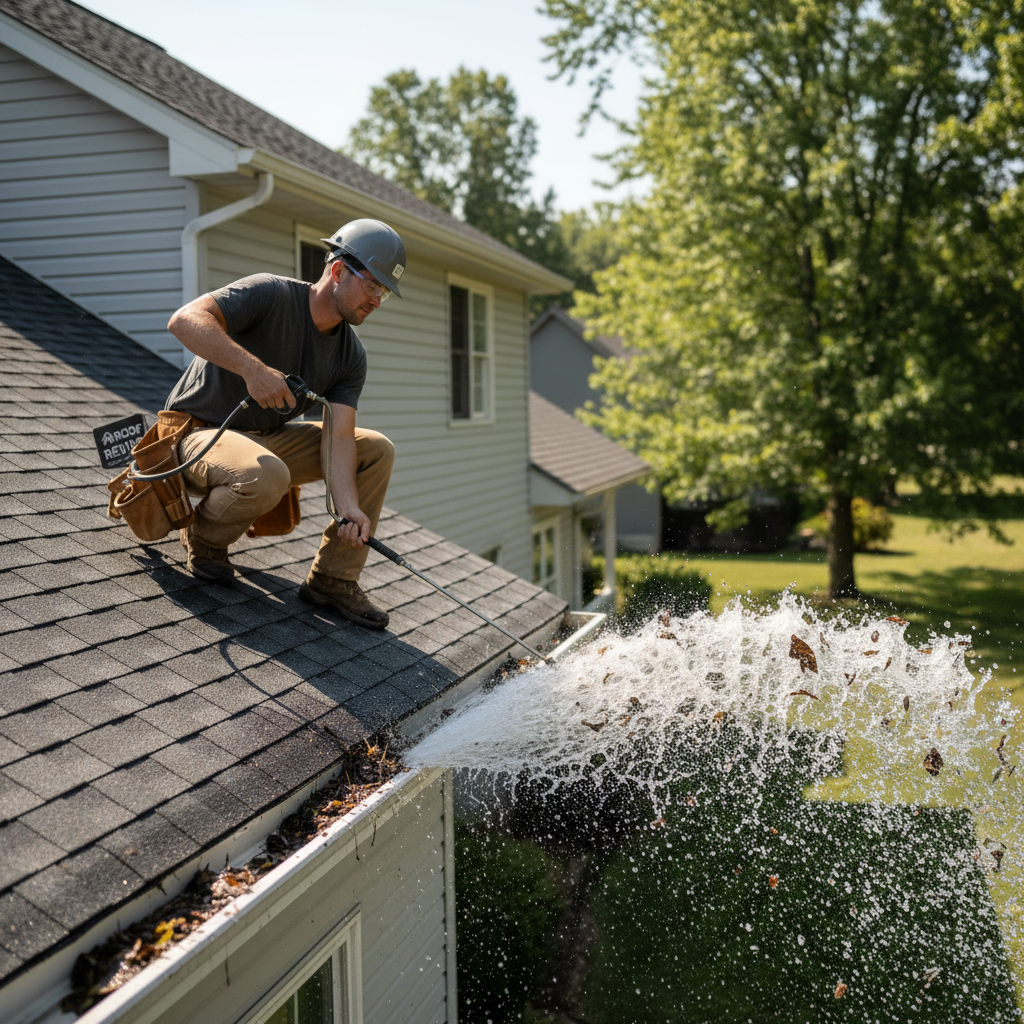
What’s the difference between soft wash roof cleaning and pressure washing? Soft washing removes roof algae and grime with a chemical solution and dwell time, then a gentle rinse. Pressure washing relies on water impact to break buildup loose.
If you’re comparing roof-cleaning quotes in Wilmington or anywhere along the coast, kick the tires on a couple options. Confusion sets in when both contractors claim “low pressure,” yet one still describes blasting stains off. On asphalt shingles, that wording matters because the granules are the roof’s armor. PSI alone isn’t the issue; the problem is relying on impact as the primary cleaning method. In the sections below, you’ll get the plain-language difference and the exact questions to ask so your estimate spells out a roof-safe process, not just a marketing label.
Soft Wash vs Pressure Washing: The Real Difference
The difference isn’t the machine on the truck; it’s what’s doing the work.
| Aspect | Soft washing (roof-safe approach) | Pressure washing roof |
|---|---|---|
| What does the work | Chemical mix + dwell time | Water-jet impact |
| Rinse role | Gentle rinse to remove loosened grime | Rinse is the primary cleaning force |
| Typical rinse pressure (asphalt shingles) | Often under ~500 PSI at the nozzle | Often four-digit PSI when “blasting” |
| Main risk on asphalt shingles | Chemical overspray/runoff if not controlled | Granule loss + possible water intrusion |
Soft washing cleans by letting a chemical mix kill algae and loosen grime, then using gentle water mainly to rinse. Pressure washing cleans by using the force of the water jet to break material loose. If a contractor plans to “blast the stains off” your asphalt shingles, you’re not paying for a safer method, you’re paying for impact.
That difference matters because shingles are built to shed water, not absorb a focused stream. High-impact rinsing can accelerate granule loss and can even drive water where you don’t want it. By contrast, roof soft washing typically applies a diluted sodium hypochlorite solution (often roughly 1%–3% for algae) for roof algae removal and gives it time to work, then rinses at very low pressure, often under about 500 PSI at the nozzle.
Marketing labels aren’t a good way to buy roof cleaning. Listen for process language, not “soft wash” promises. For example, a contractor saying “we’ll use low pressure, around 1200 PSI” is still describing pressure as the cleaning force. You’ll get a clearer answer if you ask: Will chemicals do the cleaning with dwell time? Is your rinse pressure just for rinsing, not stripping?
What Can Go Wrong With Pressure Washing Shingles

Picture your roof looking “brand new” on a Friday, then showing a mystery leak the next time a coastal squall blows rain sideways. The roof pressure washing damage you pay for often starts where the wand was pointed hardest.
Pressure washing fails on shingles for one main reason: it asks a water jet to do a job the roof system was never built to tolerate. Asphalt shingles protect your home with a mineral-granule surface and overlapping courses that shed water downhill. When someone aims a concentrated stream at that surface, you can trade “clean” for damage you won’t see until the next Wilmington wind-driven rain.
The most common failure is accelerated granule loss. Granules do more than change the look; they protect the asphalt from UV and abrasion. If a contractor has to keep working an area to “erase” algae shadows, that repeated impact can strip granules and shorten roof life even if the roof doesn’t leak immediately.
Granule loss isn’t always obvious from the ground, but the first clue is often gritty shingle sand collecting in downspouts or the bottom of gutters after aggressive cleaning. Read more in our article: Roof Granules Coming Off
A second common failure is water intrusion. With a fan or pinpoint tip, pressurized water can be forced under shingle edges and into laps and penetrations, including pipe boots. You might not notice anything that day, but moisture in the deck or underlayment can show up later as staining or a leak that’s hard to trace. If you care about warranty terms or resale, it’s also worth rethinking the idea that “a little pressure is fine” on shingles, because manufacturer/trade guidance often favors low-pressure chemical cleaning over blasting.
When a “Soft Wash” Isn’t Safe
A homeowner hears “soft wash,” signs off, and only notices the truth when the tech starts chasing stains with the trigger held down. The label stayed gentle, but the method didn’t.
“Soft wash” can still go sideways if the crew uses pressure because the mix is too weak or they don’t want to wait. Hearing 1,000–1,500 PSI described as “soft,” or watching them scrub staining by force, tells you pressure is doing the work. They’re treating your shingles like concrete.
Safety comes down to a few variables: low pressure roof cleaning (often under ~500 PSI) and an appropriate mix (often ~1%–3% sodium hypochlorite for algae). Ask what they’ll apply, how long it will sit, and how they’ll control runoff.
In coastal neighborhoods, asking about overspray control and where runoff will flow is just as important as asking about PSI. Read more in our article: Protect Landscaping Siding Windows
What to Demand in a Roof-Cleaning Estimate

One number shows up again and again in training and manufacturer-leaning guidance, yet almost never makes it into homeowner quotes: soft-wash rinsing is typically kept under about 500 PSI at the nozzle. If an estimate won’t commit to a process in writing, it usually won’t commit on the roof either.
Don’t accept an estimate that just says “soft wash roof.” Get it in writing. Vague labels won’t protect your shingles, so require the roof-safe process in writing before anyone shows up.
Ask for these specifics on the estimate (or in an email)
-
Confirmation they’ll use chemicals + dwell time to remove algae/moss, with rinse pressure kept low (not using pressure to “blast” staining off)
-
The type of growth they’re treating (algae vs moss/lichen) and the expected results (including any remaining shadowing) and reappearance window
-
Runoff and plant protection plan: pre-wet/rinse, containment where needed, and how they’ll keep solution out of storm drains
-
A clear exclusion: no high-pressure cleaning of asphalt shingles, and rinse direction kept downhill
On the phone, one question does a lot of work, even if you found them while searching roof cleaning near me on Nextdoor neighborhood recommendations: “What PSI will hit my shingles during the rinse?” If they can’t answer plainly, or their “low pressure” is four-digit PSI, you’re purchasing risk, not roof cleaning.
FAQ: Soft Wash Roof Cleaning vs Pressure Washing
How Long Does a Soft-Washed Roof Stay Clean in Humid Coastal North Carolina?
In a humid coastal climate like Wilmington, algae typically starts to recolonize sooner than you’d like, but many roofs look noticeably cleaner for roughly 18–36 months depending on shade, tree cover, and ventilation. If someone promises “it’ll stay clean for years” without caveats, that’s a quick once-over of reality. They’re selling you a story, not a process.
Is Soft Washing Only for Algae, or Does It Work on Moss and Lichen Too?
It can work on moss and lichen, but it usually needs more dwell time and sometimes a stronger mix than simple algae treatment, so results may take longer or require a second application. If a contractor says they’ll handle thick moss “the same way as algae” in a quick spray-and-rinse, expect leftovers.
Moss and lichen usually have deeper root-like holdfasts than algae, so removal often takes longer and may need a different approach than a quick spray-and-rinse. Read more in our article: Cleaning Moss From Roof
Will the Chemicals Hurt My Plants, Pets, or Storm Drains?
They can if the crew doesn’t control overspray and runoff, especially with sodium hypochlorite solutions, so you should expect a plan for pre-wetting/rinsing landscaping and keeping runoff out of storm drains. Ask where the rinse water will go on your property and what they’ll do if it starts moving toward the street.
A Contractor Offered a “Gentle Pressure Wash” Around 1,200 PSI. Is That Basically Soft Washing?
Not on asphalt shingles, because the risk isn’t just “too much PSI,” it’s using impact to do the cleaning at all. What you want is chemicals plus dwell time followed by a low-pressure rinse; needing four-digit PSI means they’re still blasting, just rebranded.
Roof not getting any younger? Contact us or call 703-673-6301 to find out where you stand.The right method depends on what you’re cleaning, not just how dirty it looks. Wilmington pressure washing gets matched to the surface every time.