You’re looking at black streaks on your shingles and wondering if your roof is failing. Most of the time, those streaks are algae staining and they’re cosmetic. But in some cases, the same dark marks show up alongside real wear or water problems.
If you’re in Wilmington or anywhere along coastal North Carolina, the climate makes this more confusing because humidity and frequent dew help algae show up fast, even on a roof that’s still performing fine. The goal isn’t to guess from the driveway. Better safe than sorry, but verify first. Instead, confirm whether the marks are broad surface discoloration or staining that follows a single water path. This guide explains how to tell them apart, what to check, and how to clean without cutting the lifespan of an asphalt shingle roof.
| What you’re seeing | Most likely | What to do next | Urgency |
|---|---|---|---|
| Broad, fairly uniform streaking across one slope (often worse on shaded/north-facing areas) | Cosmetic algae staining | Consider careful, low-force cleaning if appearance/HOA/insurance optics matter | Low |
| Dark marks that line up with a specific runoff path (under a drip edge, beneath an overflowing gutter spot, below a downspout discharge) | Water-management issue contributing to staining | Trace and correct the water source; consider an inspection if unclear | Medium |
| Discoloration plus red-flag symptoms (granule loss, curling/cracking/missing tabs, exposed nails, sagging/soft spots) | Wear or failure beyond algae | Schedule a roof inspection; plan repairs/next steps based on findings | High |
| Any interior moisture signs (ceiling staining, musty attic smell, damp insulation near one slope) | Likely active water entry | Treat as a functional problem; schedule inspection promptly | High |
When Black Streaks Are Harmless Algae

In coastal North Carolina, a lot of black streaking on asphalt shingles is simply algae discoloration, like soot on the surface, caused by microorganisms (roof algae black streaks cause) that thrive where roofs stay damp. It’s widespread across the eastern U.S. so seeing it doesn’t automatically mean your roof is failing or that you have an active leak. The bigger risk is how people react to it, because a rushed, aggressive cleaning can do more harm than the staining.
Around Wilmington and nearby beach communities, persistent humidity and dew make the growth show up quickly. Once the organisms take hold, rainwater can carry the staining down-slope, which is why you often see vertical streaks that look worse after a storm.
You’ll make better decisions if you stop treating streaks as a reliable sign of “roof age.” A mid-life roof can look old fast from algae alone, while a worn-out roof usually shows other symptoms besides discoloration.
As an example, “harmless algae” often presents as broad, fairly uniform streaking across a slope (are black streaks on roof bad), not one isolated dark patch. When the staining follows a clear runoff line, such as under an overflowing gutter area or below a downspout discharge, focus on diagnosing the water source rather than washing for looks.
The Red Flags Algae Can’t Explain

You ignore the streaks for another season, and the first real clue shows up indoors: a faint ceiling stain that spreads after every hard rain. By the time it looks like a “roof problem,” the damage is already more than cosmetic.
Early leak clues often show up in the attic or on ceilings before you see obvious shingle failure from the street. Read more in our article: Early Roof Leak Signs
Black streaks alone rarely mean failure, but ignoring red flags is a bad bet, even if Angi says the cleaner’s “five-star.” If any of these show up, shift from cosmetic decisions to scheduling a roof inspection, roof leaks warning signs matter more than appearance.
-
Water staining on ceilings or around skylights/vents
-
Shingle tabs curling, cracking, missing, or sliding
-
Heavy granules collecting in gutters/downspout splash areas
-
Widespread lifted nails or exposed nail heads
-
Sagging roofline or soft spots (from the attic side)
-
Musty attic smell or damp insulation traced to one slope
A Homeowner Decision Path: Clean, Inspect, Rejuvenate, Replace

A neighbor spends money on a cleaning to satisfy an HOA letter, while another calls for replacement based on photos alone. The smart move is the one that matches what’s happening on the roof, not what the streaks look like from the curb.
If you treat black streaks as a “replace the roof” alarm, you’ll throw good money after bad, roof cleaning vs roof replacement depends on what’s happening. If you treat them as “just cosmetic” in every case, you’ll miss the moment. A small water-entry issue turns into sheathing rot. What matters is whether the roof is showing only discoloration or discoloration along with performance symptoms, not how dramatic it looks from the driveway.
Clean (when it’s cosmetic, and you need the appearance): Choose cleaning when the roof is otherwise behaving normally and the streaking is widespread and surface-level. This is often about curb appeal or insurance/HOA optics, not leak prevention. The tradeoff is that the wrong method can shorten roof life, so you’re not buying “a cleaner roof,” you’re buying a careful process.
Inspect (when you need an answer, fast): Schedule an inspection when you spot any of the red flags above, when staining follows a specific runoff path (overflow, downspout discharge, roof-to-wall intersection), or when your roof is older and you can’t confidently separate staining from wear. As an example, an insurer notice based on aerial photos is easier to address with an inspection report and current photos than with assumptions.
Rejuvenate (when the roof is aging but still structurally sound): Consider rejuvenation when you’re trying to extend service life on a roof that’s past “like new” but not at end-of-life, and you want a bridge strategy before replacement. Don’t use it to talk yourself out of fixing active defects; use it after you’ve confirmed the roof is functionally intact.
Replace (when function is compromised or lifespan is spent): Replace when you have recurring leaks, widespread shingle failure (curling, cracking, missing tabs), soft decking, or pervasive granule loss. At that point, cleaning is lipstick, and delaying usually costs more once hidden moisture damage spreads.
A documented inspection can quickly separate cosmetic staining from issues like lifted fasteners, deteriorated flashing, or soft decking. Read more in our article: Typical Roof Inspection
Cleaning Without Shortening Roof Life

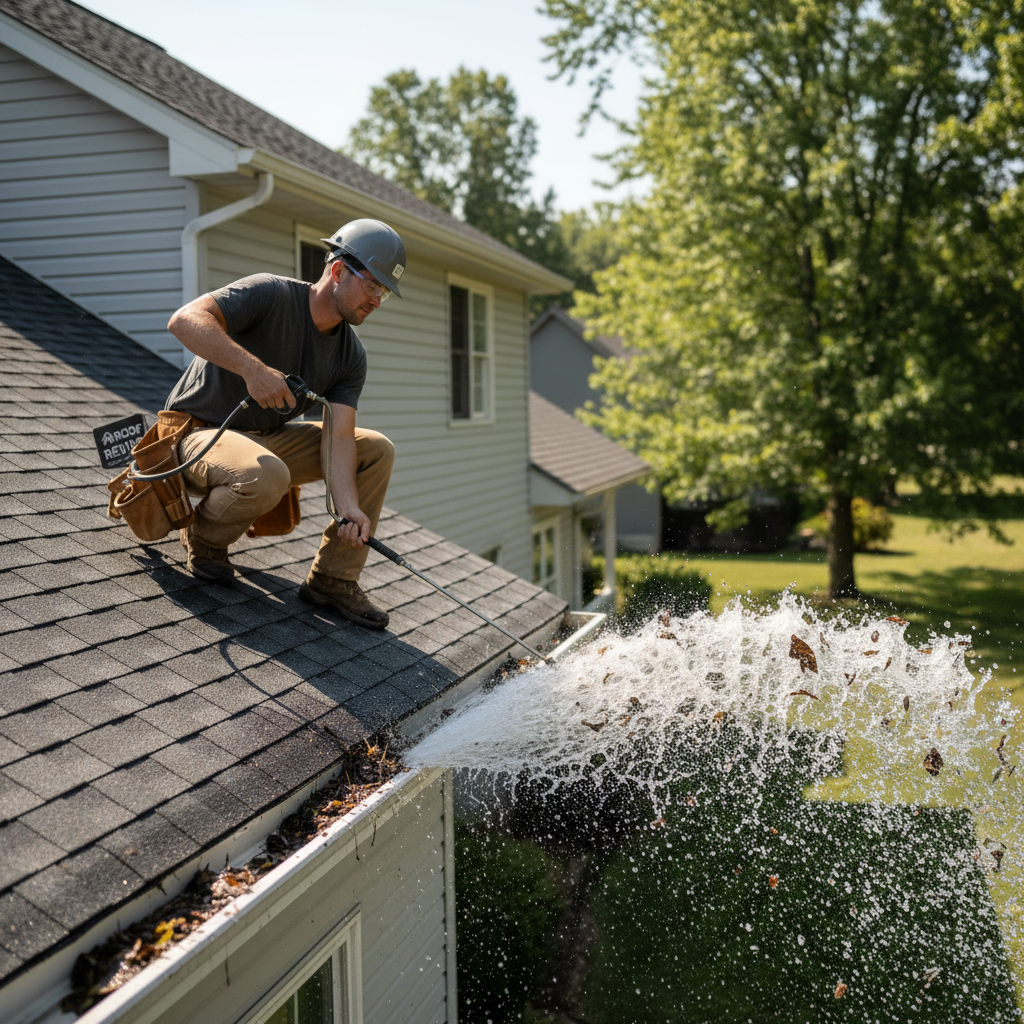
You can get the roof to look dramatically better without trading away years of shingle life. The difference comes down to method, because the wrong “quick clean” can turn a cosmetic issue into real wear.
The fastest way to shorten an asphalt shingle roof’s life is to treat “roof cleaning” like driveway cleaning, roof pressure washing dangers are real. High pressure and aggressive brushing can strip the mineral granules that protect the shingle from UV, loosen seal strips that keep tabs bonded in wind, and force water up under courses and around penetrations. The irony is that algae staining is often cosmetic, but a harsh cleaning is permanent damage.
If you’re cleaning to satisfy an aerial-photo flag (insurance or HOA) or to improve curb appeal, choose a method that minimizes mechanical force. In practice, that means soft wash roof cleaning, low-pressure treatment and rinse. Blasting is reckless, even if Home Depot makes it look easy. Ask how they’ll control runoff onto landscaping and how they’ll avoid directing water up-slope.
Don’t let the ugliness push you into a same-weekend “fix” that just kicks the can down the road like a tarp in a nor’easter. A roof that isn’t leaking can become a roof that is if the cleaning process breaks what’s still working.
Soft-wash methods are designed to remove organic growth with minimal abrasion so you don’t strip granules or break shingle seal strips. Read more in our article: Roof Cleaning
FAQ: Roof Algae and Black Streaks
Can roof algae or black streaks mean my roof is failing?
Usually no. If you’re only seeing discoloration and you don’t have leaks or heavy granule loss, streaks by themselves point to algae staining more than roof failure.
Is Roof Algae an Emergency, or Can I Wait?
If the roof is performing normally, waiting is often fine, but investigate promptly when staining follows a defined water path (beneath an overflowing gutter area or a downspout discharge) or when interior moisture signs appear.
If I Clean It Once, Will It Just Come Back?
In a humid coastal climate, it often does. You’re not “solving” the environment, you’re resetting the appearance, so plan on recurrence and focus on avoiding methods that remove granules or disturb shingle seals.
Can Insurance or an HOA Treat Algae Streaks Like a Roof Problem?
Yes, sometimes they do, because aerial photos can make a roof look older or poorly maintained even when it isn’t leaking. If you get a notice, respond with current roof photos and, when needed, an inspection write-up that documents condition beyond the staining.
Do Algae-Resistant (AR) Shingles Prevent This Completely?
No, but they can delay visible streaking and reduce how fast it shows up compared with older shingles without algae protection. If your roof is newer and already streaking heavily, that’s a cue to look harder at shade, slow-drying areas, and water management to prevent roof algae growth rather than assuming “the shingles failed.”
Roof not getting any younger? Contact us or call 703-673-6301 to find out where you stand.