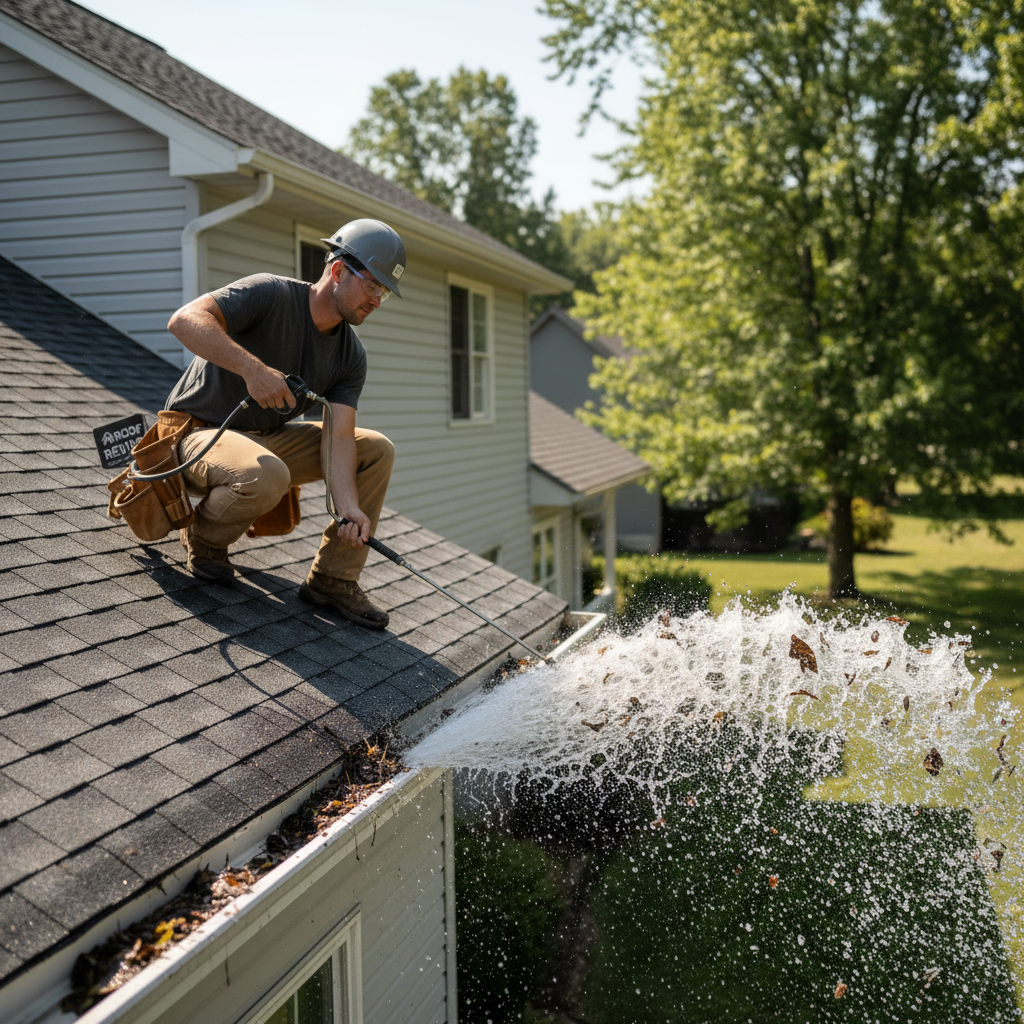
The short answer
- A true soft-wash usually won’t damage asphalt shingles. Risk depends on method, not the name on the truck
- Granule loss comes from concentrated pressure or spray driven up the roof plane, not water itself
- Safe pressure at the shingle surface is roughly garden-hose level (under about 60 PSI)
- Standard mix is around 1.5%–3% sodium hypochlorite with a surfactant
- Red flags: close-range rinsing, upward spray angles, brushing or scraping on asphalt shingles
Will a soft-wash damage your asphalt shingles or strip off the granules? It can, but a true soft wash usually won’t. It comes down to what reaches the shingle surface and how the crew applies it.
You’re right to be skeptical of the label, especially if your roof is 10–25+ years old in coastal North Carolina and you’re already seeing black streaks or moss. Granules come off when force is concentrated at close range or when spray is driven up the roof plane. In the sections below, you’ll learn what roof-safe soft washing looks like and what questions help you confirm a contractor will clean your roof without trading curb appeal for lost shingle life.
Soft Wash vs Pressure Wash Roof: The Real Question Is “How It’s Done”
You hire a “soft-wash” company expecting a gentle treatment, and by afternoon your gutters look like someone poured a bucket of sand into them. Most roof damage starts when the marketing promise doesn’t match the method on the shingles.
Calling it “soft wash” doesn’t make it safe (asphalt shingle rejuvenation treatments). Granule loss usually comes from directed force, not water by itself. It’s concentrated force and bad technique: a tight spray driven hard into the shingle surface or aimed up the roof plane (the devil’s in the details, especially when growth is bonded on). Two companies can both say “soft wash” and still treat your shingles in completely different ways, especially if one plans to brush/scrape bonded growth (practitioner discussion).
| What to check | Roof-safe soft wash (typical) | Pressure-wash in disguise (higher risk) |
|---|---|---|
| Pressure at shingle | Roughly garden-hose level (often described as under ~60 PSI at the surface) | Claims “low pressure” but uses a concentrated jet (often hundreds to 1,000+ PSI) (soft wash roof cleaning) |
| Spray pattern & distance | Wider fan, kept back; not used to “cut” the surface clean | Tight stream held close to make stains look perfect immediately |
| Direction on roof plane | Avoids spraying up the roof plane | Sprays up the roof plane so force bites under edges |
| Agitation | No brushing/scraping on asphalt shingles | “Light scrubbing,” brushing, or scraping bonded moss |
| What does the work | Chemistry + dwell time (may need a second light application) | Impact/force + “touch-ups” to chase instant cosmetic results |
| Expected look right after | May be uneven; improvement can lag 30–90 days | Markets same-day “like new” results via aggressive rinsing |
If you want to protect an aging asphalt roof in coastal North Carolina, stop evaluating the name and start evaluating the variables: what pressure actually hits the shingles and what chemical strength they’re applying.
If you want a quick way to spot an aggressive “soft wash,” the clearest red flags are close-range rinsing and any upward spray angle that drives force under shingle edges. Read more in our article: Roof Cleaning Without Removing Granules Ask for those specifics in writing, because vague wording like “power wash” or “soft wash” tells you almost nothing about granule-loss risk.
When Granules Come Off

Granules don’t “rinse off” from gentle water; asphalt shingle granule loss causes are usually something acting like sandpaper or a chisel on the shingle surface. Most problems show up when a narrow jet is used or when spray is pushed upward into the laps. If a contractor needs to “work” a stain with a wand held close, you’re not in the safe zone. And if they sold you that approach off an Angi profile, that’s a bad sign.
Age matters because older asphalt shingles get brittle. Even normal handling can shed grit. For instance, on a 15–25-year roof, heavy foot traffic during cleaning can scuff granules at the butt edges and along walk paths, especially in heat. A simple risk check: if you see piles of gritty material in gutters/downspout splash blocks after cleaning or you hear talk of “light scrubbing,” you should rethink whether the method matches the roof’s condition.
On older asphalt roofs, the most useful follow-up check after any wash is whether the amount of grit in gutters looks like normal shedding or a sudden, localized pile that suggests technique problems. Read more in our article: Granules In Gutters After Treatment
What “Safe” Soft-Washing Looks Like
You get the black streaks under control, your landscaping stays unharmed, and your shingles are not left looking scuffed or thin. That only happens when the cleaning method is designed to let chemistry do the work instead of the wand.
A roof-safe soft wash relies on chemistry and time, not impact, using a low pressure roof cleaning method. It’s like low-and-slow BBQ for your roof, and you do it right the first time. The easiest way to sanity-check a proposal is to ask yourself what’s doing the work: if the plan depends on a tight stream “cleaning” the shingle surface, you’re back in granule-loss territory. A true soft wash usually applies the mix at roughly garden-hose pressure, often described as under about 60 PSI at the surface. Even “lower” pressure-washing numbers like 800–1200 PSI can dislodge granules when they’re aimed at asphalt.
What you want is a controlled mix applied with a patient, repeatable process. Many roof-cleaning approaches land around a 1.5%–3% sodium hypochlorite solution with a surfactant so it clings (soft washing vs pressure washing roofs). Case in point: if you live near Wilmington’s salt air and humidity and you’ve got heavy black streaking, the right move is usually longer dwell time and a second light application, not getting closer with the wand.
When it comes to rinsing, “more rinse” isn’t automatically safer (roof softwashing). Some crews keep rinsing minimal so the biocide can keep working, even if the roof stays blotchy for 30–90 days after the organisms are already dead. If you need it to look perfect today, you’re often asking for the very step that raises risk.
Ask for these specifics in writing before you say yes
-
What pressure hits the shingles during application and any rinse (not the machine’s max rating)
-
Exact mix strength (or target % sodium hypochlorite on the roof) and whether they use a surfactant
-
Planned dwell time and whether they expect one pass or multiple treatments
-
Whether they’ll avoid close-range rinsing, upward spray angles, and any brushing/scraping on asphalt shingles
Roof Conditions That Change The Answer

A neighbor with a 20-year roof books a cleaning and suddenly notices grit everywhere and tabs that look more tired than before. Sometimes the wash isn’t the real cause, it’s just when an already-worn roof shows you what shape it’s in.
Soft-washing can be safe for shingles. How worn the roof is still sets the risk level. On a 10–25+ year asphalt roof, you can have a process that’s gentle on paper and still end up with extra grit in the gutters because the granules were already loose or the mat is already brittle from sun and storms. If you’re treating cleaning like “maintenance,” you might be skipping the more important decision: whether you’re just paying to make a tired roof look better for a season. That’s a bad trade when your GAF-style asphalt shingles are already telling you they’re near the end.
You’re in a higher-risk category if you notice any of these before you schedule a wash: visible bald patches or lots of granules collecting at downspouts, or widespread curling or cracking tabs. In those situations, cleaning can still be a “buy time” move, but it can also be false economy if it accelerates shedding or exposes weak spots you were about to have to replace anyway.
Coastal NC Realities: Regrowth, Salt, and HOAs
A typical soft-wash cleaning is often priced around $300–$600, while replacement figures are commonly framed as $8,000–$15,000+ (soft wash roof cleaning costs). That cost gap is why coastal homeowners try to “buy time,” but the environment here makes that clock run faster.
Coastal North Carolina is basically a petri dish for black streaks and green growth: humidity stays high and salty air leaves a film that holds moisture. So keep an eye on it. So even a well-done soft wash is usually a temporary reset here, and regrowth tends to return sooner than it does inland.
The bigger friction point is timing. Some roof-safe soft-wash methods prioritize roof algae removal without pressure washing over making the roof look brand-new the same day, and the cosmetic improvement can lag for 30–90 days as weather rinses away dead growth. If your HOA or a pending appraisal demands immediate curb appeal, don’t let that pressure push you into an aggressive rinse or “touch-up.” It trades speed for granule loss. Before you book, ask what it will look like at 24 hours or 2 weeks, and line that up with any deadlines you’re trying to hit.
In coastal North Carolina, salt film and persistent humidity can speed up biological regrowth and make roof maintenance timelines look very different from inland homes. Read more in our article: Salt Air Humidity Shingles
Questions to ask a contractor (and answers to avoid)

Ask: “What pressure hits the shingles during application and rinse?” Avoid: “We use 1,000 PSI but it’s fine” or “power wash” wording. “What’s your roof mix strength?” (look for a specific number, often roughly 1.5%–3% sodium hypochlorite; avoid: “secret sauce”). “Will you brush/scrape moss?” (avoid any planned agitation on asphalt).
Then ask: “How do you protect plants and manage gutter/downspout runoff?” (avoid: “It’ll be diluted by rain”). “Will you walk the roof, and how do you limit scuffing?” (avoid: “We’ll just move fast”). Finally: “Can you email proof of liability insurance and your workmanship policy in writing?” (roof cleaning insurance recommendations should be easy to provide). If they dance around that, walk away, even if Nextdoor swears they’re great.
For Wilmington-area homes, this is exactly what we do. See our Wilmington soft-wash roof cleaning service for how it works locally.
FAQ
I Found Granules In My Gutters After A Soft Wash. Did The Cleaning Ruin My Roof?
Some grit is normal on older asphalt roofs, but fresh piles (especially right under downspouts or in splash blocks) can signal the crew used too much force or got too close with a rinse. If you see bald patches or exposed fiberglass mat, treat it as damage and document it.
Will Bleach Or Sodium Hypochlorite Void My Shingle Warranty?
It can, depending on your shingle manufacturer and how the product was used, so you shouldn’t accept “it’s fine” as an answer. Ask the contractor what chemical they’ll apply and at what on-roof percentage, then compare that to your warranty language before you authorize the job.
How Often Is Too Often To Soft-Wash An Asphalt Shingle Roof?
If you’re cleaning often enough that you’re chasing cosmetic perfection every year, you’re increasing the odds of wear from foot traffic and rinse technique. In coastal NC where regrowth happens faster, the better target is “as needed for growth control,” not “on a schedule to keep it looking new.”
The Roof Still Looks Stained Right After The Wash. Does That Mean It Didn’t Work?
Not necessarily. Many roof-safe treatments kill the organisms first, and the visual improvement can lag for weeks as rain and weather lift dead staining, which is why some roofs look better at day 30 than day 2.
Can I DIY A Soft Wash Safely?
You can reduce risk by avoiding pressure entirely and by never brushing asphalt shingles. DIY still goes wrong fast with ladder falls or plant damage from runoff. If you do it yourself, the smartest “safety move” is to stop the moment you feel tempted to get closer with a tight spray to speed things up.
Roof not getting any younger? Contact us or call 703-673-6301 to find out where you stand.