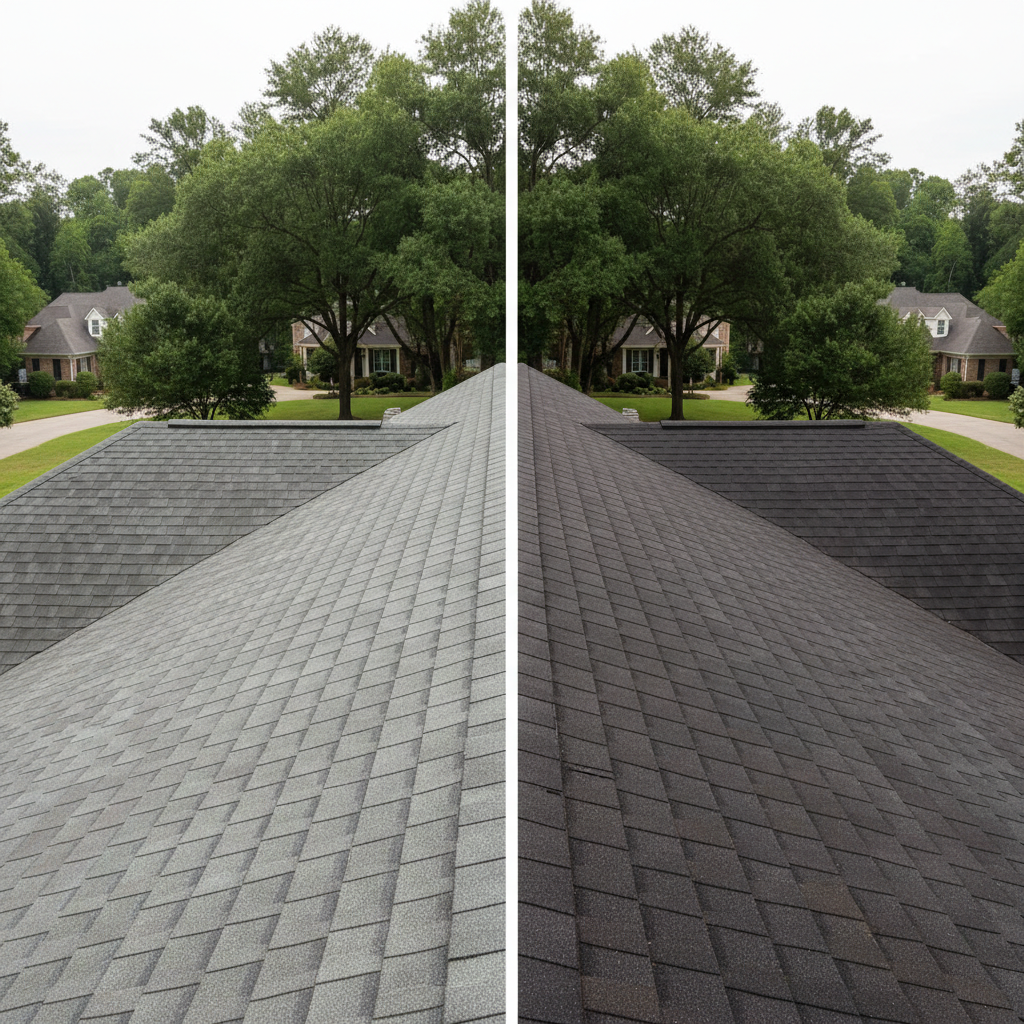
Salt air and coastal humidity usually don’t destroy shingles in one dramatic event. Instead, they keep your roof damp longer and drive repeated wet-dry and heat cycles that can speed up granule loss and weaken seal strips.
If you’re near Wilmington and your roof looks “old” before it should, you’re probably seeing one of two things: cosmetic algae staining that thrives on long-lasting moisture, or real performance wear that starts at corners, ridges, rakes, and metal details like flashing and drip edge. This guide shows what changes first and which symptoms matter most. It helps you decide on cleaning or replacement by following performance, not curb appeal. Think of it as your roof’s compass, not “salt air eats everything.”
Salt Air + Humidity: The Real Mechanism

You can spend thousands chasing the wrong culprit if you assume every salt air roof damage shingles issue is “salt damage.” The real giveaway is often how long the roof stays wet after everyone else has dried out.
Salt air rarely “eats” asphalt shingles overnight; wear shows up through slow exposure and recurring moisture. Salt residue can pull in and hold moisture, so your roof stays damp longer after dew, fog, or a quick shower. When it’s humid as all get-out, that extra wet time turns the roof into a slow-leaking boat deck.
Over years, a surface that dries slowly tends to show algae staining sooner and can turn small issues into bigger ones because seal strips and shingle edges spend more time wet and less time fully drying out. If your roof still looks wet hours after nearby roofs dry, treat that as a signal. Get it inspected. And yes, check the NOAA forecast before you decide it “needs a new roof.”
What Changes on Shingles Over Time

When salt residue and high humidity keep your roof damp longer, coastal roof shingle deterioration shifts from “one big event” to thousands of small cycles. Asphalt shingles do best when they wet and then fully dry. Along the coast, they often don’t, so the mat and asphalt spend more of their life soft and swollen.
You’ll usually see the effects in a few predictable places. Granules tend to loosen sooner because the shingle surface stays tackier longer and sheds granules more easily during rain run-off. Edges and corners can start to lift or curl because the shingle repeatedly swells and shrinks (shingle curling causes humidity), and once an edge lifts even slightly, wind can work it like a tiny flap for years. The seal strip can also lose reliability faster because it has to re-bond after those wet-cool nights and hot afternoons; when it doesn’t, wind-driven rain has more chances to get underneath.
By way of example, a north-facing slope in Wilmington that stays shaded and dewy until late morning may look “dirty” long before the sunny side does. Those black streaks are usually algae (not impact damage), and there’s no good evidence the algae itself is eating your shingles, so don’t let staining alone push you into a premature replacement. What should change your decision is staining plus performance clues like persistent damp patches, lifted corners, or granules shedding faster than the rest of the neighborhood.
A useful next step is to ask an inspector to call out whether the issue is mostly surface wetness (environment-driven) or loss of adhesion (seal strip, edges, and transitions), because that’s what determines whether you’re looking at maintenance and targeted repairs or a roof that’s aging out early.
Black Streaks in Humid Coastal Air
A Wilmington homeowner sees black streaks and schedules a replacement, only to learn the shingles are still performing and the problem is mostly cosmetic. The difference between panic and a smart plan starts with identifying what those streaks actually are.
Most black streaks are algae or cyanobacteria (often Gloeocapsa magma), not storm damage or a “bad shingles” batch. High humidity and frequent dew make the roof stay damp longer, and that extended surface wetness gives the staining a head start, especially on north-facing or shaded slopes.
Here’s the part that trips homeowners up: there’s no scientific evidence that the algae itself is actively damaging asphalt shingles. It can make the roof look older and it often points to long drying times, but streaks alone don’t prove failure. If you’ve been treating every dark stain as a replacement trigger, you’re making the wrong call. Even This Old House would tell you looks are not the diagnosis.
Use the streaks as a sorting tool, not a verdict. For instance, if the roof looks intact up close and you’re not seeing performance symptoms, you’re likely dealing with a cosmetic and maintenance decision. If streaks show up with system clues, focus the next look on drying behavior and adhesion points
-
More likely cosmetic: uniform streaking on one shaded slope, shingles still lie flat, granule loss looks typical for age.
-
More likely a roof problem: streaking plus persistent “never dries” patches, lifted corners, exposed nails, or leaks that only happen with wind-driven rain from the ocean side.
-
Worth asking in an inspection: whether attic humidity or weak ventilation creates slow-drying zones that mimic an exterior roof failure.
If algae staining is your main concern, professional cleaning can often restore appearance without replacing a roof that’s still performing. Read more in our article: Roof Cleaning
Salt Damage You Don’t See: Metal and Edges

You catch a small rust line at the drip edge during an inspection, fix it, and avoid the kind of slow leak that ruins sheathing and drywall. The trick is looking where water actually changes direction, not where the roof looks prettiest from the street.
Along the Wilmington coast, the failure point isn’t always the shingle field, salt corrosion at roof flashing is often the trigger. Salt-laden air accelerates corrosion on the roof’s metal parts, so drip edge and step flashing can degrade while the shingles still look decent from the yard.
Leaks often begin at edges and transitions rather than in the middle of the shingle field. Without that detail, repairs are a patch job at best, like chasing a drip without finding the wicking path. For example, a slightly corroded drip edge at the eave can let water wick back under the first course, or rusting step flashing can open tiny gaps that only show up as a leak during wind-driven rain. If you’re judging roof health mostly by how flat the shingles lie, you can miss the components that actually control the water path.
When you get an inspection, ask for close-up photos specifically of eaves/rakes and flashing joints, not just the shingle surface.
When a roof is aging out early, rejuvenation can be a cost-effective middle step when shingles are still intact but losing flexibility and shedding granules faster than expected. Read more in our article: Roof Rejuvenation
What to Do Next With an Aging Shingle Roof
Some coastal-focused roofing sources estimate asphalt shingle lifespan coastal areas can lose roughly 30% of its expected service life in harsher coastal conditions. That makes early sorting between cosmetic issues and performance wear a budgeting decision, not just a maintenance debate.
| What you see (typical) | Likely category | What it usually means | Next step |
|---|---|---|---|
| Shingles lie flat; no abnormal granules in gutters; uniform staining on a shaded slope | Maintenance / cleaning | Mostly cosmetic moisture-driven staining | Photo-documented inspection; clean/maintain as needed |
| Localized lifted corners; small adhesion failures; early edge issues; one-off flashing defects; field otherwise holding | Targeted repair or rejuvenation | Limited loss of adhesion or a localized transition defect | Photo-documented inspection (edges/flashing/penetrations); targeted repair/rejuvenation |
| Widespread granule loss; repeated wind-driven rain leaks from same direction; many tabs won’t stay sealed; soft decking spots; multiple corroded metal components failing at once | Replacement | Broad performance wear and multiple system weak points | Plan for replacement based on how the roof behaves (not appearance) |
Don’t let “it looks fine from the yard” override evidence. That assumption can push you into missing early failure signals. Skip the HomeAdvisor vs. Angi debates and ask for close-up photos of drip edge and step flashing. Then decide based on performance, not pictures.
Persistent damp areas and wind-driven leaks usually show up as subtle interior or edge symptoms before they become obvious ceiling stains. Read more in our article: Early Roof Leak Signs
Contact us for a free inspection or call 703-673-6301 to find out where you stand.
That judgment call is easier with evidence, and our free roof inspection with a written report provides it free.