Your roof can look fine and still get labeled “near end of life.” When replacement quotes hit hard, asphalt roof restoration starts to look like the sane middle option.
The problem is that “restoration” means different things depending on your roof, and the internet rarely separates them cleanly. On an asphalt shingle roof, restoration usually means a rejuvenating treatment meant to improve things like flexibility and granule retention. It is a conditioner, not a structural reset. On a flat or low-slope asphaltic roof, restoration usually means a coating system over an asphalt-based membrane. This guide helps you sort out which roof you have and whether you’re a good candidate in coastal North Carolina, so you can vet claims and warranties without putting off a real decision for a shiny-sounding promise.
Asphalt Roof Restoration: Shingle or Flat?

A homeowner gets quoted for a “restoration,” signs off, and only later learns the product was meant for a different kind of roof. Getting the roof type right up front is the difference between a smart bridge and a wasted spend.
If you’re Googling “asphalt shingle roof restoration,” you may be mixing two different roof types. On a shingle roof, “restoration” usually means a rejuvenator, while on a flat asphaltic roof it usually means a coating system over modified bitumen or BUR. Skip this distinction and you’ll evaluate the right product with the wrong checklist. Worse, you can pay for a product that was never meant for your roof.
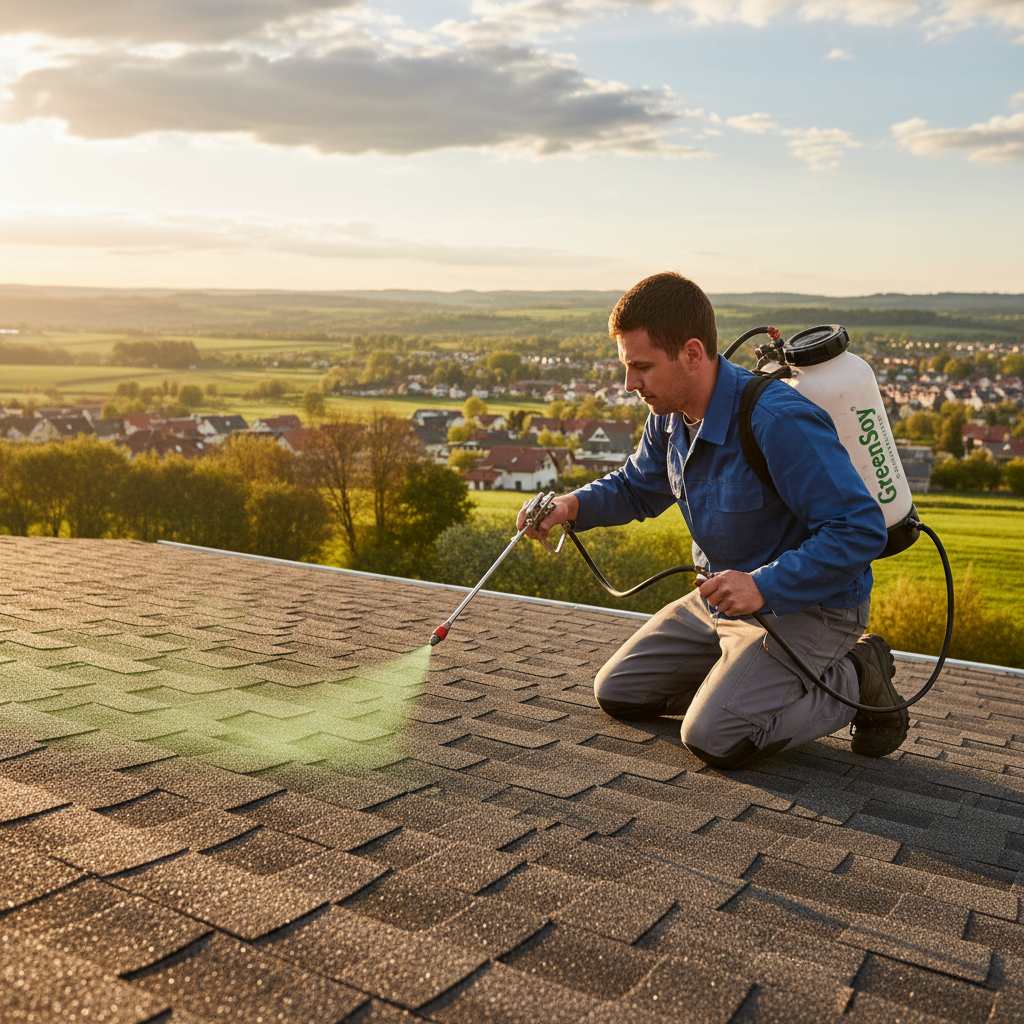
Most homes around Wilmington with a pitched roof have asphalt shingles: individual overlapping tabs and lots of visible granules. In that context, “restoration” usually means a spray-on or brush-applied rejuvenator meant to replenish oils and improve performance indicators like granule retention and pliability. It’s maintenance-minded, and it only makes sense if the roof is still fundamentally intact.
On flat or low-slope asphaltic roofs, you’ll usually see seams or rolled materials, often on porches, additions, or low-slope sections. Here, “restoration” typically means a multi-step coating system (often including a primer layer, with published system sheets specifying application rates like about 1.5 gallons per square for an asphalt primer in one example, per GAF’s Silicone Over Asphaltic Restoration (5-Step) info sheet). That’s not a shingle “rejuvenation,” it’s closer to resurfacing a membrane.
To confirm the roof type, look for either distinct shingle tabs and texture or a continuous surface with seams. If it’s the second, stop comparing it to shingle rejuvenation claims and ask contractors specifically about coatings designed for asphaltic flat roofs.
The Real Question: Is Your Roof a Candidate?
If you’re trying to decide on asphalt roof restoration for shingles, stop anchoring on the number of years on the roof. Two roofs can be the same age in Wilmington and look nothing alike depending on sun exposure and salt air. “It looks fine from the driveway” also doesn’t tell you what matters for rejuvenation: whether the shingle is still intact enough for conditioning to be worth doing.
| Condition gate (hard “no” for shingle rejuvenation) | What it suggests | What to do instead |
|---|---|---|
| Active leaks or wet decking/insulation (water stains, recurring ceiling spots) | Water path/assembly is already compromised | Diagnose and fix leak path first (flashing/underlayment/sheathing) |
| Storm damage that changed the roof’s structure (missing shingles, widespread creasing, punctures, lifted fields) | Structural/shingle-field failure, not surface aging | Repair or replace before considering any treatment |
| Severe granule loss or bald areas (exposed fiberglass/mat, heavy granules in gutters year after year) | Protective layer is already gone in areas | Replacement (or major repair) is typically the realistic path |
| Brittle, cracking, or curling shingles visible at edges and ridges | Tabs are past pliability; handling can cause breaks | Replacement (or targeted replacement where feasible) |
| Bad ventilation or moisture history (musty attic, rusty nail tips, past mold remediation) | Roof is aging from the inside due to heat/humidity | Correct ventilation/moisture drivers before spending on treatment |
A practical next step: during an inspection, ask for evidence-based notes, not a yes/no pitch. For instance, “Where are you seeing granule loss and how widespread is it?” and “Do you see any signs of decking moisture or ventilation problems in the attic?” If they can’t show you photos or specific locations, you’re being asked to decide on faith, and that is a bad bet even if they have five-star Angi reviews.
Most Wilmington asphalt-shingle roofs are either clearly good candidates or clearly bad candidates once you know what “too far gone” looks like in the field. Read more in our article: Asphalt Shingle Roof Fit
What Lab Testing Can—and Can’t—Prove
You’ll see lab results in this category reported around 1,500 hours of accelerated weathering, sometimes paired with claims like 86% less granule loss in treated-vs-untreated comparisons. Those numbers can be useful, but only if you know what they do and do not translate to on your roof.
Lab testing is the best antidote to “trust me, it adds X years,” but only if you understand what the lab is measuring. In this category you’ll often see PRI-style accelerated-weathering screening reported around 1,500 hours, with results framed in physical performance changes, not a calendar promise. That’s valuable because it focuses on whether a treated shingle behaves more like a healthier shingle, even if nobody can translate that cleanly into “your Wilmington roof now lasts 7.2 more years.”
What matters is how those metrics map to real handling and weather exposure. When a report shows reduced granule loss (some summaries tout large improvements, like dramatically lower shedding), that points to a roof that may hold its protective surface longer, especially on slopes that take the brunt of sun and wind. When tear strength improves, you’re looking at more resistance to ripping during handling and in high-stress areas like ridges, hips, and around pipe boots. When cold pliability improves, it suggests the shingle stays more flexible instead of getting brittle, which matters after a cold snap when tabs can crack or snap during minor repairs.
What this testing can’t prove is the part most marketing leans on: a guaranteed lifespan extension on your specific roof. A lab sample doesn’t include your attic heat and humidity, salt air, nail placement, or deck condition. It also misses the real-world truth that leaks often start at flashing and penetrations, not the middle of a shingle field. If a contractor treats “1,500 hours in a chamber” as the same thing as “you won’t need a replacement for a decade,” you’re not hearing science, you’re hearing sales.
To keep “lab tested” from turning into a sales shortcut, ask, “Which metrics improved, and under what conditions?” That question can save you from a bad call. If they can’t name granule loss/adhesion and tear strength, and explain what the test compared (treated vs. untreated, same shingle type), then the “lab tested” claim won’t help you make a real decision.
Coastal NC Stress Test

In coastal North Carolina, rejuvenation depends on exposure more than roof age, since salt, sun, and wind-driven rain quickly exploit weak details. Salt air and steady sun accelerate drying, and wind-driven rain finds tiny flashing failures fast. That means a treatment can be a smart bridge only if the roof is already tight and you’re pairing it with detail work that actually stops water entry.
Practically, you should plan a tighter maintenance cadence than you’d expect inland. Good enough for now does not stay good for long near the water. For instance, north-facing slopes that stay damp and streaked with algae may need cleaning and inspection discipline so you can capture the added life instead of watching a “restored” roof age prematurely at the edges, penetrations, and valleys.
Salt air and humidity can speed up shingle drying and surface breakdown, especially on the most sun-exposed slopes near the coast. Read more in our article: Salt Air Humidity Shingles
Restoration vs Repair vs Replacement Math
You can end up with a roof that costs less to own each year, even if the upfront price is higher, because the right choice buys reliable time instead of hopeful time. The trick is doing the math before you pay for the wrong kind of “savings.”
Run one simple comparison for roof restoration cost: (total cost you’ll pay) ÷ (years you realistically capture), then adjust for disruption and risk. By way of example, a $20,000 replacement that lasts 25 years can land near the same cost-per-year as a $3,000 roof rejuvenation cost that truly buys 3–4 years. That is especially true if you’ll need a re-treatment to keep the “added life” from evaporating.
Don’t let the lowest quote make the decision for you, and don’t let a Saturday Home Depot or Lowe’s roofing aisle substitute for an actual scope. Repairs often win when they stop a specific leak path with minimal disruption, while restoration only “saves money” if your roof is a strong candidate and the warranty and insurance posture stay normal (many treatments don’t warrant leaks, and some insurers care more about roof age than coating or spray claims).
How to Choose a Contractor and Next Steps
You hire the wrong crew, and what you get is a nice-looking application with the same weak flashing and penetrations still waiting to leak. A few specific demands during the estimate can keep you from paying for confidence instead of results.
You don’t need a roofing PhD to pick the right asphalt roof restoration contractor, but you do need to stop treating this like a spray purchase, unless you want to feel like they’re nickel-and-diming me line by line. The difference between “bought time” and “paid for optimism” usually comes down to whether the contractor can prove your roof is a good candidate, and whether the scope fixes the real weak points (penetrations, flashing, seal integrity) before any rejuvenator touches the shingles.
A credible roof inspection Wilmington NC should look like more than a quick walk and a price. Case in point: in Wilmington, a legit evaluator will check the shingle field up close for granule loss patterns. They will also probe the usual leak starters (pipe boots and step flashing) and take attic conditions seriously because heat and moisture can age a roof from underneath. You should also get documentation, not just a thumbs-up, so you and your partner can make the call without relying on memory.
Use these as go/no-go checks during the estimate:
-
Ask what they’ll inspect and document: photos of slopes, ridges, penetrations, flashing, and at least a quick attic look for moisture/ventilation red flags.
-
Get the exact product name and chemistry: don’t accept “soy-based” as the whole answer; require the data sheet and any third-party test summary that lists metrics like granule loss/adhesion, tear strength, or cold pliability.
-
Separate “tune-up” from the treatment: have them itemize repairs (replacing cracked pipe boots, resealing exposed fasteners, swapping a few damaged shingles) so you can see what you’re paying for.
-
Read the warranty for what it doesn’t cover: if it doesn’t meaningfully address leaks, you still need confidence the roof is already watertight.
Decide within a week by comparing 2 estimates, reviewing itemized repair scope and documentation quality, and choosing the contractor who’s most specific about candidacy and limitations.
If a service promise doesn’t include fixing leak starters like pipe boots and flashing, you can end up paying twice—once for “restoration” and again for real repairs. Read more in our article: Small Roof Repair Risks If someone won’t name the product, won’t show photos, or claims a guaranteed decade based on “lab testing” alone, move on.
FAQ
How Many Years Does Asphalt Roof Restoration Really Add?
If someone promises a guaranteed number of years for your specific roof without addressing signs roof needs replacement, treat it as marketing. The most credible “lab-backed” claims focus on measurable improvements like granule retention/adhesion and pliability, but your actual added life still depends on roof condition, exposure, and whether leak-prone details were already sound.
When Should You Re-Treat a Restored Asphalt Shingle Roof?
Plan retreatment based on condition, not a calendar countdown. A practical approach is to recheck the roof on a regular inspection cadence and re-treat while shingles still have granules and flexibility, rather than waiting until you see widespread cracking, curling, or bald spots.
What Does “USDA Certified Biobased” Actually Mean?
It’s a concrete certification that the product contains a verified percentage of biobased content, which helps you compare options beyond vague “eco-friendly” language (see the USDA BioPreferred Program). It doesn’t guarantee performance by itself, so you still want to see test metrics and candidacy standards.
Will the Treatment Smell, Track, or Create Safety Issues Around the House?
Most reputable contractors schedule application to minimize disruption and keep you away from wet surfaces until they dry. Ask what the product is, request the safety data sheet, and confirm how they protect landscaping and manage overspray so you’re not guessing on day-of.
Does Asphalt Roof Restoration Come With a Real Guarantee?
Many warranties focus on the treatment and exclude leak coverage, which surprises homeowners later. Before you sign, ask in plain language what happens if you get a leak after the service and whether the contractor’s scope included the common leak starters like pipe boots, flashing, and valleys, because Nextdoor neighborhood posts are full of people learning that lesson the hard way.
Roof not getting any younger? Contact us at Contact us or call 703-673-6301 to find out where you stand.For roofs that are weathered but structurally sound, our roof rejuvenation for Wilmington homes adds 6 or more years of life.