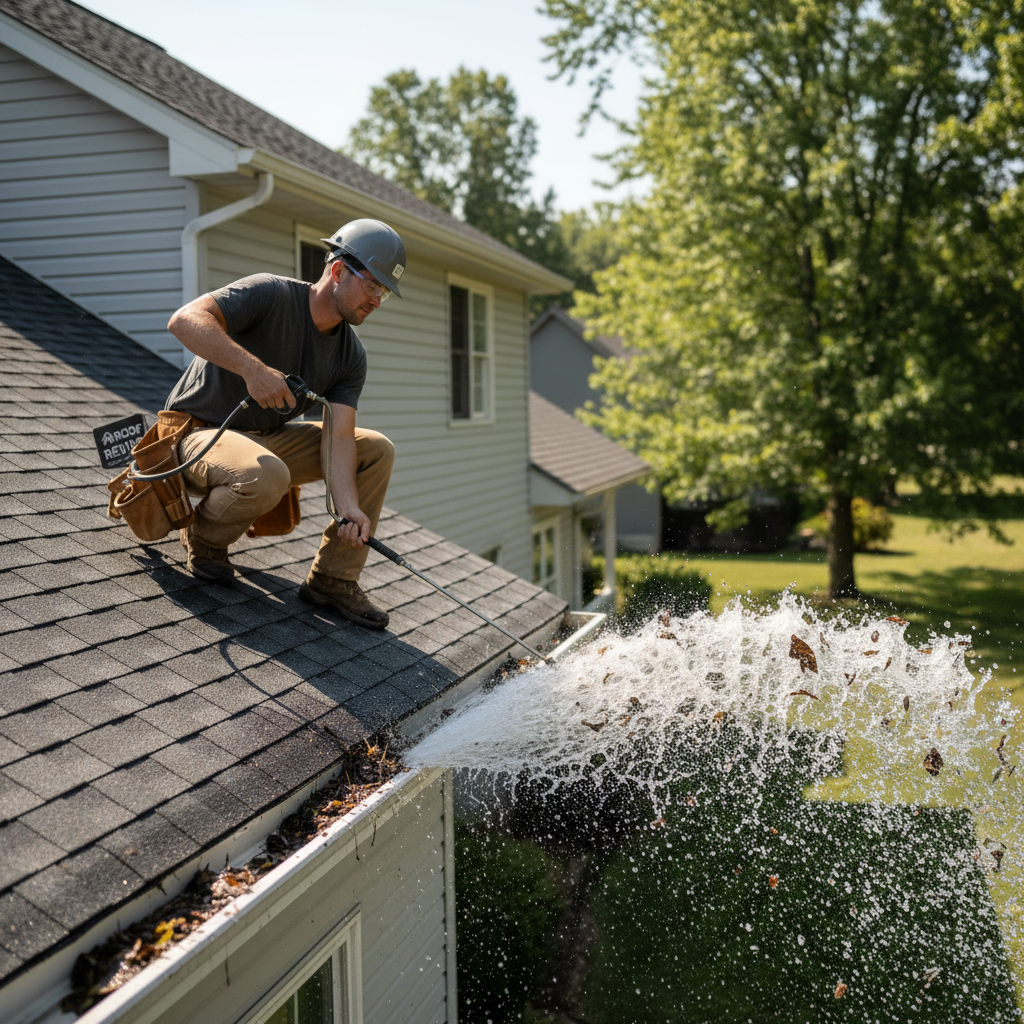
If you’ve got gutters that tie into downspouts or a curb inlet nearby, roof-wash runoff can leave your property fast. The goal is simple: keep cleaning solution out of gutters, downspouts, and storm drains. The devil is in the details: you control the pathways like valves before any chemical goes on the roof, then you capture, redirect, or neutralize runoff at the downspout discharge so it can’t reach the street.
In Wilmington and the surrounding coastal communities, a lot of homes have “fast paths” where roof water disappears into underground piping and reappears at a pop-up emitter or a storm inlet. So “we’ll just dilute it with rinsing” still isn’t a plan. Even on Nextdoor, that kind of advice usually just creates more volume moving off-site. In the sections below, you’ll learn what a responsible on-site sequence looks like and what you can physically check while the work’s happening.
How Runoff Reaches Storm Drains Fast

On a lot of Wilmington-area homes, your roof runoff doesn’t “soak into the yard,” which is why roof cleaning runoff prevention starts with understanding where it goes. It hits the gutter, drops into a downspout, then disappears into a buried leader that daylights at a pop-up emitter or straight into a street inlet. So if a roof wash mix or loosened black streak grime goes into the gutter, you can unintentionally send it off-site in minutes.
And once that liquid contains cleaning chemistry and roof contaminants, it’s not just water anymore, even if it looks diluted. Dilution only reduces concentration; it doesn’t prove you managed the route to the street.
Downspouts and gutter flow often act like a “conveyor belt,” so protecting them is one of the quickest ways to prevent off-site runoff. Read more in our article: Protect Gutters Windows Siding
The On-Site Sequence That Prevents Discharge

A crew starts spraying, and ten minutes later you notice a faint bleach smell at the curb because a buried downspout line carried everything straight to the street. The fix is straightforward, but the order of steps is what makes it work.
You don’t have to guess whether a contractor is “being careful.” Do it right the first time. On a well-run job, you’ll see a repeatable sequence that treats roof wash runoff like wastewater and manages timing and pathways, not just total gallons, basic containment for soft wash roof cleaning. When the plan is “we’ll dilute it with lots of rinsing,” you typically just drive more volume into the same downspout routes.
A practical, observable workflow often looks like this
-
Trace where your downspouts actually go before any spraying starts. The crew should identify which ones dump to lawn and which ones tie into buried piping.
-
Block or redirect the “fast path” first. If a downspout discharges near a driveway slope or a curb inlet, you’ll typically see downspout blocking methods like a downspout diverter, splash blocks, or a simple berm setup that keeps liquid on-site long enough to manage it.
-
Apply in controlled sections, not a whole-roof flood. Case in point: working one roof plane at a time limits how much solution can reach gutters at once while it dwells.
-
Interception at the downspout discharge point. As an example, they may capture or neutralize at the end of the downspout run instead of hoping it “soaks in” wherever it lands.
-
A curb check during the work, not just at the end. You (or the crew) should be able to walk to the street and confirm there’s no suds or discolored flow entering an inlet, how to keep chemicals out of storm drains is largely about this real-time verification.
What you can do differently in real time: ask, “Where will the runoff sit long enough to be recovered or neutralized, and who’s checking the curb while you’re applying?” If the answer is vague, you’re seeing a missing step in the process, not a minor detail.
Soft washing reduces the chance of forcing water under shingles compared with high-pressure methods, but runoff still has to be managed at the downspout. Read more in our article: Soft Wash Roof Cleaning
What Controls Fit Your Drainage Setup
Choose the wrong control for the downspout route and careful roof work can still push washwater off-site through a hidden pipe. The fastest route wins unless you slow it down or intercept it.
Pick controls based on your home’s fast path: where does each downspout go in the first 20–50 feet?
| Downspout discharge / “fast path” | Best-fit control focus | What to verify on-site |
|---|---|---|
| Ties into buried pipe / leader | Capture or pump at discharge; neutralize if needed | Discharge is intercepted; no flow continues into buried line |
| Daylights at pop-up emitter | Capture/pump at emitter; block/redirect to hold on-site | Emitter is controlled; no water crosses hardscape toward street |
| Near driveway slope / hardscape to curb | Redirect away from hardscape; berm/diverter; capture if needed | Runoff is kept on permeable area; curb stays clear |
| Directly near curb cut / storm inlet | Treat as highest risk: capture/pump; neutralize at discharge point | No suds/odor/discoloration at inlet during application |
If it ties into buried pipe, a curb cut, or any route that reaches the street quickly, you should treat runoff like wastewater and plan for roof wash wastewater containment via capture/pumping and, when needed, neutralizing at the discharge point. If it daylights onto lawn or mulch with real setback from hardscape, diverting to permeable area can be enough.
Use blocking/bagging (for example, a downspout filter bag) as a temporary brake, not the whole plan.
If you find granules or sludge in downspout discharge after a wash, that’s a sign your gutters may need a careful cleanout to keep flow predictable. Read more in our article: Clean Gutters After Roof Wash Treat anything less as unacceptable, like trying to impress the Better Business Bureau (BBB) with excuses. Ask: “Which downspouts are you isolating, and where does the captured liquid go after collection?”
FAQ: Keeping Cleaning Solution Out of Gutters, Downspouts, and Storm Drains
Should You Rinse the Roof a Lot to “Be Safe”?
Not automatically. Heavy rinsing can push a lot more liquid into your gutters and downspouts, and it can shorten the treatment’s residual effect, so “more water” can mean more discharge risk and less durability (a tradeoff also noted in roof softwashing guidance).
If You Neutralize Runoff, Where Should It Happen and How Do You Know It Worked?
Neutralizing only helps if you do it where the runoff concentrates, typically at the downspout discharge point or where a temporary capture setup empties. Ask what they’re using and what verification looks like at the discharge point before anything can reach the street.
Is Protecting Plants the Same Thing as Protecting Stormwater?
No. Keeping shrubs wet and using tarps can reduce plant damage, but it doesn’t stop washwater from entering a buried downspout line or a curb inlet; you need pathway control, not just landscaping precautions.
What Should You Ask Before You Approve the Work?
Ask: “Which downspouts are you isolating, and what’s your plan for runoff once it reaches the discharge point?” Then add: “Who is checking the curb or storm inlet during application, and what will make you pause and change the setup?” If nobody has a clear trigger, that’s a deal-breaker, because you need a red light before runoff hits the street (and Wilmington NC stormwater ordinance pressure washing expectations are one reason contractors should have that trigger).
Roof not getting any younger? Contact us or call 703-673-6301 to find out where you stand.