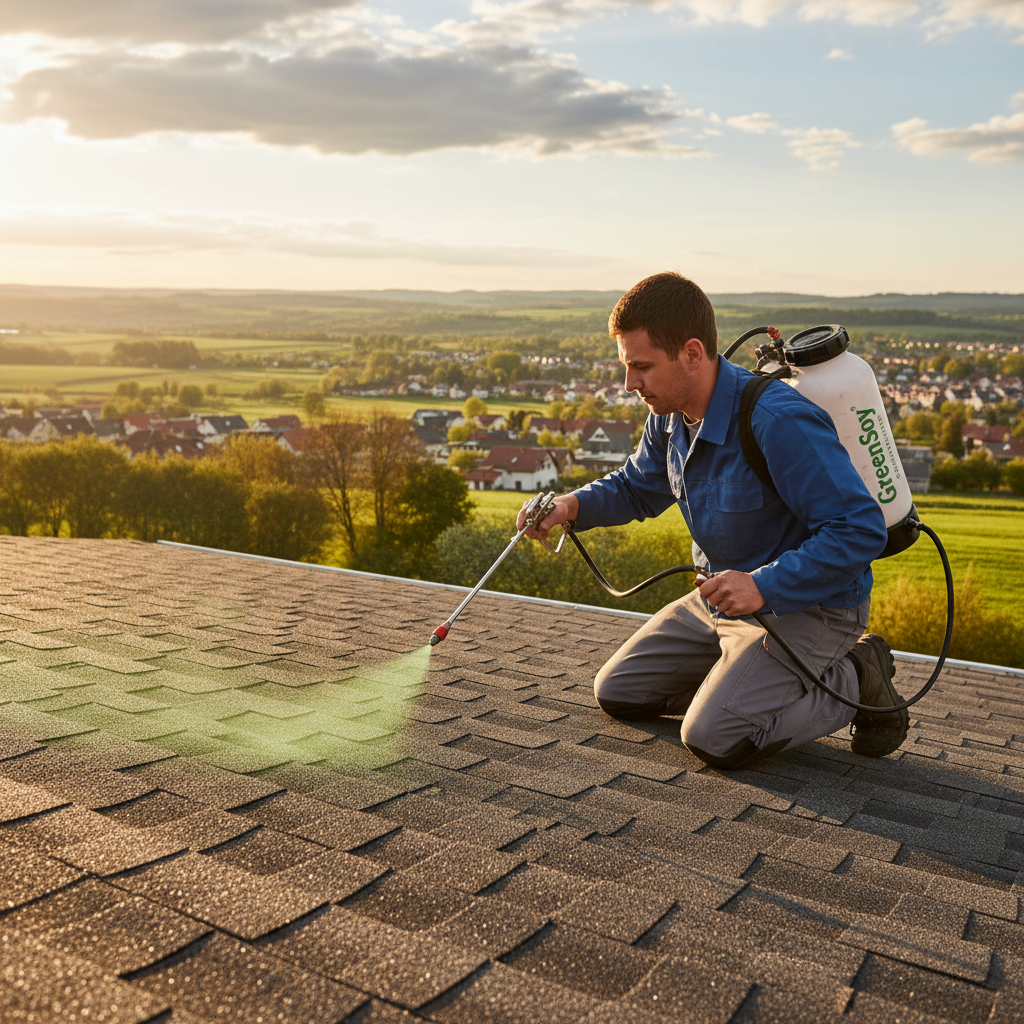
You know the treatment worked when you can prove full coverage and improved shingle condition. You also need it to hold up through real weather. Visual darkening alone doesn’t count.
If you’re staring up at your roof from the driveway in Wilmington and wondering what you just paid for, that’s a fair question. That darkening can be a coat of paint on bad shingles. Roof rejuvenation doesn’t rebuild your roof or fix flashing, so you can’t judge it like a mini replacement. This guide gives you a clear pass/fail definition. It also lays out what to document within 24 hours and what to re-check over 30–180 days. You’ll also know exactly what to request in writing so you can separate real roof life extension from wishful thinking.
What “worked” should mean
If you judge roof rejuvenation like it’s a mini roof replacement, you’ll call it a failure even when it does what it’s capable of doing. A treatment can’t re-seat flashing or rebuild pipe boots (it only addresses shingle surface condition, not common leak sources like flashing/penetrations per NRCIA guidance). So “no leaks this month” is not a clean test, and “it looks darker” is not proof either.
Call it “worked” only when you can document real shingle-surface improvement. Anything else is wishful thinking. For instance, on an aging asphalt shingle roof in Wilmington, the meaningful win isn’t a next-day makeover. It’s that shingles that were trending brittle and dry become measurably more pliable and less prone to accelerated wear, and you can confirm the product was applied evenly across each roof plane.
Use this as your pass/fail definition for roof treatment effectiveness, not a Better Business Bureau (BBB) rating
A basic pre/post documentation package is often the difference between a measurable result and a “looks darker” impression. Read more in our article: Roof Rejuvenation Documentation
| Pass/fail criterion | What to document (proof) | When to check |
|---|---|---|
| Material condition improved | Notes/photos showing shingles are less brittle/more pliable; no new widespread cracking or other fresh red flags | Day-of and again after weather exposure |
| Application proof exists | Date-stamped wide shots of every roof plane plus close-ups of representative areas to confirm even coverage | Within 24 hours |
| Performance holds over time | Repeat photos from the same spots/angles; look for retained improvement after storms/humidity | ~30 days and again ~90–180 days |
| Limits are acknowledged | Written note that flashing/penetrations often drive leaks; inspection findings separated from shingle-surface condition | In writing at time of service |
24-hour proof you can demand

You can pay for a full treatment and still have thin spots or sloppy overspray you only notice after the first rain. Catching that is simplest before it turns into a “looks fine from the driveway” assumption.
Within the first day, you’re not trying to “see a new roof” as proof roof rejuvenation worked. You’re trying to trust but verify the job was actually done. If your only checkpoint is that the shingles look a little darker, you’re judging vibes, not workmanship.
Ask for a date-stamped photo set taken the day of service. Think of it like a roofer snapping a chalk line for coverage: wide shots of every roof plane plus close-ups of representative areas on each slope. Then do a quick walkaround: gutters and downspouts should be clear of obvious residue, and siding and windows shouldn’t have oily overspray. If the provider can’t show complete coverage and clean containment in writing and photos, don’t treat the treatment as “accepted” yet.
Overspray and runoff control should be part of the workmanship standard, especially around gutters, windows, and siding. Read more in our article: Protect Gutters Windows Siding
30–180 day follow-up checks

One widely cited lab-aging benchmark is about 1,500 hours of accelerated exposure intended to represent roughly five years of weathering (see the discussion of accelerated-weathering claims at ), so next-day looks are the wrong finish line. The real question, how long does roof rejuvenation last, is whether the improvement holds after heat and storms.
Real Wilmington weather is where meaningful proof starts. Next-day impressions don’t tell you much. Pick two checkpoints, around 30 days and 90–180 days. If The Weather Channel hurricane season tracking shows a blow between them, re-take photos from the same spots. If you don’t replicate angles and timing, you’ll talk yourself into “it’s better” or “it’s worse” based on lighting.
After a couple of hard rains, look for cleaner water shedding at valleys and drip edges (less lingering wet look) without new staining below. Track granules by cleaning gutters once, then noting whether the next clean-out is normal seasonal grit or an obvious uptick. And watch algae: in humid coastal air it can return, but a fast, widespread comeback on north-facing slopes suggests you didn’t get much durability benefit.
If you’re tracking durability at 30–180 days, spotting fast algae return is one of the clearest signs the roof is still in a high-growth cycle. Read more in our article: Roof Algae Returning
The roof rejuvenation proof checklist
A homeowner in Wilmington thinks they bought five more years, then learns the provider has no before photos or nothing in writing about warranty tradeoffs. That is when a simple checklist turns into leverage.
Before you pay, get the proof package in writing. If a provider won’t document the basics, you’re not buying roof life extension, you’re buying hope and a darker-looking roof.
Request this checklist (email is fine)
-
Date-stamped photos: wide shots of every roof plane plus matching close-ups of representative areas, before and after.
-
Condition report: brief notes from an inspection that separates shingle-surface condition from leak-risk items (flashing, penetrations, pipe boots, valleys).
-
Coverage statement: confirmation the product was applied to all specified slopes, and what areas were intentionally excluded (and why).
-
Warranty and tradeoffs: roof rejuvenation warranty documentation, including a written acknowledgment of what happens to any existing shingle warranty after treatment (some manufacturer guidance says coatings/rejuvenators can make a limited lifetime product warranty not applicable, see this technical bulletin), plus what the provider will and won’t warrant.
-
Rating disclosures: a clear statement on whether the treatment affects (or is not certified to preserve) the roof’s original classifications, such as fire rating (an industry critique notes rejuvenation products generally aren’t fully certified to guarantee the original fire classification remains unchanged, see Roof Observations).
-
Replacement triggers: a written list of conditions that mean you should stop treating and plan replacement instead (for example: widespread cracking, repeated active leaks traced to the field shingles, significant shingle loss, or pervasive soft decking).