You’re looking at green growth or dark streaks on your shingles and trying to answer one question: what is it, and do you need to treat it differently. Yes, because they act differently on asphalt shingles, and that shifts what counts as a safe cleanup method.
In coastal North Carolina, shade and humidity keep shingles damp, so regrowth is common and the right approach depends on which organism you’re dealing with. In this guide, you’ll learn how to spot each one fast and how to choose a low-risk treatment approach that kills the growth first instead of grinding granules off your shingles.
Spot It Fast: Streaks vs Mats vs Crust
A homeowner sees dark streaks and grabs a stiff brush, while their neighbor snaps a quick close-up photo first. One of those moves usually ends with a cleaner roof, and the other can end with bald shingles.
| What you’re seeing | Looks like | Common pattern/where it shows up | Removal note |
|---|---|---|---|
| Algae staining | Black or dark brown streaks running with the roof slope (black streaks on roof algae) | Often on sunny areas | Primarily a staining issue |
| Moss | Puffy green clumps or a sponge-like mat | Along shingle edges/seams, where pine needles collect, shade/humidity | Holds moisture and can wedge into seams |
| Lichen | Flat, pale green/gray coin-like spots; feels “painted on” | Can appear as bonded spots that don’t rinse off easily | Bonds tightly; peeling/scrubbing risks granule loss |
Don’t default to “scrub it off.” Check a zoomed-in photo and then step back for a 10-foot view. Note shade and exposure. A stiff scrub often strips granules instead of just removing growth.
Algae streaks are often caused by airborne organisms that spread down-slope, so treating the stain is different than removing thicker growth like moss. Read more in our article: Roof Algae Black Streaks
What Each One Is Doing to Your Roof

If you treat every green or black mark like it is just cosmetic, you can trade a minor cleanup for lifted edges and lost granules, plus a leak that shows up after the next hard rain.
Algae is mainly a staining issue: it ages curb appeal, but it usually doesn’t work up shingle edges. Moss is different because it holds water like a sponge and can lift shingle edges, which speeds granule loss and raises your risk of wind-driven leaks after a coastal storm.
Lichen typically adheres hard to the shingle surface. When it’s pulled off, granules often come with it, and that’s where the real damage starts. If a home inspection report flags roof wear, don’t guess. Misidentifying growth is the most common mistake. Prioritize anything thick and lifting edges over dark streaking.
Treatment Changes by Organism Type

For asphalt shingles, lead with kill-first chemistry and let weathering do the removal over time. For algae streaks, you want a low-pressure soft wash where the cleaning comes from chemistry and dwell time, not impact. For moss, focus on killing it and only disturb what has already loosened, and only when you have to. For lichen, expect the slowest improvement because it bonds tight; aggressive removal is where you lose granules.
The rule stays the same: skip pressure washing, because the difference is chemistry doing the work versus force doing damage. Don’t chase a quick patch job of an instant, spotless look. If the method is sound, results often continue to improve as rain and time loosen dead growth. Rushing it scalps the “sod” of your shingle granules.
What “Soft Wash” Should Mean
Some pros quantify “low pressure” as under about 500 PSI for any rinsing or a finish rinse. If the force is doing the work instead of the chemistry, you are already in the danger zone on asphalt shingles.
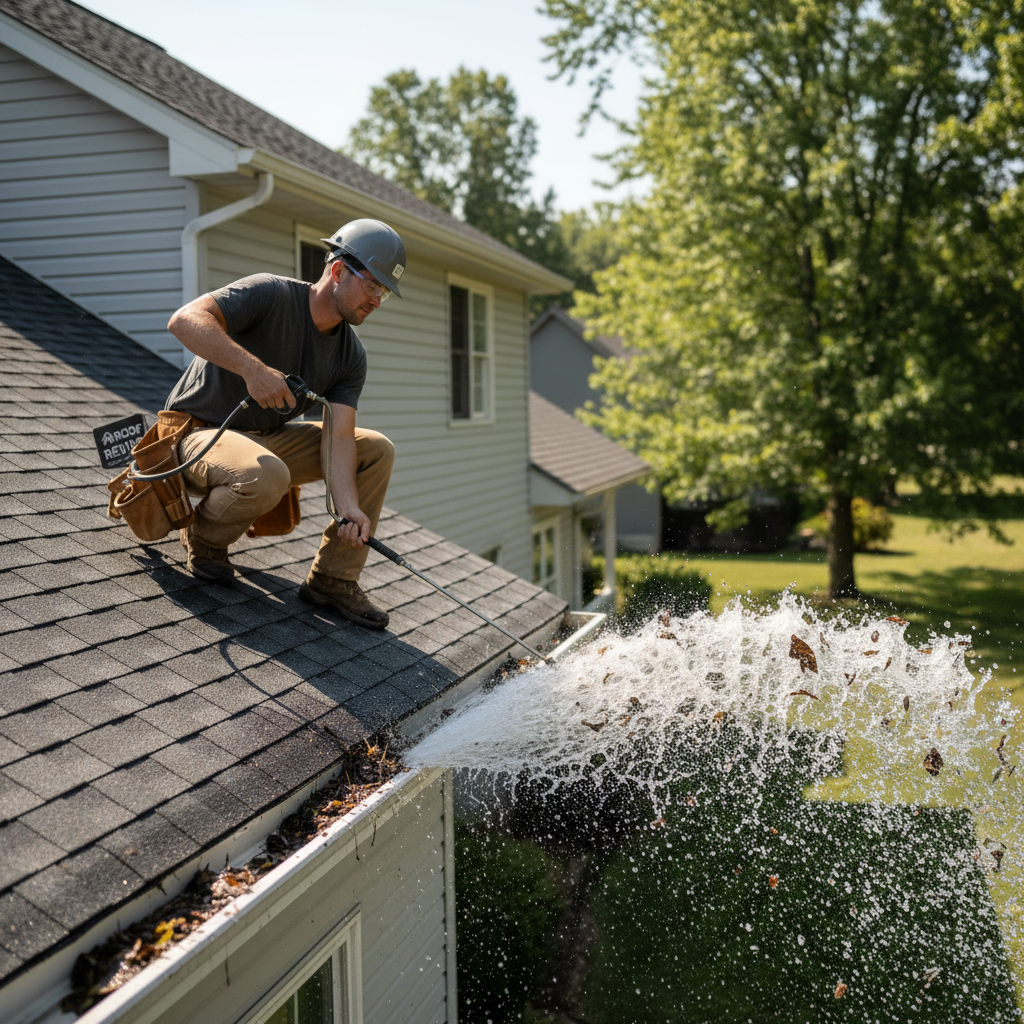
On an asphalt shingle roof, “soft wash” should mean roof cleaning without pressure washing—you’re not removing growth with force. You’re applying a roof-safe cleaning solution at low pressure (think garden-hose intensity, not a pressure washer) for soft wash roof cleaning, giving it dwell time to kill the organism, then doing only a light rinse if needed so you don’t strip granules.
Be wary of any “spotless in an hour” pitch. That promise is a red flag. Check BBB ratings before you hire. Safer cleanups usually look better gradually as dead growth lets go over a few rain cycles. Ask how they’ll protect landscaping and control runoff before they start—protect landscaping during roof cleaning—not after your shrubs turn brown.
True soft washing relies on chemistry and dwell time to kill growth while keeping rinsing pressure low enough to avoid stripping shingle granules. Read more in our article: Soft Wash Roof Cleaning
Prevention That Works Here

You trim back a few branches, keep valleys clear, and suddenly the roof dries faster after storms and the green fuzz stops winning every spring. Small changes in shade and debris can do more than another round of harsh cleaning.
In coastal NC humidity, prevention is less about finding a magic product and more about changing the conditions growth loves. If you’ve got oak shade, north-facing slopes, and pine needles in valleys, you’ll see regrowth no matter how “strong” the last cleaning was. Those needles act like a wet blanket.
Start with what you can control: trim back overhangs to let sun and wind dry shingles and keep gutters and valleys clear so needles don’t hold moisture at seams. If you use zinc or copper strips, treat them as a regrowth suppressor with limited reach (often about 1–2 feet below the ridge for zinc or 2–4 for copper), not a whole-roof fix, and don’t let copper contact aluminum flashing or gutters unless it’s properly isolated.
FAQ: Moss vs Algae vs Lichen on a Roof
How Long Until My Roof Looks Better After Treatment?
Algae streaks often lighten quickly, but many soft-wash jobs keep improving over about 15–30 days as the growth dies and weather loosens it. Lichen usually takes the longest to fade because it bonds tight, so a same-day “perfect” look can mean overly aggressive cleaning.
When Should I Call a Pro Instead of DIY?
Call a pro if the roof is steep, you’ve got moss lifting shingle edges, or the growth sits in valleys where mistakes can start leaks. If you can’t apply and rinse at truly low pressure without walking risky areas, you’re better off paying for safe access and controlled runoff.
What Does Professional Removal Usually Cost?
Many consumer price guides land around roughly $300–$1,500 for roof cleaning cost Wilmington NC, depending on roof size and how much moss or lichen you’re dealing with. If someone bids far under Angi (Angie’s List) estimates, ask what they’re skipping. Cheap often translates to pressure washing or no plant protection.
How Often Will It Come Back in Coastal North Carolina?
With Wilmington’s humidity and shade, expect regrowth, especially on north-facing planes, and plan for periodic maintenance rather than a one-and-done fix. Your repeat timing depends on shade and how quickly the roof dries after rain.
Can Cleaning Void My Roof Warranty or Cause Insurance Issues?
It can if the method damages shingles, so document what you have (photos before) and make sure the contractor explicitly avoids pressure washing asphalt shingles. Ask for proof of liability insurance and a written description of the process, because “we’ll just blast it off” is the kind of shortcut that turns into a premature roof replacement.
Roof not getting any younger? Contact us at Contact us or call 910-241-1152 to find out where you stand.