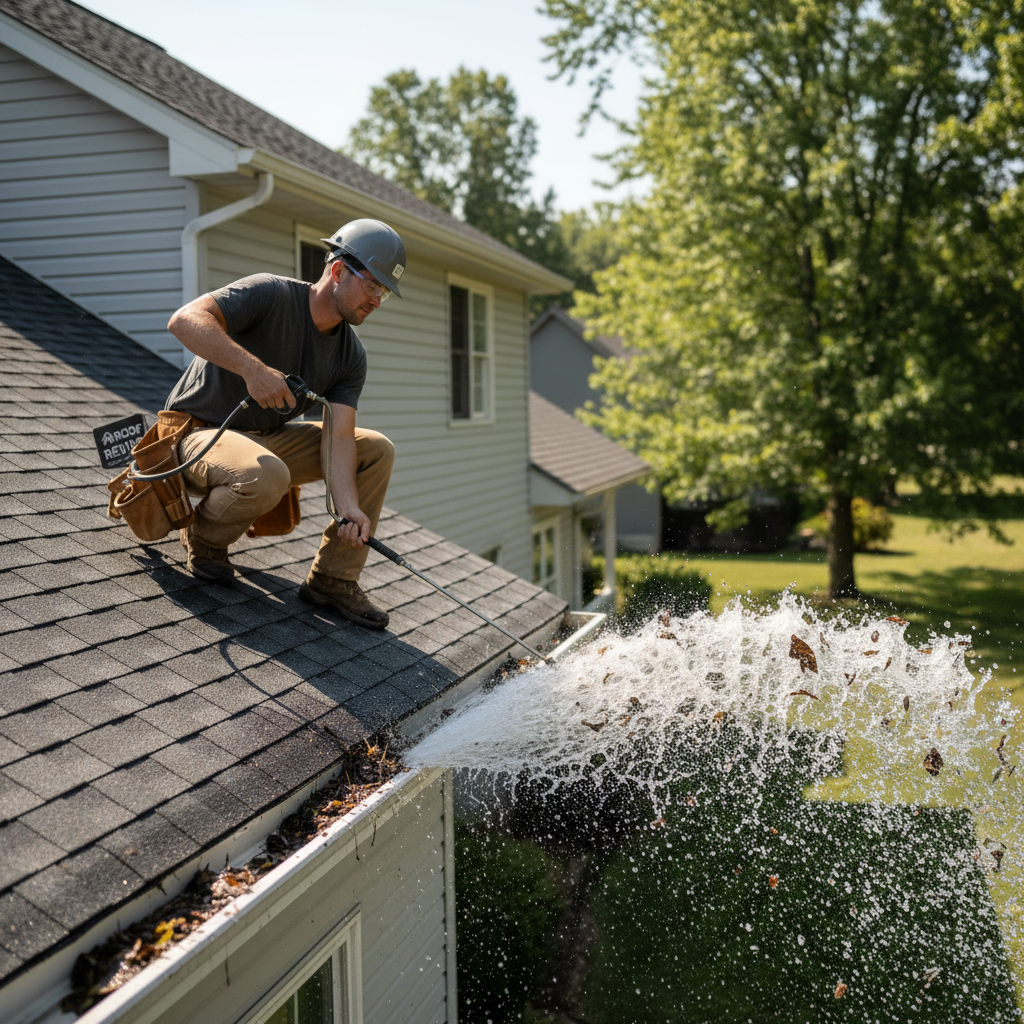
Will your treatment help with that black streaking you’re seeing on the shingles? Yes, if those streaks come from algae staining on the surface. You’ll see fading over 30–90 days, not an instant color change.
The key is making sure you’re treating staining, not hiding a bigger problem. Think of your roof like a watershed. In coastal North Carolina, algae streaking is common and often cosmetic, but patchy “burnt” areas and soft decking point to roof wear or a localized repair issue that a wash won’t fix. This guide helps you tell cosmetic algae staining from roof damage. It also shows what a treatment can realistically do and when you should skip treatment and move straight to inspection or repair.
Confirm it’s algae, not damage
A homeowner spots black streaks and books a “cleaning,” then learns too late the real issue was a small flashing problem that kept getting worse. Before anyone puts chemicals on the roof, the pattern needs to match what algae actually looks like.
| What you see | More likely | What to do next |
|---|---|---|
| Broad, vertical gray-black streaks starting near the ridge and running downward; often worse on shaded north side | Algae staining (often cosmetic) | Treatment/soft-wash may help; expect gradual fading over 30–90 days |
| Patchy dark areas; concentrated under a chimney | Soot/localized issue or damage (not simple staining) | Get an inspection focused on the source before treating |
| “Burnt” spots | Shingle wear or localized repair issue (not algae) | Skip treatment; move to inspection/repair |
| Curling, cracking, bald granule loss, warped/uneven shingles, soft decking | Roof breakdown/wear | Skip treatment; plan repair or replacement timeline |
| Interior water stains, exposed nail heads, dark marks tied to one area (chimney/vent/valley) | Active leak or flashing issue | Skip treatment; request a repair-focused inspection |
Algae staining usually shows up as vertical gray-black streaks that begin near the ridge and track downward with runoff, often worst on the shaded north side. In coastal North Carolina, that pattern is common and mostly cosmetic, but you still need to match the pattern before you treat anything, and you should insist on photo proof like a Google Reviews + Google Maps contractor should provide.
If the dark area is patchy, concentrated under a chimney, or appears as “burnt” spots, you’re not looking at a cleaning problem. That points to a roof issue that needs diagnosis, not cleaning. Don’t default to “just algae” when the marks could be shingle wear or a localized issue that needs repair, not chemicals.
In Wilmington’s humid coastal climate, those gray-black algae streaks are extremely common on asphalt shingles and are usually more cosmetic than structural. Read more in our article: Roof Algae Black Streaks
What a roof treatment can do

You get the streaks to stop spreading, the roof stays intact, and the “before” slowly fades without anyone scouring granules off the surface. That’s the version of this that’s worth paying for.
A proper roof treatment (soft wash roof cleaning) targets the biology first (Owens Corning’s algae cleaning guidance). It kills the algae causing the streaking so it slows down, and you can ask what mix and dwell time they use. The roof usually doesn’t look “new” the same day. Over time, weather and runoff usually wash away the dead staining without aggressive abrasion.
Rejuvenation is different: it’s meant to condition aging shingles, not erase every dark line. It can’t replace missing granules or undo curling, so don’t judge it by a same-day cosmetic reveal. What you can judge is whether the treatment was designed to stop the organism and improve appearance over time without relying on aggressive pressure or scrubbing.
Soft washing is specifically designed to kill organic growth without using high pressure that can strip granules or shorten shingle life. Read more in our article: Soft Wash Vs Pressure Washing
What Results Should Look Like

Right after treatment, the “win” usually isn’t a dramatic color change; it’s that the algae has been killed without beating up the shingles. If you expect a same-day before-and-after, you’ll misjudge good work as failure, and that’s exactly how people get talked into bad methods. Angi is full of those “looked great that day” stories.
Over the next 30–90 days, the weather does most of the visual cleanup (soft-wash expectation-setting). Remaining discoloration loosens as conditions cycle. A realistic success metric is streaks that fade unevenly but steadily (often first in the areas that get more sun and runoff), not a perfectly uniform “new roof” look in a week.
When Treatment Is The Wrong Call
If you treat the wrong problem, you pay twice: once for the wash, and again when the real issue keeps advancing underneath the cosmetics. The goal here is to spot the “nope” signals early.
Skip treatment when the issue isn’t surface staining. Once the roof is breaking down, a chemical wash won’t change the underlying condition. Widespread curling, cracking, or granule loss still requires repair planning because cleaning can’t restore material. It is like spraying sunscreen on rotten decking.
Also skip treatment if you’ve got active symptoms: interior water stains and dark marks tied to one area (around a chimney, a vent, or a valley) where flashing could be failing. In those cases, get a repair-focused inspection (roof inspection Wilmington NC) and a replacement timeline, not a cleaning quote.
Water stains indoors or dark marks tied to chimneys, vents, and valleys often trace back to flashing details, not something a cleaning chemical can fix. Read more in our article: Roof Leaks Chimneys Vents
Choosing a credible pro in coastal NC
ARMA’s updated guidance notes algae discoloration is widespread along the Eastern Seaboard, and good cleaning results are often temporary (ARMA technical bulletin). That reality changes what “credible” sounds like when you’re hiring.
A credible pro will talk like a risk manager, not a magician. If they dodge specifics, walk away and ask for Nextdoor recommendations before you call the next company. They should explain that improvement is gradual and plays out over 30–90 days. They should also get it in writing that algae can return, so maintenance may be periodic, not one-and-done.
They should also show a clear plan for runoff control and plant protection. For instance, they’ll pre-wet and rinse landscaping and explain how they’ll protect soffits, siding, and nearby beds instead of hoping dilution takes care of it.
Roof not getting any younger? Contact us or call 703-673-6301 to find out where you stand.