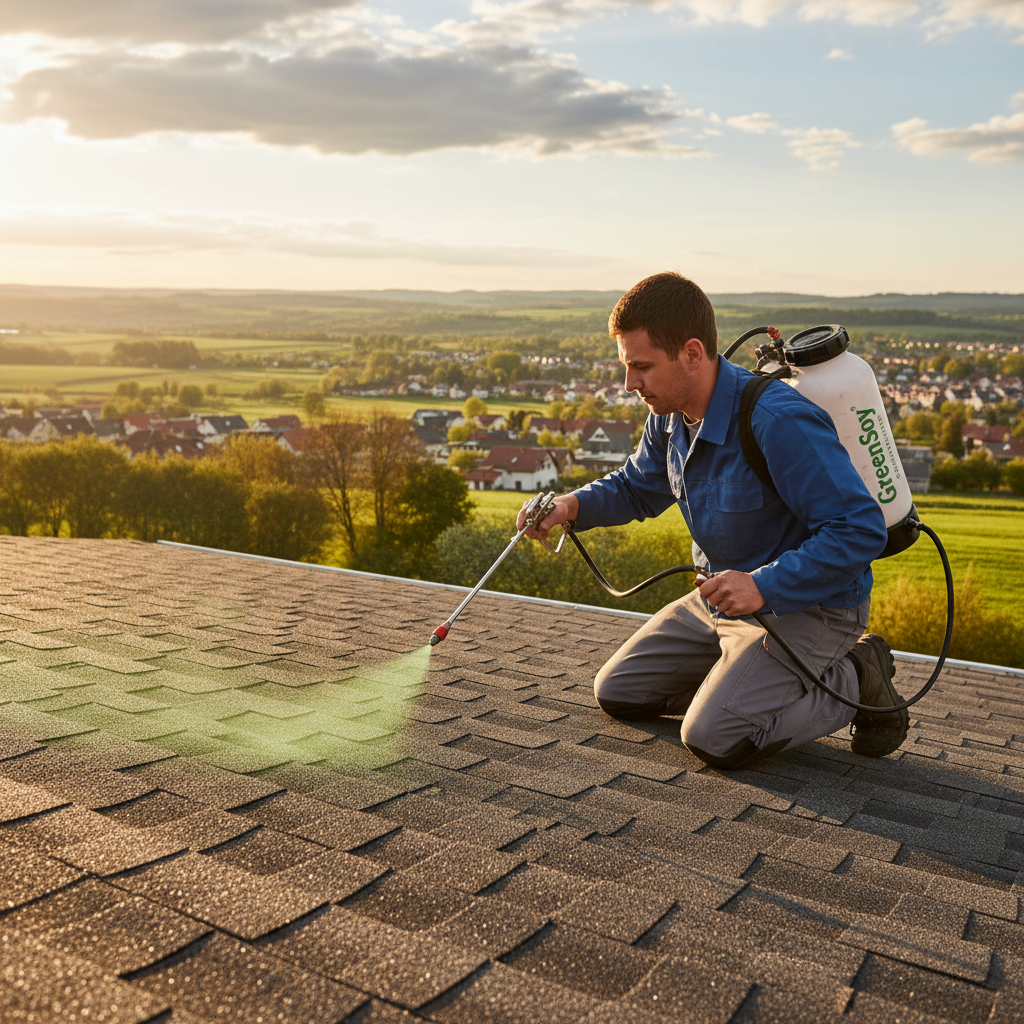
It can be safe for your landscaping and pets around the house. Safety depends on controlling runoff. Keep pets away until everything’s rinsed and dry.
If you’re picturing the risk as something happening up on the shingles, you’re likely missing the real exposure zone: the ground where the mix drains, splashes, and lingers. Most roof rejuvenation jobs include a cleaning step first, and that’s often the part that can irritate paws or burn plants if it pools in one spot. In this guide, you’ll learn where products typically end up around your home and what to ask a Wilmington-area crew so you get a real process (not “it’s eco-friendly”). You’ll also learn what you can do before and after the job to protect beds and patios, because runoff acts like a paint spill that follows every slope, so keep an eye on it.
What Can Reach Your Yard

Even though the product goes on your roof, what matters for landscaping and pets, and for roof rejuvenation safety for pets, is where it lands at ground level. Most of the liquid ends up somewhere you can trace: gutters, downspouts, and the ground below. It follows gravity and your drainage. That makes the downspout discharge and splash zone the highest-exposure areas, and pretending otherwise is wishful thinking, the kind you see when people skip Angi reviews and hope for the best.
You can also get smaller, less obvious contact points: a light mist of overspray on nearby siding or windows (roof treatment overspray landscaping) and wind drift onto beds close to the eaves. If you’ve been picturing this as “roof work” that stays up top, you’ll miss the spots your dog sniffs, rolls in, or drinks from, like the damp edge of a flower bed under a downspout.
The Safety Hinge: Cleaning vs Roof Rejuvenation

Even with a careful crew, one neglected splash zone can concentrate runoff fast, and that’s where pets get into trouble. The difference is rarely the roof, it’s whether anyone treated the rinse paths like a containment problem.
Most homeowners ask, “Is the rejuvenation safe?” but the make-or-break step for pets and landscaping is often the cleaning that happens before it, so focus on shingle rejuvenation pet precautions. A typical roof “soft-wash” uses a diluted sodium hypochlorite mix applied at low pressure, which is where roof rejuvenation chemical toxicity concerns usually come from. Low pressure protects shingles, but it doesn’t protect your azaleas if the chemistry hits leaves at working strength or funnels to one spot.
If your yard is already dealing with algae or staining, the cleaning step is often the biggest driver of plant and paw exposure because the chemistry travels through gutters and downspouts. Read more in our article: Roof Cleaning Chemical Safety
Here’s the usual chain of exposure: the solution starts on the roof. From there it moves through gutters, gathers at downspouts, and hits the ground where pets walk and sniff, so the job isn’t finished until those discharge areas are fully soaked and rinsed. That’s why crews who treat safety seriously spend more effort managing dilution, pre-wetting, and thorough rinsing than they do talking about PSI.
Rejuvenation products themselves may be marketed as “plant-safe,” but “plant-safe” doesn’t mean “ignore runoff.” You’ll get a clearer answer fast by asking: Are you doing a soft-wash first, what chemical are you using, and how will you control and rinse downspout discharge before my dog goes back out?
Questions to Ask Your Wilmington Crew
A typical soft-wash mix is often sodium hypochlorite diluted to roughly 1% to 6% and applied at under 500 PSI, often well under 100 PSI. That’s why the answers that matter sound like handling and dilution details, not marketing (see typical soft-wash ranges from the National Soft Wash Authority).
You don’t need to be a chemist to protect your yard. You do need specifics. If a contractor answers with vague lines like “it’s eco-friendly” or “we’ve never had a problem,” that’s a nonstarter, and it belongs in a Nextdoor thread as a warning, not as reassurance. In coastal Wilmington neighborhoods, the big risk isn’t just a shrub getting splashed, it’s roof treatment runoff storm drains. The bigger issue is where that flow ends up: drains, swales, and water edges.
| Question | What a clear answer includes | Why it matters (pets/plants) | Red flags |
|---|---|---|---|
| Soft-wash first? If yes, what chemical and approximate dilution? | Names the chemical (often diluted sodium hypochlorite) and gives an approximate dilution/range | Sets realistic expectations for irritation/burn risk and rinse needs | “Eco-friendly,” “secret mix,” or refuses to describe dilution |
| Plant protection at downspouts? | Pre-wet beds, manage discharge during application, then rinse leaves/soil | Downspout splash zones are highest-exposure areas | No downspout-specific steps; “we’ll just rinse after” |
| Where will runoff go today? | Walks each downspout path; prevents pooling on pavers/patios/mulch | Prevents concentrated puddles where pets sniff/walk/drink | Can’t map runoff; ignores patios/walkways |
| How keep product out of storm drains/water features? | A plan if a downspout routes toward the street; keeps discharge away from drains/pond edges | Reduces environmental exposure and backflow toward yard | “It’ll be fine,” no contingency if discharge points to street |
| Provide SDS for cleaning mix and rejuvenation product? | Shares roof rejuvenation safety data sheet upon request and identifies products used | Confirms transparency and basic safety documentation | Won’t provide SDS or can’t name products |
Precautions for Plants and Pets

Treat this like a runoff-control job, not just a roof service. Before they start, point out your most sensitive areas: vegetable beds and anything under downspouts. Move pet bowls and dog beds off patios and out of splash zones, and plan to keep pets indoors while product is being applied and while the crew does its final rinse.
Your highest-leverage protection is simple: have the crew thoroughly pre-wet and then re-rinse the plants and soil at every downspout discharge. Case in point: a foundation planting bed that stays damp will dilute what hits it, while a dry bed can take a stronger “dose” right where the water concentrates.
Having the crew map each downspout path and protect the splash zones is one of the simplest ways to prevent runoff from hitting beds, walkways, and pet areas. Read more in our article: Prepare Driveway Yard
After the job, keep pets in until the crew’s final rinse is complete and the wet areas have drained. That waiting window prevents quick contact with concentrated puddles. Wait until the crew has done a full rinse and the wet areas around downspouts and walkways have had time to drain and dry, typically about 30 to 60 minutes (how long to keep pets inside after roof rejuvenation), because those corners can be a watering hole for trouble if your dog laps at them. If you still smell chemical near a corner or see foamy puddling, treat that as “not done yet,” hose it down again, and keep pets away from that spot.
When to Pause or Choose Another Option
A crew finishes, everything looks fine, and then a light rain pushes yesterday’s residue straight toward a storm drain by the curb. The smartest call is sometimes to slow the job down until runoff has a predictable path.
Pause if your yard has a pond/koi feature (roof rejuvenation near koi pond), vegetable beds under eaves, delicate ornamentals packed tight to downspouts, or gutters/downspouts that leak or dump unpredictably. In those setups, you can’t count on runoff going where the crew expects. “We’ll rinse it” stops being a plan.
Also hit pause if a storm drain sits right where your downspout discharges or heavy rain is forecast. Instead, reschedule for a dry window and fix or extend downspouts first. Ask for a written runoff-control approach (or a modified cleaning method) before you approve the job, the same way an HOA ARC expects specifics before exterior work gets a yes.
If a downspout discharges toward the curb, even a small amount of residue can be pushed toward drains during the next rain. Read more in our article: Roof Rejuvenation Environmental Impact
Roof not getting any younger? Contact us or call 703-673-6301 to find out where you stand.When the shingles are dry rather than done, our roof rejuvenation service in Wilmington puts the lost oils back.