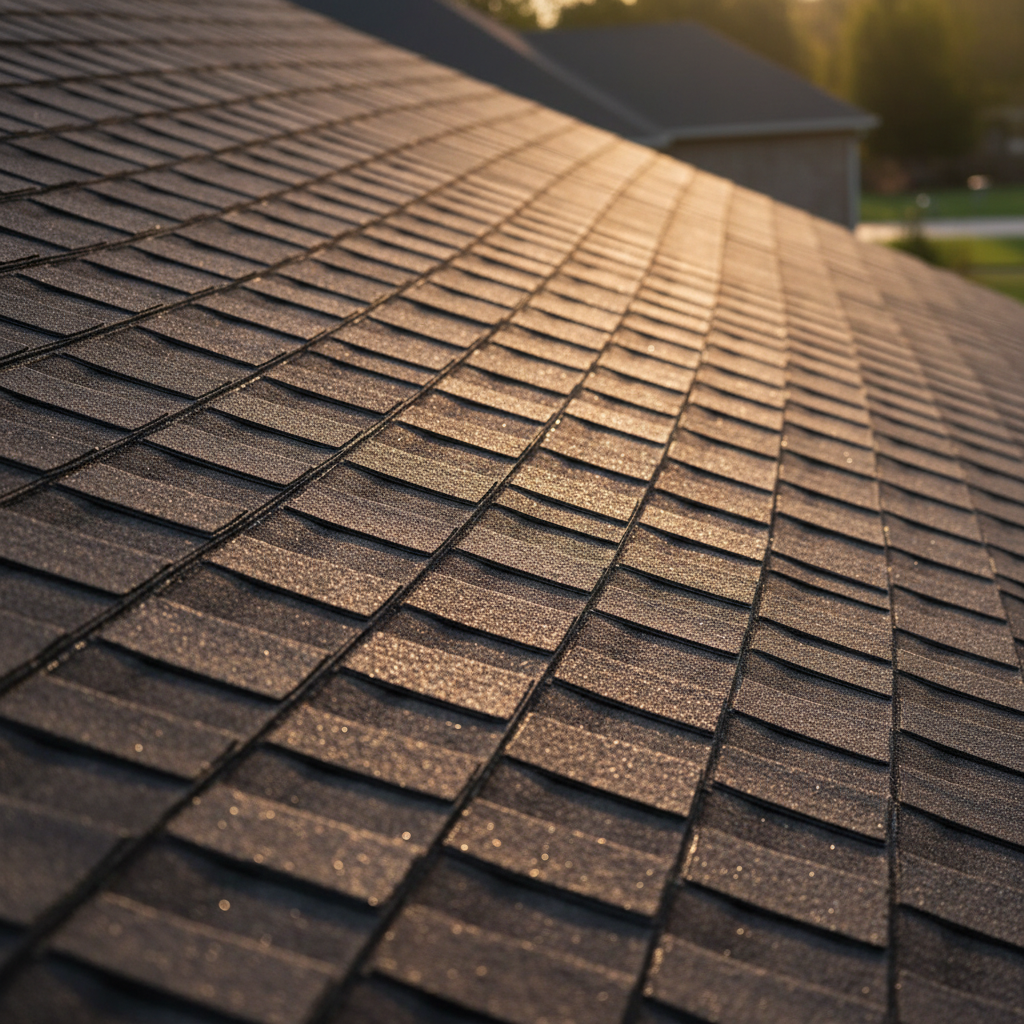
If you’re asking this because you’re finding granules in the gutters, this can help. It depends on what the shingles look like up close.
A treatment can only slow future granule loss on shingles that still look uniformly coated. If you already see bald spots or widespread loss across multiple slopes, you’re likely past the point where rejuvenation makes sense and you should plan for replacement instead. In the sections below, you’ll rule out the common false alarms (like post-install washout and leftover tear-off debris) and use a simple go/no-go screen so you can make a confident call before you spend money.
First, Rule Out False Alarms

You can scoop a cup of grit out of the gutter and still have a roof that’s in decent shape. The mistake is assuming the most visible symptom means failure without first checking the source and whether that shedding is normal for your roof.
Granules in your gutters feel like a verdict, but by themselves they’re just in the ballpark for asphalt shingle granule loss. For example, a newer roof can shed “extra” surface granules left over from manufacturing or installation, and a couple of hard rains can wash them into the gutters without meaning the shingles are failing.
Before you label the roof as end-of-life, step back and check the context. Did the roof go on recently, or did a teardown happen that could’ve left gritty debris behind? Also ask how the roof has been cleaned. High-pressure washing or heavy foot traffic can strip granules fast, turning a maintenance choice into a roofing problem. A simple next step: grab a handful of the gutter “sand,” then look up-slope in bright light for matching bare patches. If the shingles still look uniformly coated, don’t let what’s in the gutters force you into a replacement decision.
Gutter grit can come from leftover tear-off debris or normal post-install shedding, so confirming the source can prevent a false “roof is failing” call. Read more in our article: Leftover Granules Gutters
When Granule Loss Means “Past That Point”
A homeowner sees a few bald patches, buys a “rejuvenation” treatment, and feels good for a month. Then the first hard storm turns the same weak spots into leaks, and the money spent just delays the inevitable.
Once bald spots are real, the question isn’t whether a treatment will “put granules back on,” regardless of what a GAF brochure suggests. It won’t. You generally can’t replace lost granules on asphalt shingles, so any treatment is about slowing future loss, not restoring bald areas. At that stage, anything you do is kicking the can down the road, and that’s money after bad.
You’re typically in replacement territory (or at least “rejuvenation is a poor bet”) when you spot any of these red lines (a framing echoed in recent homeowner guidance such as this overview)
-
Exposed mat/fiberglass showing across roughly 25% or more of a slope (it can look like lighter, bare, or fuzzy areas where the shingle’s reinforcement is visible).
-
Granule loss across multiple slopes, not just one weather-facing plane or one odd patch.
-
An older roof, roughly 18–20+ years, where shedding is clearly accelerating season to season.
-
Granule loss plus other end-of-life damage, like widespread cracking or recurring leaks after simple flashing/boot fixes.
If you can’t identify a specific “bald area” and you’re only responding to the gutter debris, you’re letting what’s easiest to see drive the diagnosis.
Once exposed mat or widespread bald spots show up, treatments rarely pencil out because the roof’s protective surface is already compromised. Read more in our article: Shingles Too Far Gone
What Roof Rejuvenation Can And Can’t Do

Roof rejuvenation can’t “re-granulate” shingles. Once you’ve lost granules, you don’t glue a new protective layer back on, so any product that implies it will make bald spots look new is lipstick on a shingle.
What it can do, when the roof is still structurally intact, is recondition dried-out asphalt so the shingle stays more flexible, like warming sealant before it grabs, and holds onto the granules you still have. For instance, if your shingles look mostly uniform up close but you’re seeing a steady sprinkle in the gutters, rejuvenation may slow the shedding curve, not reverse it.
Rejuvenation works best when shingles are drying out and getting brittle but still have an intact surface layer to hold granules. Read more in our article: Shingle Brittleness
A Homeowner Go/No-Go Screen
If you can sort your roof into “treat,” “repair,” or “replace” in five minutes, you stop getting pushed around by scary photos and sales timelines. The goal is a clean decision before you spend another dollar.
Use this quick screen to decide what makes sense next.
| What you see | Likely call | Next step |
|---|---|---|
| Widespread bald spots / exposed mat (esp. ~25% of a slope) | Past the point for rejuvenation | Plan replacement (get inspection/photos by slope) |
| Granule loss across multiple slopes | Rejuvenation is a poor bet | Start replacement planning; look for roof-wide causes |
| 18–20+ year roof with shedding accelerating season to season | End-of-life likely | Prioritize replacement budgeting/timeline |
| Granules in gutters but shingles still look uniformly coated up close | Early enough that treatment can still matter | Consider rejuvenation to slow future loss |
| Localized issue (one leak area / one damaged run) | Targeted repair first | Fix the spot, then reassess the field in bright light |
Skip treatments if the roof is 18–20+ years old and you’re seeing widespread bald areas or exposed mat, especially near a quarter of a slope. Anything else is wishful thinking, even if you found it on HomeAdvisor.
Granules in the gutters with a still-uniform surface doesn’t mean you’re “fine”; it means you may be early enough that a treatment can slow future loss. When the issue is localized, repair that spot first and then recheck the rest of the roof in bright light.
What to ask in a roof inspection Wilmington NC

Most homeowner guidance comes back to three quantifiable triggers: exposed mat around ~25%+ of a slope or granule loss across multiple slopes, i.e. how much granule loss is too much. If your inspection can’t tie your roof to or away from those thresholds, it’s not actionable.
In coastal Wilmington, you want the inspection to connect granule loss to causes you can actually act on. Otherwise, the report will nickel-and-dime you with vague “it’s wearing.” Case in point: wind-driven rain can push water up under lifted edges, and salt air plus heat can harden asphalt faster, so you need to know whether you’re seeing a one-valley problem or a whole-roof issue.
Ask your roofer to answer these, in writing, with photos by slope
-
Where do you see exposed mat (if anywhere), and roughly what percentage of each slope is affected?
-
Are the worst areas tied to wind-facing edges or valleys, where wind-driven rain hits first?
-
Do you see signs of past pressure washing or aggressive cleaning (scuffing or streaked “bald” lanes), and what cleaning method do you recommend from here?
-
Is algae staining mostly cosmetic, or is it trapping moisture and correlating with faster wear in shaded sections?
If the inspector won’t quantify “how much” and “where,” you’re paying for a roof opinion, not a decision you can trust.
Roof not getting any younger? Contact us or call 703-673-6301 to find out where you stand.That’s exactly the problem our one-day roof rejuvenation in Wilmington was built for, at a fraction of replacement cost.