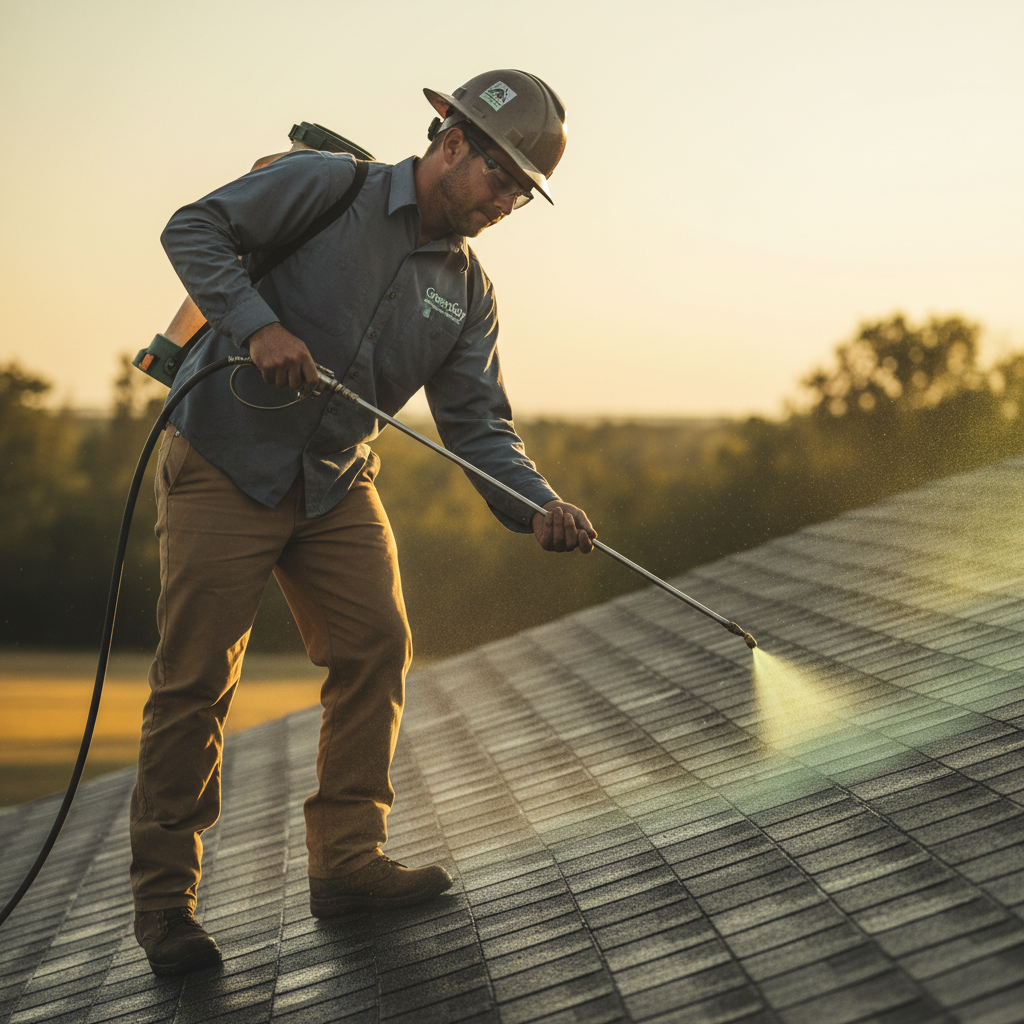
If you get a roof rejuvenation treatment, your shingles will usually look darker at first. That darkening is expected and usually fades as the product absorbs and cures. Blotchiness isn’t the goal, and it usually points to pre-existing roof variation or uneven application.
What you really want to know is whether the darker look will be uniform and how long it’ll last, especially on a coastal North Carolina roof where sun and past repairs can make color differences jump out. In the sections below, you’ll see what “normal darkening” tends to look like from the curb and the timeline to expect.
What “Normal Darkening” Looks Like

Right after a roof rejuvenation treatment, your shingles will usually look darker overall (roof treatment making shingles darker), like the roof just got “re-wet” or refreshed. That change tends to read as more saturated color rather than new stains, and it’s often even across each roof plane. By way of example, a faded gray shingle roof may temporarily shift toward a deeper charcoal tone the same day (a roof shingles color change after treatment), then gradually lighten as the product absorbs and the surface dries.
What should make you rethink the idea that “any darkening means damage” is that this immediate darkening is the expected visual effect, not a mistake. The “normal” version still looks uniform from the curb. It answers, “Does it look worse before it looks better?” without looking like a bad paint roller pass: no sharp spray lines or random leopard-spot patches.
If you’re comparing curb appeal before and after service, it helps to know which appearance changes are expected and which are red flags. Read more in our article: Roof Treatment Appearance
How Long the Darker Look Lasts

One vendor claim you’ll see repeated (and many homeowners translate as how long does roof rejuvenation last) is that the darker cast can linger for roughly 6–9 months before it reads closer to the prior color. The real question is what changes fast and what never fully goes back to “exactly the same.”
You’ll usually see the biggest color shift right away and over the first few days as the roof goes from “freshly treated” to “dry-to-the-touch” during the roof treatment curing time. After that, the change tends to slow down. The roof often looks less like it’s been re-wet and more like a refreshed version of what you had. Some providers also frame it this way: the roof can keep a darker cast for months, with many pointing to about 6–9 months before it reads closer to the prior color.
“Returning closer” rarely means “back to exactly the same shade in every light.” It means the temporary, glossy-wet darkening fades and the roof settles into a more natural, consistent tone. If you want to judge it fairly, take a few curb-distance photos before the work and compare at the same time of day at 48 hours, 2 weeks, and 2 months. Otherwise, you can talk yourself into thinking the look is permanent when you’re only seeing the early phase.
Coastal sun, salt air, and humidity can make color shifts and uneven weathering look more pronounced on different roof slopes. Read more in our article: Salt Air Humidity Shingles
When Roof Treatment Looks Blotchy
A homeowner looks up the next morning and swears the crew missed whole sections, then notices the “missed” areas match old repair lines and the sunlit slope. From the curb, those patterns can look like a bad application even when the roof is only revealing its own history.
Some unevenness is your roof’s history showing through, especially if you’re thinking, “I don’t want it looking patchy from the street,” and you’ve had a few repair patches or shingles from different batches. A fresh treatment can temporarily deepen the whole field. It can make a patchwork-quilt roof read louder even though nothing “new” happened.
True blotchiness looks like application or absorption problems (roof treatment spots on shingles): sharp spray overlaps, visible start-stop bands, drip runs below the ridge, or patchy glossy spots next to fully matte areas on the same slope (a risk often tied to uneven application/coverage disputes).
| What you’re seeing | Likely cause | What to do next |
|---|---|---|
| Even, overall darker “re-wet” look across a roof plane | Normal early-phase appearance as product absorbs/cures | Recheck after 48 hours and 2 weeks in the same light |
| Color differences that line up with repairs, shade lines, or algae zones | Pre-existing roof variation showing higher contrast after treatment | Document with curb photos; ask if those areas are expected to read different |
| Sharp overlap/lap marks, start-stop bands, or drip runs (especially near ridge) | Uneven application/coverage | Contact provider; ask about re-evening coverage after cure |
| Patchy glossy spots next to matte areas on the same slope | Uneven absorption or inconsistent coverage | Compare photos over a few days; request an inspection if it doesn’t settle |
As an example, if one section reads almost oily-dark while the adjacent area looks untouched, that’s not normal settling. Take curb-distance photos in the same light and ask whether the crew can re-even the coverage after it cures.
Blotchiness That Isn’t the Treatment

Sometimes what you’re reacting to isn’t new discoloration at all (as with asphalt shingles where some visible color variation can be normal). It’s your roof’s existing mix of materials and wear getting higher contrast once everything looks freshly darkened, and treating it like a product failure is usually the wrong call when the home inspection report photo pages already show the same patchwork in different light. Case in point: a handful of repair shingles from a different bundle, a section that bakes all afternoon while another stays shaded, or older algae shadowing on the north side can suddenly read as “patchy” even though it was there before.
In coastal Wilmington-area conditions, salt air roof maintenance realities and uneven runoff can age slopes differently. After treatment, those differences can stand out more for a while. If the “blotches” align with old repairs, shade lines, or the usual algae zones, you’re probably seeing history, not a bad spray job.
A pre-treatment inspection can flag repair patches, algae zones, and ventilation or drainage issues that tend to show up as “blotches” after the roof looks freshly darkened. Read more in our article: Typical Roof Inspection
Decide Before You Book: The Appearance-Risk Checklist
You can do everything “right” and still end up arguing about whether a streak is normal or a redo. The easiest time to avoid that conversation is before anyone shows up with a sprayer.
If you care most about how the roof will look, decide upfront whether you’re willing to accept a temporary darker phase and potential shingle color uniformity after treatment differences. If you don’t want to open a can of worms, don’t treat your curb appeal like a trial run, and accept the small risk of unevenness if application quality slips. Don’t rely on “it won’t change much” marketing. That line is wishful thinking, and Angi (formerly Angie’s List) reviews are full of homeowners learning that the hard way.
Before you schedule, ask: Will the roof look darker right away, and for about how long? How do you prevent lap marks and start-stop bands (spray pattern and coverage control)? Then walk your roofline. Note repair patches, heavy shade lines, and north-side algae zones, since those areas often show higher contrast after treatment.
Roof not getting any younger? Contact us or call 703-673-6301 to find out where you stand.For Wilmington homes, HardShore’s free roof inspection in Wilmington turns worry into a written answer in about an hour.