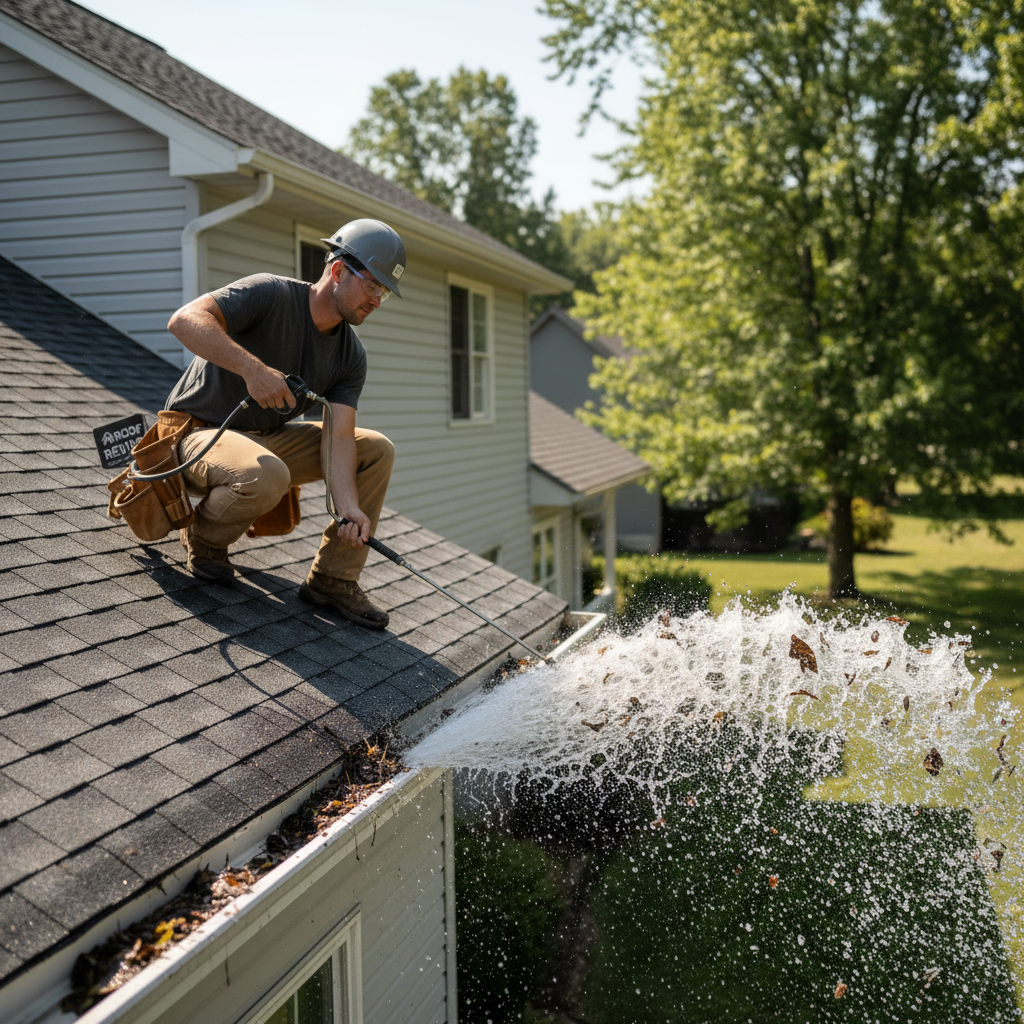
You’re searching for a roof cleaner because your shingles look worse every month. The safest option for most asphalt roofs is a low-pressure, chemical soft-wash that works over time.
If you expect an instant, pressure-washed “after” photo, you’ll either feel disappointed or get talked into a method that can shorten shingle life. In roof cleaning Wilmington NC markets with humid, tree-shaded neighborhoods, the smarter move is to figure out what you’re dealing with: algae staining you can treat or wear signs that call for an inspection first. This guide breaks down what works on asphalt, what results should look like on a real timeline, and how to vet a local roof cleaner based on process, especially runoff control around your plants and downspouts.
Roof Cleaner or Roof Problem?
You can spend good money on a careful soft-wash and still lose if the real issue was shingle wear that needed a roof inspection Wilmington NC contractors would flag. You overpay when you assume every dark roof has the same cause.
Black streaks on asphalt shingles are often algae and can look dramatic even when the roof is still structurally fine. Read more in our article: Roof Algae Black Streaks
If you’re seeing black streaks on asphalt shingles in Wilmington’s humid, tree-shaded neighborhoods, you may be dealing with algae staining that calls for roof algae removal. It’s a paint stain on the curb. It usually looks worse than it is, and a roof cleaner can treat it with a soft-wash process. Same-day appearance isn’t the right yardstick. It doesn’t pass the sniff test.
-
Thick moss/lichen mats lifting shingle edges
-
Piles of granules in gutters
-
Curling or cracked tabs
-
Soft spots
-
Widespread staining on a 20+ year roof
| What you see | Most likely situation | Best next step |
|---|---|---|
| Black streaks on asphalt shingles | Algae staining (usually cosmetic) | Soft-wash roof cleaning; judge results over days–weeks |
| Thick moss/lichen mats lifting edges | Biological growth + mechanical risk | Inspection first; remove growth without damaging shingles |
| Piles of granules in gutters | Shingle wear / granule loss | Inspection; avoid aggressive cleaning that can worsen loss |
| Curling or cracked tabs; soft spots | Material failure / potential leaks | Inspection; repair or replacement planning |
| Widespread staining on a 20+ year roof | Aging roof where cleaning may mask issues | Inspection before cleaning; assess remaining service life |
What Works on Asphalt
On asphalt shingles, the “roof cleaner” that works is the one that kills the organism causing the stain, not the one that blasts the surface. A true soft-wash uses roof cleaning chemicals applied at low pressure, typically a sodium-hypochlorite-based mix (often roughly 1% to 6% in practice, plus surfactant). That is the only responsible way to clean asphalt. High pressure can strip granules and shorten roof life. If a crew is leaning on force for an instant “after,” you’re paying for speed at the expense of shingles.
After treatment, results often develop over days to weeks as dead algae releases and rain rinses it away, even if a few streaks lighten quickly. If you’re judging the job by how it looks when the truck pulls out, you’ll misread good work as “they just sprayed and left,” like a Home Depot tool-rental counter demo that never shows the follow-through.
-
Control runoff
-
Protect what downspouts discharge onto
-
Pre-wet plants
-
Manage gutter and downspout discharge
-
Treat evenly (not visibly “etched” clean)
Moss and lichen can physically lift shingle edges and trap moisture, which is why removal needs to be gentle and methodical. Read more in our article: Kill Moss On Roof
The Hidden Constraint: Runoff

A homeowner on a tight lot gets the roof cleaned and only notices the mistake later, when browned shrubs and a salty neighbor text show up the next day. What happens below the roofline is where a “safe” job can still go wrong.
People fixate on what hits the shingles. On many Wilmington lots, the bigger question is what ends up in your landscaping or your neighbor’s yard once the roof starts shedding dead growth and wash solution. If your downspouts dump into mulch beds, a small koi pond area, or a side yard that slopes toward the street, runoff becomes the deciding safety constraint, not the cleaning strength. That is where I’m not trying to get sold to.
To illustrate this, imagine a soft-wash that’s applied evenly but allowed to pour straight out of two downspouts into azaleas. You can do everything “right” on the roof and still scorch plants or trigger a messy dispute next door. Reputable crews instead focus on protecting vegetation and routing downspout discharge during application. Runoff is a slow leak in the deal.
Before you hire, ask the roof cleaner to walk you through where each downspout goes and what they’ll do differently if it drains toward a driveway inlet or a tidal creek. If they can’t explain a runoff plan in plain language, you’re not buying a safe process, you’re buying hope.
Choosing a Local Roof Cleaner
You don’t need a chemistry degree to vet a roof cleaner, but you do need a framework that rewards process over optics. Nextdoor neighborhood posts and recommendations can help, but only if you filter for process details. If you hire based on who promises the fastest, brightest “after” photo, you’ll steer yourself toward higher risk methods on an aging shingle roof. That trade-off usually isn’t worth it.
Ask them to lay out the steps, from low-pressure application to protecting everything below the roofline. For instance, in a Wilmington neighborhood with tight side yards, a solid contractor will talk through downspout discharge points and pre-wetting and rinsing landscaping instead of just saying “we soft wash.” On solution transparency, they should name the active ingredient (often sodium hypochlorite plus surfactant) and explain why they aren’t using high pressure, even if they don’t quote an exact percentage.
Finally, ask what “proof” looks like: dated before/after photos from similar roofs and a clear re-treatment policy if streaking persists.
| What to ask | What a solid answer includes | Red flag |
|---|---|---|
| Method and pressure | Low-pressure soft-wash; chemistry does the work | Promises of “pressure wash” or instant results |
| Active ingredient | Names sodium hypochlorite (plus surfactant) and why | Won’t say what’s used |
| Runoff plan per downspout | Where each downspout exits; how discharge is controlled; plant pre-wet/rinse | “It’ll be fine” with no site-specific plan |
| Gutters/debris handling | How loosened debris is handled and where it lands | No plan for gutter debris |
| Proof, policy, insurance | Dated photos; re-treatment terms; current liability insurance | Dodges warranty/re-treatment or insurance details |
If they dodge warranty questions, at least confirm whether your shingles have an algae warranty tier so you’re not paying to chase a problem you could prevent long-term.
Cost That Makes Sense

Cost guides often cite roughly $0.15 to $0.90 per square foot, and either end can be legitimate. The number only makes sense once you connect it to access and protection work.
Many quotes land in that same $0.15 to $0.90 per square foot band. Get a couple more quotes to calibrate the scope. The spread is real because difficulty drives cost more than the word “soft wash.” A steep 2-story roof with limited ladder access and tight landscaping can legitimately cost multiples of a same-size, walkable roof with clear runoff zones.
When you compare bids, don’t anchor on square footage alone. A low bid can nickel-and-diming us later. – Roof pitch
-
Roof height
-
Access constraints
-
Staining severity
-
Gutter and downspout handling
Clean, Rejuvenate, or Replace?
When you pick the right move here, you stop throwing money at cosmetics or panic fixes and start paying only for what changes the outcome. The goal is to match the spend to the roof’s real condition, not its worst-looking spot.
If your roof is fundamentally sound, a roof cleaner is the right first move: you’re paying to remove algae staining, not to buy new years of shingle life. As an example, a 10–15-year asphalt roof with intact tabs and typical black streaking usually cleans up well and then stays presentable for a while, especially if you plan to reduce shade and keep debris from sitting.
Rejuvenation only makes sense when the shingles are aging but not failing and you’re trying to stretch the timeline, not reset it.
If you’re deciding between cleaning, rejuvenation, or full replacement, the right choice usually comes down to shingle age, granule loss, and whether tabs are starting to fail. Read more in our article: Roof Rejuvenation Vs Replacement But if you’re seeing curled or cracked tabs or soft spots, cleaning becomes wasted spend fast. Consumer Reports home maintenance guidance gets this right. You can’t wash away end-of-life.
| Option | When it fits | What it does (and doesn’t) |
|---|---|---|
| Clean (soft-wash) | Roof is fundamentally sound; typical algae streaking; ~10–15 years with intact tabs | Removes/kills staining organisms; doesn’t add “new years” of shingle life |
| Rejuvenate | Shingles are aging but not failing; goal is to stretch timeline | May improve flexibility/appearance; doesn’t fix active failure signs |
| Replace | Curled/cracked tabs, soft spots, granule loss, or ~20–25+ years | Resets roof condition; cleaning becomes low-value if end-of-life signs are present |
FAQ
How Fast Should You See Results After a Roof Cleaner Treats Your Shingles?
You might see some improvement the same day, but it’s normal for the bigger change to show up over days to weeks as dead algae loosens and weather rinses it away. A promise of a perfect look at pack-up time is often a sign they’re chasing speed over shingle safety.
How Often Do You Need Roof Cleaning in Wilmington’s Climate?
In coastal North Carolina, many homeowners end up cleaning every few years because humidity, shade, and tree cover accelerate regrowth. If your roof sits under oaks or stays damp on the north side, expect a shorter “clean-looking” window than a sunny, open roof.
Is Soft-Wash Roof Cleaning Safe for Asphalt Shingles?
It’s typically safe when the contractor uses low pressure and relies on the cleaning mix, not force, to do the work. The risk usually comes from aggressive pressure washing or a rushed crew trying to create instant visual results.
Will Roof Cleaner Runoff Hurt My Plants or Grass?
It can if the crew doesn’t manage downspouts and pre-wet and rinse landscaping, especially where your gutters discharge into mulch beds. You should hear a specific runoff plan for your downspout exit points, not a vague promise that “it’s fine.”
What Should You Ask for During a Roof Cleaning Estimate?
Ask what method they’ll use (low-pressure soft-wash), what the active ingredient is, and how they’ll control runoff from each downspout. Then ask what “done” means in real terms: how you’ll confirm progress over time and what their re-treatment policy is if staining persists.
Roof not getting any younger? Contact us or call 703-673-6301 to find out where you stand.The vetting questions above apply to us too. Start with our roof cleaning in Wilmington and ask away.