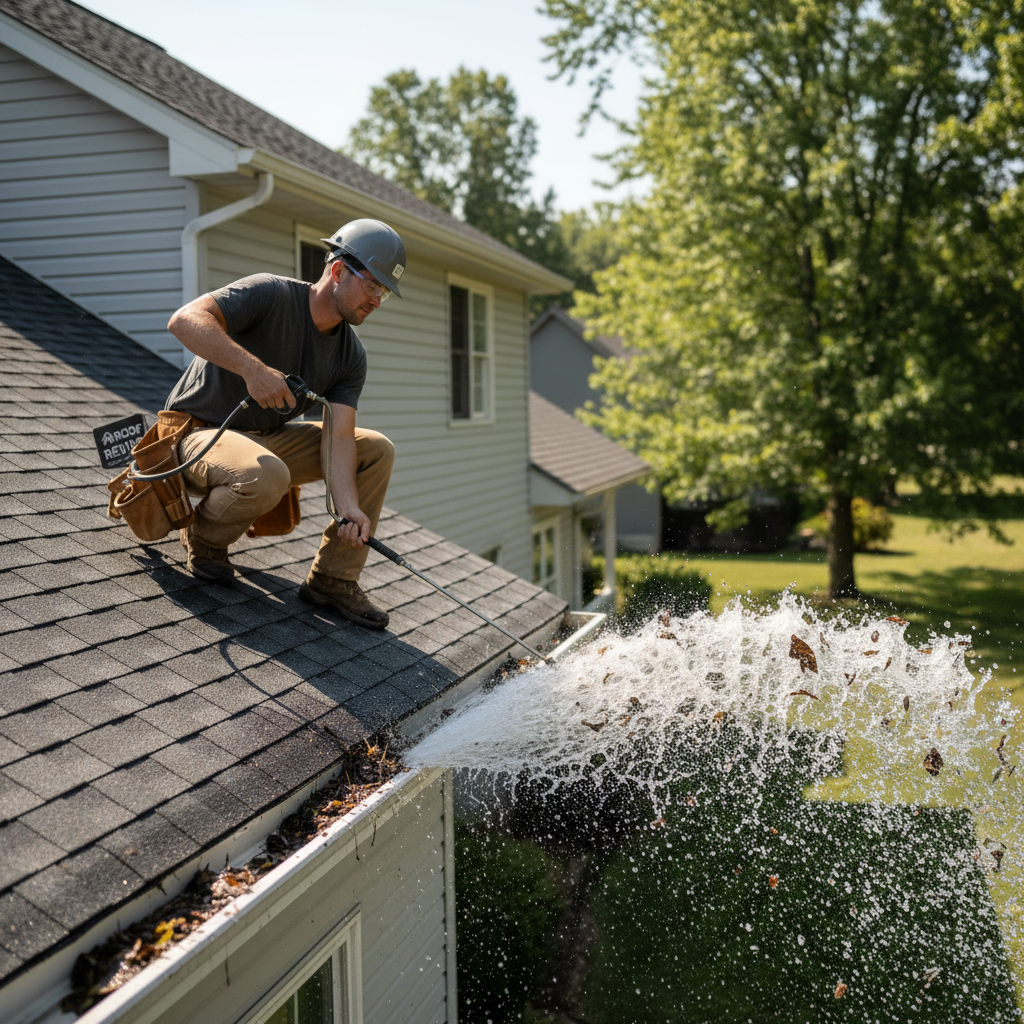
You usually notice it in the same places: the north-facing slope that never really dries, the shaded strip under live oaks, and the clumps that start showing up in your gutters after a rain. If you’re in Wilmington or nearby coastal communities, moss can feel like a constant maintenance tax.
The hard part is that the most satisfying “instant clean” methods can also shorten your roof’s life. If you pressure wash or scrape aggressively, you can strip shingle granules and lift edges that coastal wind-driven rain will exploit. This guide walks you through how to tell when cleaning is still worth it and how to remove moss without damaging asphalt shingles. It also covers when DIY makes sense versus hiring a soft-wash pro, plus how the cost adds up over 3–5 years so you don’t keep paying to reset the same problem.
Decide if roof moss removal is still worth it

Your neighbor pays for a roof wash, gets a quick cosmetic win, and then calls again a year later when the same shaded plane turns green. The difference between a smart clean and a money pit usually shows up before anyone touches a sprayer.
Cleaning moss from roof shingles pays off when you’re dealing with a localized, moisture-driven problem, not a roof that’s simply aging out (moss is also described as functionally damaging to asphalt shingles, not just cosmetic, in industry documentation from asphaltroofing.org). Moss can hold moisture and debris against asphalt shingles, so ignoring it can speed up wear, especially on shaded, north-facing planes common around Wilmington’s tree canopy.
Before you spend on a cleaning, look for signs the shingles themselves are failing. Moss is often just a warning flag. When curling, cracking, and granule loss show up across broad areas, moss is no longer the primary problem. I’m not about to throw good money after bad. For instance, if the “green strip” under your live oak also has brittle edges and gritty downspout discharge after every rain, you’ll likely get a short-lived cosmetic win, not real roof life.
Force the math: soft-wash pricing often lands around $0.15–$0.70 per square foot in some guides and can run closer to $0.50–$1.50 per square foot nationally (see todayshomeowner.com). If you’re already thinking “we’ll just clean it annually,” you may be paying replacement-level money over a few cycles without fixing the underlying decline.
A basic inspection can help you separate surface moss from true shingle failure like widespread cracking, curling, or granule loss. Read more in our article: Typical Roof Inspection
Cleaning Moss From Roof Without Damage

The real trick with cleaning moss from roof shingles is accepting that “dead” and “gone” aren’t the same thing. On asphalt, the fastest-looking methods (hard scraping or pressure washing) often cost you roof life, which is why roof cleaning without pressure washing is usually the safer play. That’s a hard pass, even if the Home Depot rental center aisle makes it feel doable. Chasing a same-day “perfect” look pushes you toward force, which is how the avoidable damage happens.
A safer mental model is: kill the moss first, then let weather do most of the removal. You apply a roof-safe treatment to stop the growth and weaken its grip. Then rain and sun take over, loosening and shedding what’s been killed over time. For instance, that thick patch on the north-facing slope behind your chimney might stay visibly “fuzzy” for weeks, but it can still be a win if it’s no longer holding moisture and debris against the shingle surface.
To protect the details that fail first, pay attention to what your method does at the edges and penetrations. If you see granules collecting at the bottom of downspouts after you “clean,” you went too aggressive; if you leave clumps to wash into gutters, you’re buying a drainage problem next. And if you’re relying on a zinc or copper strip to solve an active patch, you’re skipping a step: those strips help inhibit new growth, but they don’t clean what’s already rooted in place (manufacturer guidance frames zinc strips as inhibitors rather than cleaners, see GAF).
Good roof-cleaning practice focuses on low-pressure application and controlled runoff so you don’t strip granules or drive water under shingle edges. Read more in our article: Safe Roof Cleaning
DIY vs pro: the decision framework
You get halfway across the roof and realize the “easy” spot is slick, shaded, and angled toward the side with all your shrubs. From there, it comes down to whether you can complete the job safely without creating a fall risk or a leak.
Decide based on what you’re really trying to control: your exposure to risk (falls, shingle damage, plant runoff), not just the price tag.
If you have shrubs, flower beds, or light concrete under the eaves, protecting landscaping and managing chemical runoff is often the make-or-break detail on DIY roof work. Read more in our article: Protect Landscaping Siding Windows I’m not trying to reinvent the wheel, but gravity is the bouncer here. In coastal NC, the roof planes that stay damp tend to be exactly where DIY gets messy. Think north-facing sections under live oaks and shaded valleys behind dormers. A plan built around “clean today” tends to end in over-scraping or over-rinsing, and that’s what cuts into shingle life.
| Decision factor | When hiring a soft-wash pro is usually the better call |
|---|---|
| Risk | Steep pitch, high roof, slick algae film, or you can’t work safely from a ladder at the eave. |
| Roof complexity | Multiple valleys, dormers, skylights, or lots of penetrations where lifting edges causes leaks. |
| Runoff sensitivity | Shrubs, flower beds, a pond, or light concrete directly below drip lines where treatment can burn or stain. |
| Time-to-results | You need predictable timing (listing photos, appraisal, HOA notice) instead of “it’ll weather off in weeks.” |
| Repeat tolerance | You don’t want to re-treat, re-check gutters, and re-clean downspout strainers after dead moss breaks loose. |
What a local soft-wash service includes

A real soft-wash for moss isn’t “pressure washing on a lower setting,” and anyone selling that should not look credible once you check Better Business Bureau (BBB) ratings and complaint profiles. It’s a roof moss treatment applied with low pressure so you don’t blast granules off asphalt shingles or force water where wind-driven coastal rain already tests your roof. To illustrate this, a reputable Wilmington-area crew will often spend more time on setup and protection than on the actual spraying, because the goal is controlled dwell and controlled runoff, not an instant cosmetic strip-down.
In practice, you’ll see a sequence like: clear loose debris (so the solution can contact the moss), apply a roof-cleaning mix evenly with a pump or soft-wash system, let it dwell long enough to kill and loosen the growth, then do a gentle rinse only if conditions demand it. Case in point: if a contractor promises a “like-new roof in 30 minutes” by aggressively rinsing until it looks perfect, you’re paying for force, and force is what shortens shingle life.
Cleanup and expectations matter as much as the application. Ask what they do about gutters and downspouts, because dead moss often breaks loose later and clogs the system. Many good crews will bag obvious clumps and flush/verify drainage at the end. Also, don’t grade the outcome the minute they leave, since the roof should improve over days and weeks as weather carries off the dead growth.
Costs and ROI over 3–5 years
National roof cleaning cost is often reported around $0.50–$1.50 per square foot, and heavy moss can bump that higher (one example cost breakdown is summarized at ). Repeat visits are what turn “not that bad” quotes into real money on the same damp, shaded slopes.
Roof-moss quotes sound abstract until you force them into a 3–5 year total. Pricing gets reported in wide bands, roughly $0.15–$0.70 per square foot in some consumer guides and closer to $0.50–$1.50 per square foot in other sources. The decision usually isn’t about visit one. The point is the long-term total. It’s about how often you’ll have to repeat the work on those same damp, shaded planes. That repeat cadence is the meter running.
| Scenario (2,000 sq ft roof) | Per-visit cost (example) | Repeat cadence (example) | 5-year total (illustrative) | What it implies |
|---|---|---|---|---|
| “Clean only” quote | $0.60/sq ft ($1,200) | Every 18–24 months | ~$3,000+ over five years | Costs add up when the same damp, shaded planes keep re-greening. |
| Heavier-moss adjustment (20–50% higher) | ~$1,440–$1,800 | Every 18–24 months | ~$3,000–$5,000+ over five years | You can spend replacement-level money over a few cycles without changing why moss comes back. |
This is also where line items matter (some cost guides separately price coating/sealing-style add-ons in wide ranges, see homeguide.com). Some companies quote “roof cleaning” and stop there; others add a follow-up prevention step (like a ridge strip) or a protective add-on, and those extras can move pricing fast (some guides put coating/sealing-style add-ons around $1–$4 per square foot). When you compare ROI, separate the quote into: cleaning, moss-kill treatment, prevention, and any protective layer. That breakdown helps you spot when a one-day rejuvenation-style option beats repeated cleanings that mainly reset the clock.
FAQ
Can You Pressure Wash Moss Off an Asphalt Shingle Roof?
You can, but you usually shouldn’t, because the “good results” come from force that strips granules and can lift shingle edges where wind-driven coastal rain can get underneath. If a method needs the roof to look perfect immediately, it’s the same method most likely to shorten the roof’s life.
Is Bleach the Best Option, or Are There Safer Alternatives?
Bleach-based mixes can work, but your real problem is controlling runoff onto shrubs and light concrete. In my view, most of the “just spray it” advice you see on Angi (formerly Angie’s List) badly understates that. If you care about plant impact, look for purpose-made roof treatments that use other chemistries (some use organic fatty-acid style ingredients) and still plan for runoff control.
Do Zinc or Copper Strips Remove Existing Moss?
No. Manufacturers describe them as growth inhibitors, not cleaners, so they won’t solve an active, rooted patch by themselves.
How Much Roof Do Zinc/Copper Strips Protect?
In many real-world installs, you get meaningful protection only for roughly 10–15 feet downslope from the strip, and performance depends on how often you get rain, your roof pitch, and how shaded that plane is (trade guidance commonly describes this 10–15 ft downslope limitation, see ). If your moss problem sits far below the ridge or in a tucked-away valley, a strip alone won’t reach it.
How Often Will You Need to Treat in Wilmington’s Humidity?
If you’ve got shade plus moisture (north-facing planes under oaks are the classic example), expect re-growth pressure and plan on periodic retreatment rather than a one-and-done fix. The more you reduce shade and trapped debris, the longer you can stretch the interval.
What Should “Results” Look Like After a Soft-Wash or Spray-On Treatment?
Most good approaches kill the moss first, then the roof looks better gradually as sun and rain do the final cleanup over days to weeks. If someone promises a like-new roof the same hour, they’re usually selling you aggressive rinsing, not a roof-friendly outcome.
Roof not getting any younger? Contact us or call 703-673-6301 to find out where you stand.If the ladder isn’t calling your name, our soft wash roof cleaning in Wilmington takes the whole job off your hands.