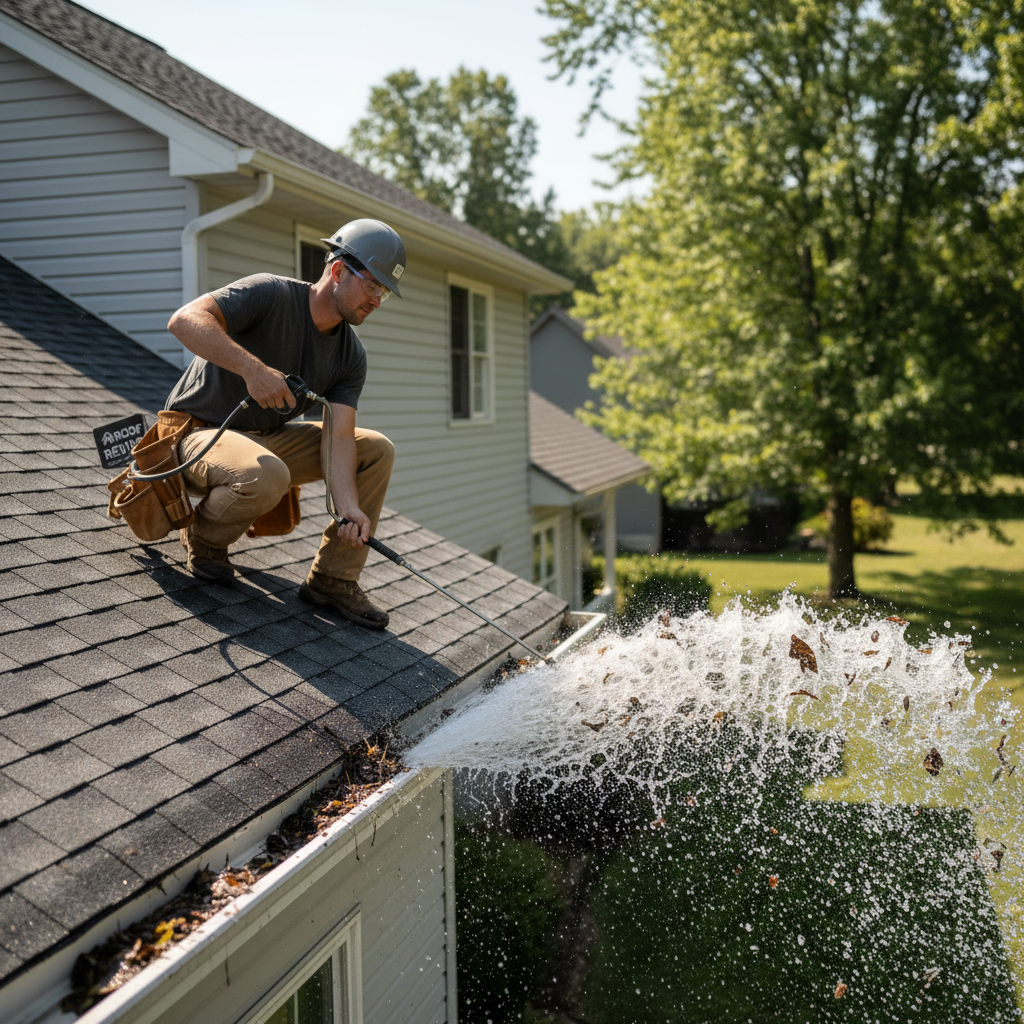
You can keep from damaging shingles or loosening granules by minimizing mechanical force and roof contact. Use a chemistry-first soft wash at very low pressure, then rinse gently down-slope.
If you’ve ever tried to “clean carefully” and still found gritty granules in your gutters, your instinct is right. Most roof damage comes from impact and abrasion, not from the stain itself. In Wilmington’s humid, algae-friendly conditions, the safest win is chemical kill plus dwell time, paired with avoiding any approach that relies on close-range rinsing, scrubbing, or flawless wand control. This guide gives you clear limits to stay inside, signs your roof is too fragile to clean at all, and a quick way to tell whether a “soft wash” contractor actually avoids the forces that strip granules.
What Loosens Shingle Granules

You can do everything “right” and still shave years off a roof if the cleanup turns into a series of tiny hits in the same few spots. Once granules start shedding, you do not get that protection back without replacing shingles.
Granules mostly come off because you apply mechanical force to the shingle, not because the roof is “dirty”, that’s the core of roof cleaning without removing granules (see the Asphalt Roofing Manufacturers Association’s guidance on preventing algae/moss and avoiding damage: ARMA algae/moss prevention & cleaning). The fastest ways to strip them are high-impact water (especially from a pressure-washer tip) and abrasion like scrubbing or scraping, which is exactly the kind of damage This Old House has warned people about for years.
The part many homeowners miss: roof cleaning damage isn’t usually one dramatic mistake, it’s a bunch of small, localized hits. For instance, one accidental close pass with a “gentle rinse” wand can blast a small patch, and kneeling and shifting your weight while brushing can sandpaper one course of shingles. Don’t go nuclear with it. If you’re seeing fresh granules collecting in gutters or at downspout outlets right after cleaning, treat that as a sign you crossed the line, especially on older shingles that have gotten brittle from years of Wilmington sun, salt air, and heat.
If you’re finding gritty granules collecting at downspout outlets after a wash, that’s a strong clue the roof surface is being abraded or hit too hard. Read more in our article: Leftover Granules Gutters
The Safe Default: Low-Pressure Chemical Wash

If your goal is “clean” without shortening roof life, the safest default is to let chemistry and time do the work, then rinse with water that feels more like a garden hose than a cutting tool, how to clean asphalt shingles without damage in one line. That tradeoff matters because asphalt shingles aren’t a surface you can safely “muscle through” with force; a pressure washer is more like a chisel than a rinse, and you’ll pay for it on the back end. Around Wilmington, that discoloration is usually living growth that responds to treatment, not buildup that needs to be blasted away.
In practice, the soft-wash method is simple: apply the roof-safe mix at very low pressure, let it dwell, then rinse gently (manufacturer guidance commonly stresses gentle, non-abrasive cleaning approaches for algae-stain situations; see GAF algae resistance & cleaning bulletin). Many pros treat about 100 PSI or less at the nozzle as a practical upper bound for asphalt shingles, which is a different world than a typical pressure washer. Case in point: a pressure washer set “low” can still spike impact if you change tips or get too close for a second. Pressure washing shingles is a bad idea in almost every DIY setup, and that’s exactly how you pepper a roof with little bald spots.
Use these as your decision filters before you touch anything:
-
If the plan involves a pressure-washer wand as the main tool, you’re betting your shingles on perfect distance and angle control.
-
If the plan is spray, wait, light rinse, you’re using the method that minimizes granule-shedding forces.
-
If you feel tempted to scrub a stubborn section, stop and rethink the objective: a slightly imperfect cosmetic result beats trading a stain for accelerated wear.
Black streaks and dark staining on Wilmington-area shingles are most often algae rather than “dirt,” which is why gentle chemical treatment works better than aggressive rinsing. Read more in our article: Roof Algae Black Streaks
Your No-Damage Operating Limits
Most pressure washers run in the roughly 1,500–4,000 PSI range, so the margin for error on shingles is basically nonexistent, which is how to avoid shingle granule loss in practice (typical consumer pressure washer PSI ranges are commonly cited by equipment references like SIMPSON Cleaning). If you can’t confirm garden-hose-like force (often ≤100 PSI at the nozzle), skip the machine entirely; that’s what low-pressure roof cleaning looks like when it’s done right.
For a “no regrets” cleaning, assume every pass is the only pass you get. In real life, most damage happens when you concentrate force into a small spot, like a narrow tip or getting too close for a second, which is why renting a pressure washer from the Home Depot paint/pressure-washer aisle and rental desk and pointing it at shingles is just asking for trouble. On an older Wilmington roof, that can mean you don’t just lose granules, you also create a spot that holds water and ages faster.
| Limit area | Safe baseline | Why it matters |
|---|---|---|
| Water impact | ≤100 PSI at the nozzle (if you can’t verify, don’t use a pressure washer) | Reduces impact that strips granules |
| Tip/nozzle | Wide fan or shower-style rinse (avoid zero-degree/tight-stream tips) | Avoids concentrating force into a small spot |
| Distance | Several feet back | Keeps water landing like a gentle rinse, not a strike |
| Angle | Spray down-slope with the shingle pattern (never upward under edges) | Helps prevent lifting edges or driving water underneath |
| Contact | Never scrub or scrape | Eliminates abrasion that sands off granules |
Decide if Your Roof Is Too Fragile to Clean

Even a low-pressure, chemistry-first wash can turn into granule loss if your shingles have aged past their “handling” stage. Old shingles behave like dry leaves. In Wilmington’s sun and salt air, a roof that’s already brittle can shed granules simply from rinsing or hose drag.
Treat cleaning as optional, not mandatory, if you see any of these red flags: the roof is roughly 20–25+ years old, you’re finding heavy granules in gutters/downspout splash blocks after normal rain, shingles look bald, cracked, curled, or cupped, or tabs lift easily in a light breeze, does roof cleaning remove granules becomes the wrong question at that point (age/condition considerations are also reflected in general asphalt-shingle lifespan expectations like those summarized by InterNACHI). That can void your warranty. If any apply, protect the roof by skipping cleaning and having a roofer assess remaining life, since a cosmetic push can be what tips a tired roof into leaks.
If your shingles are already dry, brittle, and cracking, even low-pressure rinsing can accelerate granule loss and expose the roof to faster aging. Read more in our article: Dry Brittle Asphalt Shingles
The Process That Minimizes Granule Scuffing

A homeowner treats one slope, then keeps “just rinsing a little more” and walks the same path back and forth until the gutters fill with grit. The difference between a clean roof and a scuffed one is often one extra pass and one dragging hose.
To minimize granule scuffing, set up so you touch the roof as little as possible: stage your mix and a garden-hose rinse from the ground, start at the ridge and work down, and keep the hose supported so it doesn’t saw back and forth across shingle faces; do it right the first time (this aligns with label-level directions for some roof algae control products that call for low-pressure application and avoiding aggressive pre-cleaning; see EPA PPLS label example). As a concrete setup, coil the hose on the far side of the ridge and feed only what you need while treating the front slope.
Apply once, let it dwell, then one gentle rinse down-slope to remove roof algae without pressure washing. Don’t “chase clean” with repeated passes; extra rinsing usually means extra foot traffic, more hose drag, and more runoff pushed under edges.
Granule-safe cleaning is the whole point of our soft-wash roof cleaning in Wilmington: low pressure, roof-safe detergents, no stripped shingles.
How to vet a Wilmington NC roof cleaning “soft wash” contractor
You want the kind of bid where the roof gets darker for a bit, then clears over time, and nobody ever needs to climb up and “touch it up.” The right contractor makes the easy choice the safe one by designing the job around low impact, not heroics.
What you’re paying for is a process that protects granules, not just a roof that looks clean. The easiest tell is whether they talk about chemistry, dwell time, and gentle rinse or they keep circling back to how they’ll “turn the pressure down” and make it look new fast; that sales pitch is basically Nextdoor bait.
Ask three questions and listen for these red flags:
-
“What equipment touches the roof, and what’s the pressure at the nozzle?” Red flag: they lead with a pressure-washer wand or can’t clearly describe keeping it around garden-hose force (often ≲100 PSI at the nozzle).
-
“Do you ever scrub or ‘touch up’ stubborn areas?” Red flag: any brushing/scraping plan. If they need abrasion to hit a perfect result, your shingles pay the price.
-
“How many rinse passes do you typically do?” Red flag: multiple heavy rinses for instant brightness; good enough for government work beats a showroom finish that scuffs your roof like a bad wax job on a beater. One controlled rinse down-slope beats chasing a showroom finish.