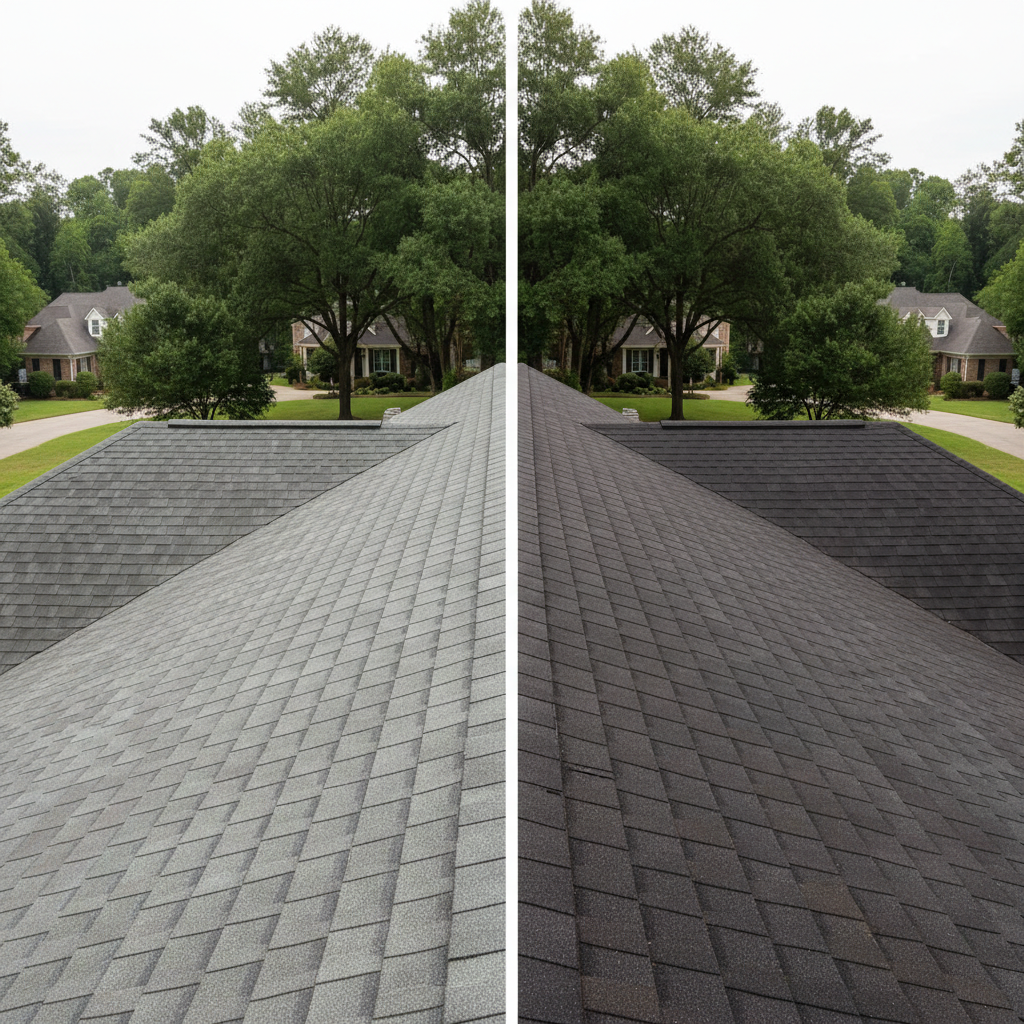
You can use roof rejuvenation to buy time in salt air and coastal wind, but only if your roof is still watertight and most shingle tabs are still sealing down. If wind can easily lift lots of tabs, you’ll usually get a safer outcome by planning repairs or replacement, not by treating the surface.
If you live around Wilmington or nearby beach communities, this coastal roof maintenance decision feels urgent because your roof can look “okay” from the yard and still act old when gusts get under the edges. In the sections below, you’ll learn what coastal exposure really does to asphalt shingles and what to inspect before you spend a dime. You’ll also see how insurance and roof-age paperwork can override a sound plan, so you can check where you stand before paying for rejuvenation and still getting pushed into replacement at renewal.
Coastal Roofs Fail Differently

On the coast, your roof usually doesn’t “wear out” evenly. Wind keeps trying to lift shingle edges, and as shingles age, the factory sealant strip can lose adhesion, leaving more tabs partially unsealed and easier to peel back in gusts. That’s why a roof can look mostly fine from the yard yet behave like it’s older when the next blow comes through.
Salt air and sun also speed up granule loss, which exposes more asphalt and accelerates deterioration. If you’ve been thinking this is mostly about shingles getting “dry,” shift your focus to two checks: how many tabs feel unsealed on a warm day and whether you see widespread granule loss on wind-facing slopes.
Salt spray and constant humidity can accelerate granule loss and make shingles behave older than their calendar age. Read more in our article: Salt Air Humidity Shingles
When Rejuvenation Is Worth It
In one accelerated lab test, asphalt shingle rejuvenation on treated 15-year-old shingles held onto granules about 53% better than untreated samples after 1,500 hours of simulated weathering. That upside matters only when the roof is still watertight and the weak points are the kind you can address with targeted repairs.
Shingle roof rejuvenation makes sense on a coastal roof only when you’re trying to extend a roof that’s still doing its primary job: shedding water. Think of it as buying time by improving shingle pliability, not as a way to “fix” wind vulnerabilities that come from widespread unsealed tabs or failing details. For example, those accelerated tests may show better granule retention on treated shingles, but they can’t restore adhesion once the sealant strip has released across large areas.
Use these as your go/no-go guardrails when you kick the tires on it.
| Check | Rejuvenation is worth pricing when… | More likely repair + replacement planning when… |
|---|---|---|
| Water intrusion | No active leaks or recurring ceiling stains | Active leaks or recurring ceiling stains |
| Key details | Flashing points (chimney, step flashing at walls, pipe boots, valleys) look intact | Failing details that need more than targeted repair |
| Surface condition | Not seeing large bare patches where asphalt is exposed across wind-facing slopes | Large bare patches/asphalt exposure across wind-facing slopes |
| Wind uplift | Only a limited number of shingle tabs lift easily on a warm day | Many tabs lift easily by hand; repeated wind-blown shingle damage after storms |
| Treatment expectations | You’re treating it like maintenance; many treatments last about five years per application | You’re expecting it to “fix” widespread unsealed tabs or act as a one-and-done alternative to replacement |
If you’re still leak-free and the key flashings look intact, pricing rejuvenation can be reasonable when bare asphalt exposure is limited and only a small number of tabs lift easily on a warm day. If an inspector can lift many tabs by hand, or you’re already chasing wind-blown shingle damage after each nor’easter, you’re past “extend life” and into “restore wind resistance,” which usually means repair plus replacement planning, not oil-on and hope.
One more reality check: this roof life extension treatment isn’t a single formula. Many treatments last about five years per application, so treat it like maintenance, not a one-and-done alternative to replacement (see a representative rejuvenation provider Q&A that frames ~5 years as typical per application).
The Wind-Uplift Reality Check

You can be one blustery afternoon away from learning your roof’s real age, when a handful of loose tabs turns into a cascade of flapping, creasing, and fast granule loss. It can happen on a roof that looked completely fine the day before.
The make-or-break issue on a coastal asphalt roof often isn’t whether the shingle looks “tired,” it’s whether enough tabs are still bonded down to act like a single surface in gusts. Over time, the factory sealant strip can lose adhesion, and tabs end up partially unsealed (a pattern described in field research on asphalt shingle sealant strip adhesion loss and wind uplift). Once that happens, wind doesn’t need to rip off a whole slope to hurt you; it only needs to get under an edge, flex it repeatedly, and start a chain reaction of lifting, creasing, and accelerated granule loss.
This is also why wind ratings can give you false confidence, because once tabs stop sealing on an older coastal roof, warranty language and wind numbers don’t reflect how it will perform in real gusts. It happens fast. Those numbers are built around new, fully sealed tabs, not an older Wilmington roof that’s heat-cycled, salt-exposed, and periodically loosened by storms.
Before you put money into rejuvenation, make a roof inspection Wilmington NC prove two things: (1) the majority of tabs on wind-facing slopes resist lift on a warm day, and (2) any unsealed areas are limited and repairable with targeted sealing, not widespread across the field. If you can’t confirm those, you’re not extending life, you’re gambling against uplift.
A structured inspection checklist helps you spot the few deal-breakers (like widespread unsealed tabs or failing flashings) before you spend money trying to “buy time.” Read more in our article: Typical Roof Inspection
Rejuvenation vs Replacement Math
If your roof passes the inspection thresholds above, the decision usually comes down to two numbers: what you’re paying per year of added life, and what it costs you if you guess wrong in the middle of hurricane season. Roof rejuvenation cost commonly prices in the low-thousands (often about $2,000–$5,000). Many treatments behave like a roughly five-year play per application, not a permanent reset. That means you’re often buying time at something like a few hundred to about $1,000 per year of expected extension, depending on price and how well your shingles respond.
Roof replacement cost Wilmington NC is more upfront, but it can reduce your “wind event anxiety” cost: fewer emergency calls, fewer surprise repairs, and less chance you discover a weakness only after water is already in the attic. If you’re leaning toward rejuvenation mainly to save money this year, sanity-check it against the downside: one storm-driven leak can wipe out multiple years of savings, and you may not be able to get scheduled quickly in hurricane season.
Use this quick math on your estimates
-
Extension window: What’s the realistic added-life range for your roof, and is it closer to ~5 years (typical) or longer only under narrow conditions?
-
Repeat-treatment plan: If you need another application in ~5 years, does the two-cycle total still beat replacement when you divide by years gained?
-
Mid-season failure cost: If tabs start lifting or you get a leak in August, what’s your likely spend for emergency service plus interior repairs, and can you tolerate that risk?
-
Paperwork reality: Will your insurer care more about recorded roof age than the fact that you treated it, especially once you’re in that 15–20 year range many carriers scrutinize?
After you run those numbers, you’re not choosing between “smart” and “wasteful.” You’re choosing between a lower-disruption, time-buying maintenance strategy and a higher-certainty reset that’s harder to regret after the next coastal wind event.
Insurance and Documentation Can Decide

A Wilmington homeowner schedules rejuvenation in spring, feels ahead of the game, then gets a renewal letter that treats the roof like it never happened. Suddenly the decision isn’t about shingles, it’s about what the paper trail says when underwriting takes a look.
Even if you decide is roof rejuvenation worth it and it’s a technically smart “buy-time” move, your insurer can still force your hand. At renewal, carriers often key off recorded roof age and condition, and underwriting systems in North Carolina may still flag a treated roof as 17 years old on paper (NCRB documentation shows roof age is formally tracked via a roof surfacing schedule). If you’re planning to rejuvenate mainly to avoid replacement, you can end up paying for the treatment and then replacing anyway when a renewal notice or lender-required proof lands.
Before you commit, verify three things: what limits apply to your carrier and what roof age they have on record, because relying on Angi or Nextdoor advice at the last minute is a terrible way to manage renewal risk. In Wilmington it’s common to get this question right after a named storm when underwriting tightens, so don’t wait until you’re 30 days from renewal to find out your “extend it” plan doesn’t count.
Insurers often care more about documented roof age and condition notes than whether a treatment was applied, especially once you’re in the mid-to-late teen years. Read more in our article: Homeowners Insurance Roof Rejuvenation
Roof not getting any younger? Contact us or call 703-673-6301 to find out where you stand.Rather than guess, let HardShore’s roof rejuvenation crew in Wilmington document where your roof really stands.