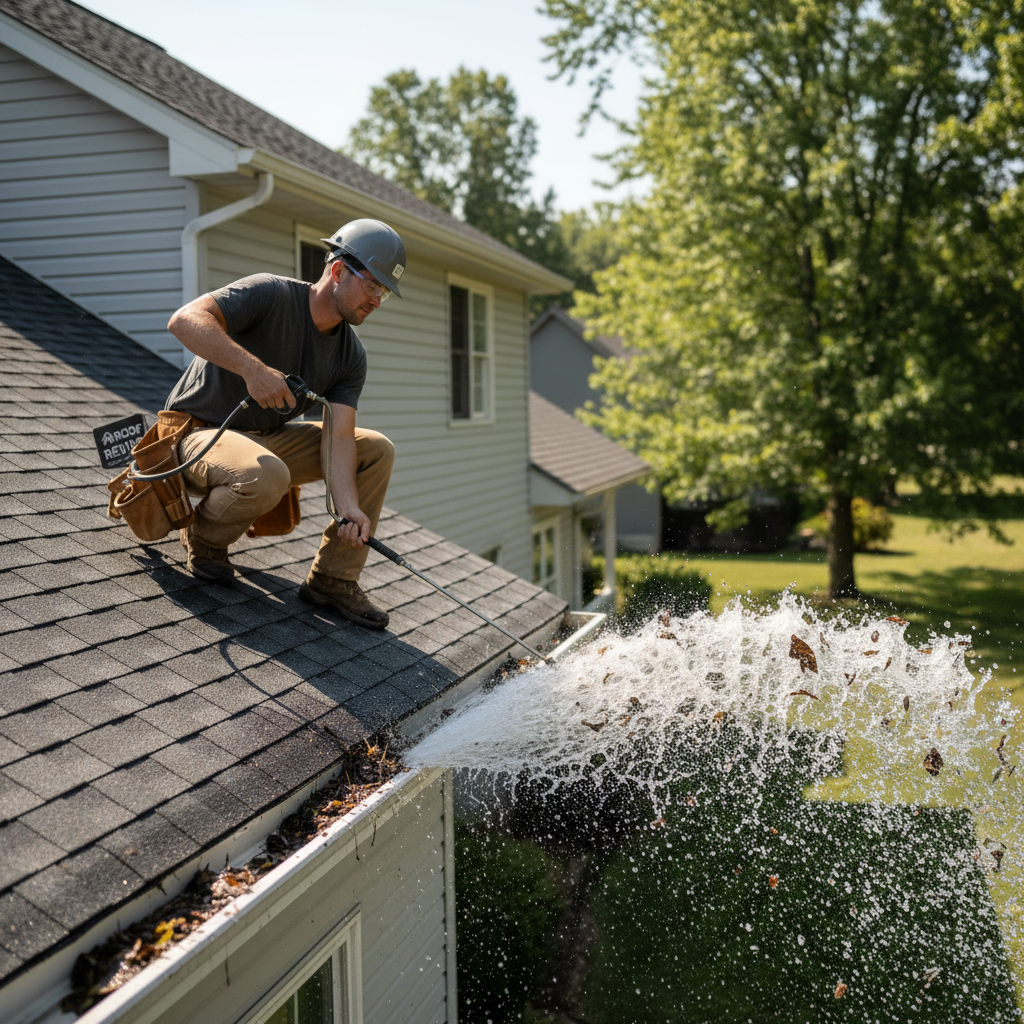
You should treat only the affected areas if the growth is truly isolated and you can apply treatment evenly and safely. You should treat the whole roof, or at least the entire affected roof plane, if you’re seeing streaking or speckling beyond one spot and you want a uniform look.
If you live around Wilmington, the hard part isn’t finding a product, it’s deciding what problem you’re trying to solve. Sometimes you’re chasing curb appeal (black streaks), and sometimes you’re trying to kill living growth and stop it from re-seeding. That difference matters. Spot-treating can leave untreated areas as a reservoir that keeps re-colonizing the cleaned zone, and it can also produce a quick “clean patch” beside darker shingles when the treated area lightens first. In this guide, you’ll learn how to choose coverage that stays solved, while keeping the method gentle on asphalt shingles by avoiding high-pressure washing and aggressive scraping, more like roof cleaning vs roof treatment than a quick cosmetic rinse.
Treat Whole Roof vs Spot: What You’re Actually Solving

You can do everything “right” and still end up with a roof that looks worse for a while if the clean area brightens and the rest stays stained. And if you pick the wrong target, you can turn one job into a cycle of callbacks.
Before you decide where to apply treatment, get honest about what outcome you want and do it right the first time, starting with a basic roof inspection Wilmington NC homeowners can do safely from the ground. In Wilmington-area conditions, shade plus humidity means algae and moss behave less like an isolated “spot” problem and more like a roof-wide exposure that shows itself first on the north-facing plane or under live oaks. If you only chase what you can see, you can end up paying for repeated visits. You can also end up with a roof that looks inconsistent while the treated section changes first and the rest stays stained.
You’re usually solving one of three different problems, and each pushes you toward a different coverage strategy
-
Cosmetic staining (often black streaks): You care about uniform appearance and resale or HOA pressure. Here, uneven coverage is the real enemy because adjacent colonies can keep feeding the “dirty” look.
-
Living growth (algae colonies and spores): You care about killing the organism, not just rinsing the surface. Spot-treating can kill what you hit while leaving enough living growth nearby to restart the problem.
-
Roof-risk (moss holding moisture): You care about stopping a moisture-trap and reducing shingle wear. This is where aggressive scrubbing or high pressure can cost you more than the moss did by stripping granules.
A quick self-check that changes what you do next, even after a ladder + smartphone flashlight quick-look from the driveway: are you trying to make one ugly patch look better, or are you trying to stop a roof-wide biology problem from coming back from the areas you didn’t touch?
In Wilmington’s humidity, black streaks are often algae that spreads beyond the darkest visible lines on the shingles. Read more in our article: Roof Algae Black Streaks
Why Spot Treatments ‘Come Back’ in Coastal NC

In coastal North Carolina, regrowth isn’t usually because the product “did nothing.” It’s because the part you didn’t treat keeps re-seeding the part you did, which is penny wise and pound foolish. Algae and moss don’t respect the edges of the patch you can see, and humidity plus frequent damp mornings gives dormant spores plenty of chances to wake back up.
The easiest way to picture it: you knock down the visible colony on one roof zone, but the adjacent shingles still hold living organisms. With the next stretch of dew-heavy mornings, wind and water move that biology right back across the boundary like sand refilling a footprint at the tide line. For instance, you treat the dark streaks on the north-facing plane near a chimney, and the streaking returns later from the untreated area above it.
Runoff patterns make this worse. Valleys and roof-to-wall lines often stay wetter longer, and they collect whatever washes down from higher courses. Case in point: you spot-treat a mossy corner under tree shade, but every rain pulls nutrients and spores from the untreated upper shingles into that same corner, so it’s the first place to “return.” If you’re choosing spot work to be gentler, challenge that logic.
Long-term results usually come from removing the conditions that let moss and algae re-colonize, not just from applying stronger chemistry. Read more in our article: Prevent Algae Moss Return The chemistry can be the same strength either way, and repeat spot hits can add up fast in cost and exposure.
A Simple Coverage Decision Framework
Imagine two neighbors with the same streaking: one chooses what’s easiest to reach, the other chooses whole roof soft wash that will look even from the curb. A week later, only one of those roofs looks like a single, finished project.
Make the coverage choice based on what will stay solved, not what looks smallest today, because guessing at scope is a bad bet. For example, if you need the roof to look even for an HOA letter or a listing photo next week, spot work can save money and still leave you with a visibly mismatched “clean patch” where the treated area lightens first.
| Criterion | Points toward spot-treat | Points toward whole roof / whole plane |
|---|---|---|
| Growth type | Thick moss clumps; isolated clump you can target | Black streaking algae; widespread speckling/streaking |
| % coverage | One small zone on an otherwise clean plane | Multiple zones or most of a plane affected |
| Roof age / warranty sensitivity | Keep application consistent and low-pressure | Avoid aggressive methods; consistent, low-pressure coverage |
| Uniformity goals | Localized improvement is acceptable | Uniform look matters; spot treatment rarely delivers |
| Access / safety | Patch is safely reachable without risky setup | Reaching “just the patch” is risky; broader coverage may be simpler |
| Timeframe | Fast visual change can create a clean-patch contrast | If contrast is a problem, broader treatment avoids patchiness |
When Spot-Treating Is the Smarter Call

You take care of the one small clump, avoid touching the rest of the roof, and the problem actually stays put. That’s the best-case version of spot work, and it does happen.
Spot-treating makes sense when you’re dealing with an isolated issue and you’re intentionally buying a localized improvement, not a uniform, long-lasting result. That usually means one small moss clump at a flashing or a minor patch you can clearly trace to a single cause like a constantly dripping gutter corner.
What trips people up is equating a small stain with a contained problem when the underlying growth can extend well beyond what’s visible. If you spot-treat, expect the treated area to change faster than the rest of the roof. Plan on follow-up treatment if nearby shingles still harbor spores that restart growth.
A practical rule you can use: if you can circle the problem area with your finger on a roof photo and it’s the only spot on that entire plane, spot work is rational. Once streaking or speckling extends past the zone, spot work becomes incomplete coverage.
If You Treat the Whole Roof, How to Keep It Gentle

Spot work is not automatically “milder” when the chemistry is the same. Many softwash approaches for asphalt shingles use roughly 3% to 5% active chlorine, so gentleness comes down to pressure and control, not just square footage.
Whole-roof coverage doesn’t have to mean “harder on the shingles,” but it does force you to control the method. The biggest shingle risk isn’t treating more square footage, it’s using force to get instant results, which can strip granules and shorten roof life.
Keep these non-negotiables in place
-
Low-pressure application only: think chemical treatment that kills growth, not blasting it off.
-
No pressure washing for asphalt shingles: if the plan involves a high-pressure rinse to “make it look new today,” walk away.
-
Let time do some of the work: expect visible improvement fast in some areas (often within 24 to 48 hours), with the rest continuing to lighten as weather rinses away dead organisms.
-
Protect what’s below the roofline: pre-wet landscaping, control runoff, and rinse plants after, especially around foundation beds common in coastal NC homes.
FAQ: Whole-Roof Treatment vs Spot Treatment
Is Whole-Roof Treatment Just a Way to Charge More?
Not when the priority is a roof that stays evenly clean. When algae extends beyond the obvious spot, whole-roof coverage often cuts repeat visits by removing the untreated source that restarts staining (black streaking is often tied to Gloeocapsa magma).
How Long Will a Spot-Treated Area Look “Patchy” Next to the Rest?
You can see the treated area lighten within 24 to 48 hours, while the rest of the roof may stay darker until it’s treated or naturally weathers. If uniform appearance matters, that fast contrast is exactly why spot work can backfire.
Will Cleaning Void My Shingle Warranty?
The bigger warranty risk usually comes from aggressive methods like pressure washing that can strip granules, not from whether you treated 20% or 100% of the roof. You should ask exactly how the contractor applies and rinses, and avoid any plan that relies on high pressure to get instant results.
How Often Will I Need Retreatment in Coastal North Carolina?
In humid, shade-heavy areas around Wilmington, plan for periodic maintenance rather than a one-and-done fix, because roof treatment longevity depends heavily on shade and moisture. If you treat isolated patches, you’ll usually be back sooner since untreated shingles keep supplying regrowth.
Should I DIY Spot Treatment or Hire a Pro for Whole-Roof Coverage?
DIY can work for a truly small, reachable area, but you still have to manage runoff and protect landscaping. So get ahead of it. If you can’t apply evenly and safely without getting on the roof, hiring a pro often ends up being the lower-risk option, and it beats kicking the can down the road like a loose shingle in the wind.
Roof not getting any younger? Contact us or call 703-673-6301 to find out where you stand.