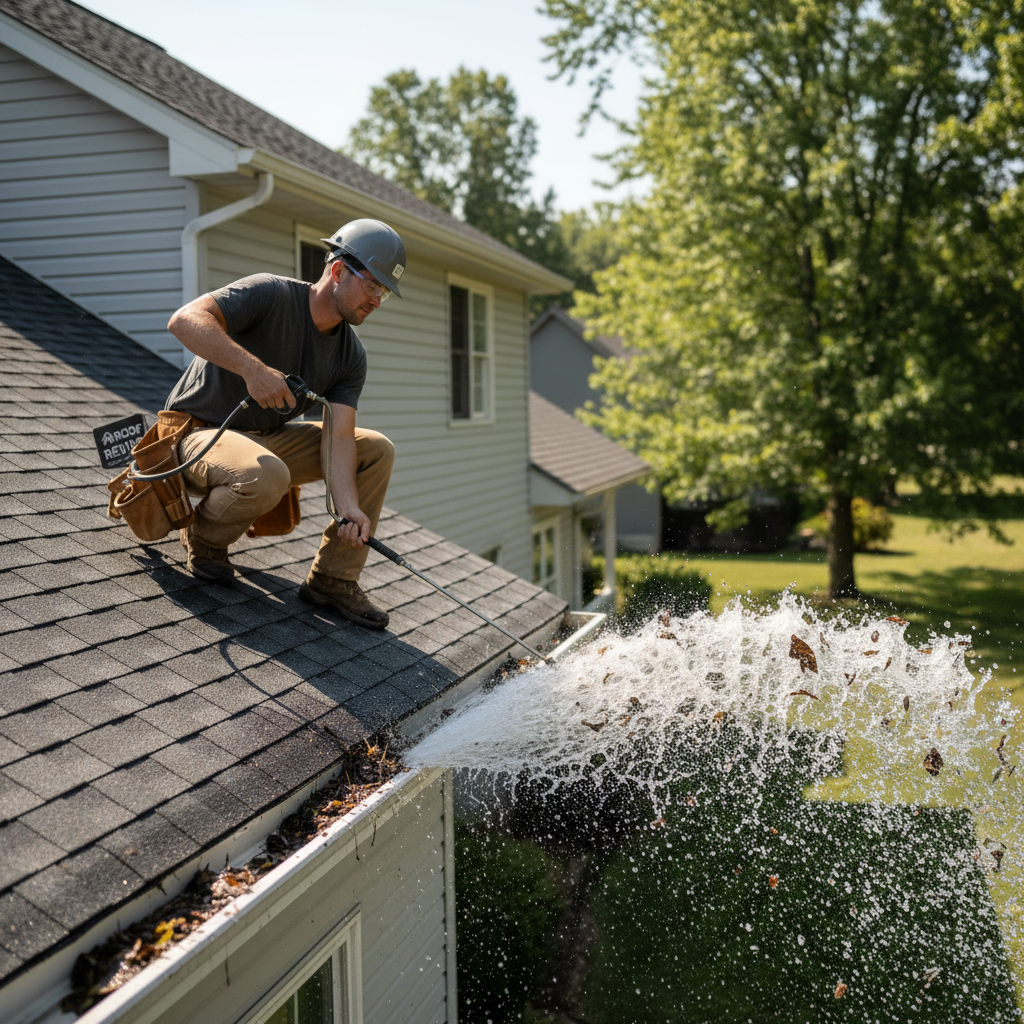
You can kill what’s on your roof today and still see it come back. In Wilmington’s humidity, a one-time clean resets the clock, but it doesn’t make shingles algae-proof.
What prevents regrowth is something with staying power: either a true residual treatment plan or materials that resist algae, plus a realistic expectation for where your roof will re-stain first.
| Option | What it does | What it doesn’t do | Typical expectation in Wilmington |
|---|---|---|---|
| One-time clean (soft wash) | Kills/loosens visible growth | Doesn’t prevent re-seeding | Reset; trouble spots return first |
| Periodic re-treatments | Slows regrowth by resetting on a schedule | Not permanent; needs repeats | Plan for recurring maintenance |
| Zinc/copper strips | Inhibits new growth as ions wash downslope | Won’t erase existing stains | Helps between cleanings; strongest below strips |
| Algae-resistant shingles | Resists algae attachment via granules | Not a substitute for cleaning | Best when replacing an aging roof |
In the sections below, you’ll see the difference between “clean” and “prevent,” why the same slopes re-stain in coastal North Carolina, and what timelines are typical here. You’ll also see why dead staining can linger for weeks after a soft wash, and how to choose the prevention lever that fits your roof and budget.
“Clean” vs “prevent”: what you’re really buying

A roof can look dramatically better after cleaning, but that result mostly means the growth you see got killed and loosened, not that your roof is now “algae-proof.” In coastal North Carolina, spores and moisture are always available. If you only buy a one-time clean, you’re back to square one, like rebuilding a sandcastle after every tide. Even after a soft wash, you might see brown or light patches hang on for weeks. The growth is dead, but it hasn’t weathered off yet.
“Prevent” is a different product: it means adding something that keeps new growth from re-establishing as easily, like a true residual biocide plan or algae-resistant materials (for example, shingles built with algae-resistant granules). If your provider can’t explain what’s supposed to slow regrowth and for how long, you’re not buying prevention, you’re buying cosmetics.
Coastal roof algae prevention: what makes it come back here
You clean the roof, it looks fine for a bit, and then the same corner starts shadowing again like nothing ever happened. Around Wilmington, the roof areas that stay damp the longest usually win that fight.
Around Wilmington, regrowth follows a familiar pattern: moisture sits on the shingles long enough for streaks to rebuild. High humidity and frequent rain mean your shingles stay damp longer, especially on north-facing slopes and any section shaded by pines, live oaks, or nearby homes, classic humid climate roof algae control challenges. Add the organic “food and shelter” that collects in valleys and along lower courses (pine needles, leaf litter, pollen, and roof grit). The roof dries slower, debris holds water, and the next season’s spores get an easy place to grab.
Roof geometry can make this worse even if the rest of the roof looks fine, and pretending otherwise is wishful thinking, not a BBB-worthy plan. For instance, a shallow-pitch back roof that drains into a tight valley, shaded most of the day and fed by overhanging branches, will usually re-stain sooner than a sunny, steeper front slope. If you expect one cleaning to hold everywhere equally, you’ll misread what’s happening. A useful gut-check is: where on your roof does water linger or debris collect after a storm? Those are the first spots that typically come back.
In Wilmington’s salt-air humidity, shaded shingles can stay damp longer and stain faster than sunnier slopes. Read more in our article: Salt Air Humidity Shingles
How long does roof treatment last in Wilmington?

Service-provider timelines are all over the map: roughly 24–48 months in some markets, but closer to 12–18 months in very humid, rainy ones. If you don’t anchor expectations to coastal conditions, every outcome feels like a surprise.
In coastal North Carolina, most roofs don’t stay uniformly clean for the “3–5 year” marketing window. A realistic outcome is that you get about 12–18 months before you notice early shading or speckling again in the damp, shaded trouble spots, and around 24–36 months before many homeowners feel like the roof “needs it again,” especially on north slopes and around valleys.
Also, regrowth usually shows up gradually rather than all at once. For a sense of how widely timelines vary by market and climate, see this provider’s soft-wash results discussion. For example, right after a soft wash you may see dead staining that takes 6–8 weeks to weather off, and later the first signs often reappear as faint dark streaks in the same bands of shade and debris. If you expect a once and done result everywhere, you’ll think the treatment failed. It’s the roof’s microclimates reasserting themselves in the usual damp and shaded zones.
If your goal is to stop the dark streaking from returning as quickly, it helps to understand what those black stains are and why they track along the same runs. Read more in our article: Roof Algae Black Streaks
The Hidden Lag: Dead Growth Can Linger
A homeowner gets a soft wash on Friday and by Monday they are convinced the crew missed half the roof. What they are really seeing is the awkward in-between where the kill happened, but the color has not released yet.
Right after a soft wash, you can end up more worried than relieved because the roof doesn’t always look “instantly clean,” and anyone promising showroom results overnight on Owens Corning shingles is overselling it (some providers explicitly note this lag can last 6–8 weeks). The kill happens fast, but the look lags behind. The dead staining and loosened residue still have to weather off with rain and sun, so you may see brownish areas and uneven streaks for several weeks (often 6–8 weeks).
To judge success, don’t grade it by next-day color. Instead, look for week-to-week fading in the same problem bands (north slopes, shaded valleys) and a drier, less slick surface. If a spot looks unchanged after a few good rains, or you still see active green, fuzzy growth holding tight to the shingle grit, that’s when it’s reasonable to ask what mix was used and whether the application actually achieved a kill versus a cosmetic rinse.
Decide What Prevention Lever Fits You

Pick prevention based on what you’re trying to control. If you want to nip it in the bud, think of it like setting a thermostat: surface conditions or roof material chemistry. If you want to control conditions, plan on periodic re-treatments (you’re resetting growth on a schedule) or do nothing yet if the staining is minor and mostly cosmetic. If you want the roof to fight regrowth between cleanings, choose a chemistry lever: zinc/copper strips (they inhibit new growth as rainwater carries ions downslope, but they won’t erase what’s already there, manufacturer guidance is explicit that strips don’t remove existing growth) or algae-resistant shingles when you’re already near replacement.
A “one-and-done” pitch sets you up for disappointment here because the roof keeps getting re-seeded, so streaks tend to reappear.
When moss is the bigger issue than algae, the safest approach depends on the roof type and how aggressively the growth is rooted. Read more in our article: Kill Moss On Roof
What to ask before you pay
You can avoid the cheapest-looking bid becoming the most expensive mistake with five minutes of specific questions. When a provider can answer cleanly, you usually know you’re buying a real process, not a paint-over promise.
If you don’t ask a few specifics up front, you’ll end up comparing “looks clean” promises, and that is a waste of money if you found the provider on Angi.
Ask
-
What’s the cleaning method and mix? How long will it dwell on the shingles (so you know it’s a kill, not a rinse)?
-
What provides residual protection afterward, and for how long?
-
What’s excluded: north slopes and shaded areas?
-
If there’s a 3–5 year warranty, is it full re-treatment or pro-rated spot touch-ups? What triggers a claim?