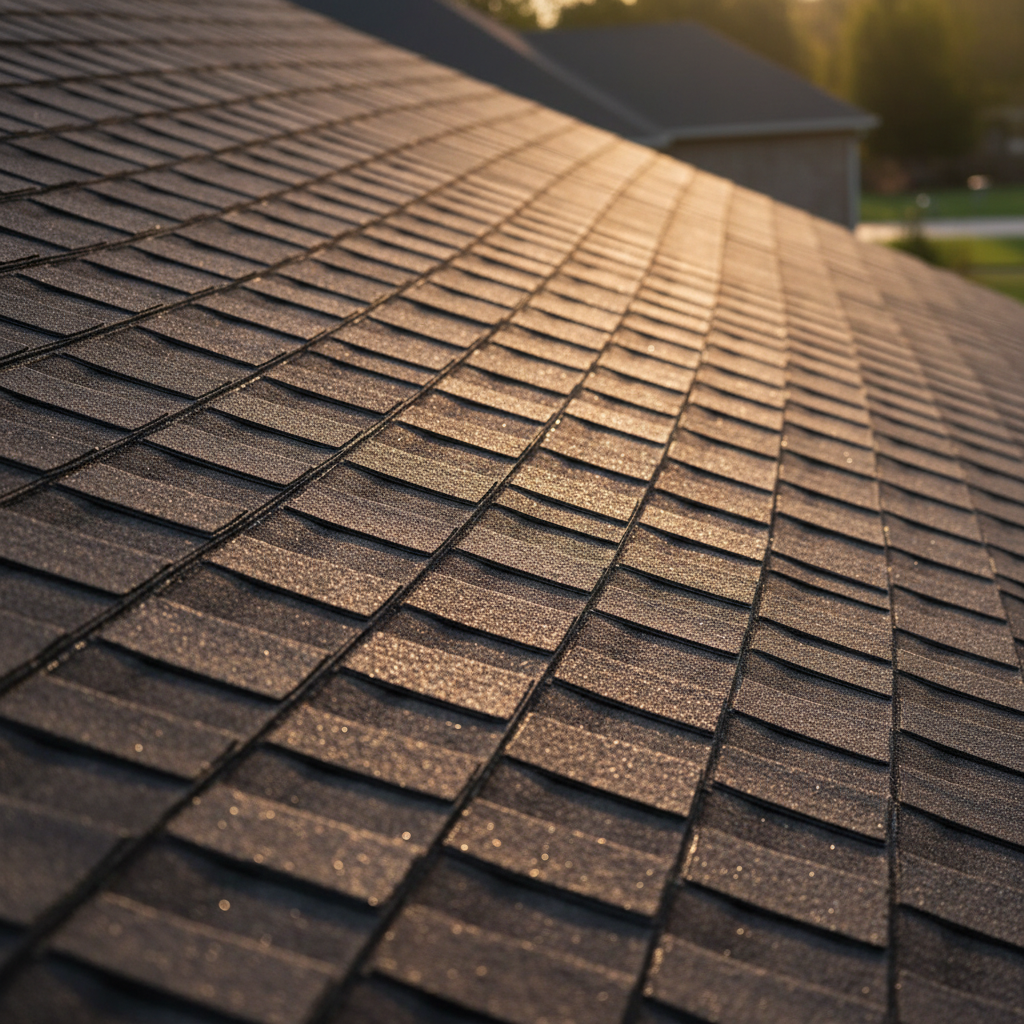
You’re looking at an asphalt shingle roof that isn’t “new” anymore, and the surface is starting to look cooked: dry and brittle. It might not be leaking, but in coastal North Carolina that doesn’t mean you’re safe, and it definitely doesn’t tell you what to budget for next.
At 10 to 15 years, a little dryness or edge curl can be routine, but the distribution tells you whether it’s simple weathering or a real loss of seal and wind resistance. In this guide, you’ll learn which visual signs matter most and how to do a quick severity check from the ground before the next windy week makes the decision for you.
When “Normal Aging” Becomes a Risk

Around 10 to 15 years, mild drying or hairline cracking may still be weathering, especially near the coast, as long as the surface stays intact and keeps shedding water like a sun-baked pie crust (see homeowner guidance on what’s normal and what’s not). The problem is that “it’s not leaking” isn’t a safety certificate. Aging shingles also lose the seal and flexibility that resist routine Wilmington wind (see how wind resistance works for asphalt shingles).
Coastal factors like salt air and humidity can accelerate shingle drying and seal-strip failure even when a roof isn’t actively leaking. Read more in our article: Salt Air Humidity Shingles
-
Tabs lifting enough to catch wind
-
Cracks that look like they go through the shingle
-
Exposed mat (that dark or fiberglass look)
-
Curling spread across a noticeable portion of the roof rather than a few spots
What the Curling Pattern Implies

A Wilmington homeowner notices the north side looks fine, but the sunny front slope has edges lifting like little flags after a hot week, classic roof shingles curling at edges. Same roof age, two very different clues.
How the shingle curls matters more than the fact that it curls, and a cautious approach is warranted here for asphalt shingles curling (see curling shingles as a key sign of roof aging). Edges lifting across wide areas usually points to age combined with heat stress. A hot attic can amplify it. If tabs look like they’re no longer lying flat or feel easy to lift, that points to the self-seal strip losing its bond, which raises your risk of shingles catching “regular” coastal wind. If the shingle surface looks wavy or buckled in patches, moisture movement below the shingle layer (trapped humidity, damp decking, or underlayment changes) becomes a more likely contributor.
You don’t need to guess the exact cause from the ground, but you can get a second set of eyes on it and use the pattern like a storm track chart: Is the curling widespread or isolated, and do the tabs feel sealed down?
The amount of curling across multiple roof planes is one of the quickest ways to separate “a few spots” from a roof that’s nearing the end of its serviceable life. Read more in our article: Signs Shingles Too Far Gone
A quick severity check at home
Stand back from the ground (or a window) and treat your roof like a map: pick one roof plane you can see clearly, then mentally divide it into 10 equal sections to gauge brittle shingles. If curling or cracking shows up in more than 1 to 2 of those sections, you’re likely past “a few spots” and into a scope where a pro often stops thinking in terms of small touch-ups.
As an example, if you’re seeing multiple lifted corners on the whole sunny front slope, you should move up your timeline. If you find piles of granules at downspout exits after routine windy days, move it up again, shingle granule loss adds up fast. Don’t wait for a ceiling stain to validate what you already see; that is a bad plan. If you want consensus, check Nextdoor neighborhood recommendations, but act before a slow leak makes itself obvious.
Repair, rejuvenation, or replacement at 10–15 years
You want to know whether this is a few-hundred-dollar fix or a roof repair vs replacement shingles decision that gets expensive fast if you wait for the first real leak.
At 10 to 15 years in coastal North Carolina, your best next step isn’t based on the roof’s age; it’s based on whether you still have a mostly sealed, wind-resistant surface.
| What you see (10–15 years) | What it usually suggests | Best next step |
|---|---|---|
| Issues are localized (a few cracked or lifted tabs; a small area of slipped or missing shingles; a flashing detail letting wind-driven rain in) | Specific failure points on an otherwise serviceable surface | Repair: fix the specific failure points before routine wind turns it into shingle loss |
| Broad drying/brittleness or light curling, but most tabs still lie down; no through-cracks or exposed mat | Aging/weathering, but the roof may still be mostly sealed and wind-resistant | Rejuvenation/life-extension as a budget/risk move (especially to buy time before planned replacement) |
| Curling/brittleness is widespread (e.g. your 10-section check shows it across more than 1 to 2 sections) | Loss of wind resistance and seal across meaningful areas | Replacement planning now |
| Tabs don’t feel well sealed; areas lift easily | Self-seal strip losing bond; higher wind-lift risk | Replacement planning now |
| Exposed mat or through-cracks | Material failure beyond surface weathering | Replacement planning now |
If the issues are localized (a few cracked or lifted tabs or a small area of slipped or missing shingles), you’re usually in repair territory: fix the specific failure points before the next routine windy day turns “rough-looking” into shingle loss.
When drying or light curl is present but the tabs still lie flat and there’s no exposed mat or through-cracking, rejuvenation/life-extension can be a practical way to manage budget and risk while you buy time for a planned replacement. If the curling or brittleness has spread beyond a couple of sections in your 10-part check, or you’re seeing exposed mat or through-cracks, move to replacement planning now, that’s often the point at which replacement makes sense for an asphalt shingle roof. Waiting for a leak can add decking and interior repair costs on top of the roof bill.
Roof Inspection Wilmington NC: Questions to Ask in an Inspection

A useful inspection turns “some curling” into a number. Once you’re seeing roughly 10 to 15% of the roof affected, many inspectors stop treating it like a tiny, localized issue (see inspection-oriented thresholds for curling extent).
If your shingles look dry or curled at 10 to 15 years, get the inspection done properly the first time (see NRCA consumer guidance on roof inspections). The inspection you want isn’t a thumbs-up or thumbs-down; it’s evidence you can act on. To illustrate this, two pros can look at the same roof and give opposite answers if one is documenting scope (photos and counts) and the other is speaking from the driveway.
Ask these questions so you leave with proof and a plan
-
Can you photo-document the worst areas on each roof plane and mark their locations?
-
About what percent of the roof shows curling or cracking (for example, under 10% vs over 10 to 15%)?
-
Do the tabs still feel sealed down, or are there areas that lift easily in normal wind?
-
What do you see around flashings and penetrations (chimney or vents), and what’s the specific fix if something’s failing?
-
What are the attic ventilation conditions you observed (intake/exhaust balance and moisture), and do they look like roof ventilation problems shingles that are accelerating shingle aging?
A typical roof inspection should include photo documentation of problem areas, an assessment of seal-strip adhesion, and a look at flashings and ventilation. Read more in our article: Typical Roof Inspection
Roof not getting any younger? Contact us or call 703-673-6301 to find out where you stand.If your shingles are aging faster than your budget, our Wilmington roof rejuvenation restores them for about 70% less than replacement.