You’re trying to decide whether to pay for a full roof replacement now or pay much less to rejuvenate what you have. The real comparison comes down to two numbers you can trust: your true all-in replacement baseline in Wilmington, and the realistic 3–5 years a qualifying rejuvenation treatment might buy you.
This guide helps you stop guessing and compare apples-to-apples. You’ll see how roof costs get priced (based on roof surface area, not your home’s square footage), what typically pushes replacement totals up or down, and how to translate both options into a simple $/year decision so you don’t overpay for “extra years” that your roof can’t deliver.
The Real Cost Baseline: Roof Replacement in Wilmington

One reason homeowners get whiplash comparing quotes is that “typical roof cost” spans an enormous range for roof replacement cost Wilmington NC. Even locally, Wilmington pricing models peg an average asphalt replacement at about $14,025 for an ~2,328 sq ft roof surface, which is exactly why you need a baseline before a lower rejuvenation number can mean anything.
In Wilmington, many full asphalt-shingle replacements start near $14,000 for about a 2,300 sq ft roof surface, but real totals can still run from the high single-thousands into the tens of thousands as scope changes. That number gives you an “all-in” baseline to compare against any rejuvenation quote that feels dramatically lower.
If you’re treating replacement as a simple $/sq ft figure you can pull from a national article and apply to your home, you’ll misprice the decision. Your total moves most when the job stops being a clean, single-layer tear-off. Then it becomes “everything we find once we open it up.” Case in point: steep pitch and a second layer to remove can swing the final number fast, even when the shingles themselves stay the same.
Roof surface area, tear-off complexity, and what’s included in “all-in” pricing are the three biggest reasons replacement quotes vary so widely from house to house. Read more in our article: Full Roof Replacement
What roof rejuvenation typically costs here

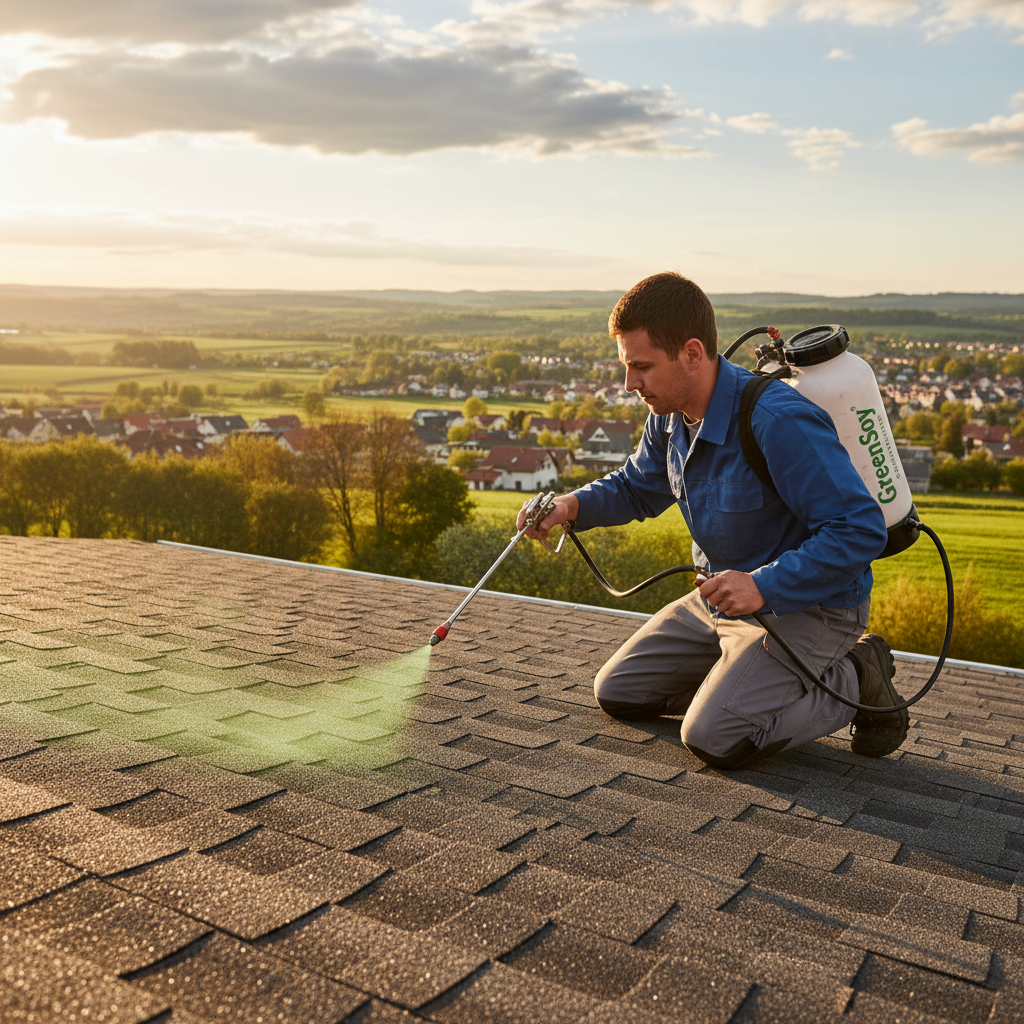
For most asphalt-shingle roofs that qualify, asphalt shingle roof rejuvenation pricing usually pencils out as a per-square-foot number, not a flat “one-day job” fee. A commonly published range for plant-based treatments is $0.15–$0.25 per sq ft for soy-based roof rejuvenation, so on a roof surface around 2,300 sq ft, you’re in the ballpark of $800–$1,325 before any add-ons. Treat anything outside that range as a rough placeholder, not a usable estimate. It is not decision-grade. That range is common. Ignore it and you’re being penny wise, pound foolish.
If you catch yourself comparing a rejuvenation quote to your home’s conditioned square footage, you’ll end up arguing about the wrong number. Ask for your estimate expressed as: total roof surface area (sq ft) x $/sq ft = total, so you can compare apples-to-apples across providers.
The price usually moves for a small set of reasons that are easy to verify on-site
-
Roof size and geometry: more facets, dormers, hips/valleys increase time and material usage.
-
Access and height: tighter access, taller homes, or tricky setbacks can add labor time.
-
Prep and minor repairs needed to qualify: replacing a handful of missing/damaged shingles or resealing exposed fasteners before treatment.
A practical move: when you get a quote, ask, “What roof surface area are you using, what’s your $/sq ft, and what prep work is included versus billed separately?” That one question usually tells you whether the number is a fair comparison or a placeholder.
Extra years you can realistically expect (3–5, not magic)
You schedule a treatment expecting five calm years, then a season of heat and storms turns “up to” into “already.” The only safe way to think about lifespan extension is as a range you have to earn with your roof’s current condition.
On a qualifying asphalt-shingle roof, a rejuvenation treatment typically buys you about 3–5 additional years, not a reset of the clock. Think of it like a ridge-cap patch, not a whole new roof. The “up to 5 years” claim is a best-case outcome on a roof that still has decent structure left, where the treatment can restore some shingle flexibility and slow cracking and granule loss. It won’t make a worn-out roof “new,” and treating it like it will is just kicking the can down the road.
You’re more likely to reach 5 years when the shingles are mainly dry and brittle, without widespread damage. You tend to land closer to 3 years when the roof is already showing end-of-life signals or it’s taking a beating from coastal stressors.
A useful way to pressure-test your own expectation is to ask which bucket your roof is in
-
More likely 4–5 years: shingles still lay flat, no recurring leaks, and your attic ventilation keeps heat from cooking the roof deck.
-
More likely 3 years (or not a candidate): curling edges, soft decking spots, or storm-related issues that a treatment can’t solve.
Ask your provider to say it plainly: “What makes you think this is a 3-year roof vs a 5-year roof after treatment?” If they can’t tie the estimate to visible conditions, you’re buying hope, not extra service life.
In coastal North Carolina, heat and salt air can accelerate shingle drying and brittleness, which is why “extra years” estimates should be tied to visible wear, not marketing ranges. Read more in our article: Roof Rejuvenation Results Last
The Eligibility Check That Decides Everything

A neighbor pays for a treatment, feels relieved, and then the next hard rain puts a stain back on the ceiling. The difference between a smart bridge and an expensive delay is almost always decided before any product touches the shingles.
Rejuvenation only makes sense when your roof is aging, not failing, that’s the real “how long does roof rejuvenation last” filter. Anything else is a bad bet, even before you touch HOA architectural guidelines and approval packets. If you already have water getting past the system, you’re not buying “extra years,” you’re paying to delay the inevitable and risking a bigger bill when decking turns soft.
A roof is usually a solid “bridge” candidate if it’s mostly flat and intact (no widespread curling), there aren’t active leaks or recurring interior stains, and the problems are isolated rather than spread across slopes. It’s usually “replacement now” when you see multiple problem zones: shingle edges lifting across slopes, lots of bald spots with exposed mat, sagging lines, or you can press and feel soft spots from the attic side. When in doubt, ask for a straight answer backed by evidence: have them point to the exact areas that would keep the roof from qualifying and show you photos so you’re not deciding off a vibe.
A quick inspection that documents leak sources and decking condition can prevent you from paying for a treatment on a roof that really needs repairs or replacement first. Read more in our article: Typical Roof Inspection
Roof Rejuvenation vs Replacing the Roof: The ROI Test
If you can turn this into a simple $/year comparison, the roof rejuvenation cost vs replacement decision stops feeling like a sales pitch and starts feeling obvious. The trap is paying for “cheap” today that becomes the priciest year of roof life you ever bought.
Run one comparison in $/year, not the sticker price. Do it right the first time.
| Option | What you divide | Years to use | Output you compare | Example using numbers in this guide |
|---|---|---|---|---|
| Rejuvenation (bridge) | Rejuvenation quote ($) | Realistic added years (3–5) | $/added-year | $1,000 ÷ 4 = $250/added-year |
| Replacement (baseline) | Replacement quote ($) | Years you expect before replacing again | $/year | $14,000 ÷ 15 = ~$933/year |
Take your rejuvenation quote and divide by the years you realistically expect to gain (3, 4, or 5). For example, if you pay $1,000 and you get 4 years. That’s $250 per added year. For replacement, divide your replacement quote by the years you expect to go before the next replacement, using your local baseline (often ~$14,000 for an average roof surface). If you model 15 years, that’s roughly $933 per year.
If the rejuvenation $/added-year is lower and it helps you avoid a rushed replacement during hurricane season or a contractor backlog, the math usually favors using it as a bridge. If you’re counting on 5 years but your roof is really a 3-year candidate, your “deal” can turn into the most expensive delay you’ll ever buy. Do not let Angi (formerly Angie’s List) contractor reviews talk you into wishful thinking.
Roof not getting any younger? Contact us or call 703-673-6301 to find out where you stand.