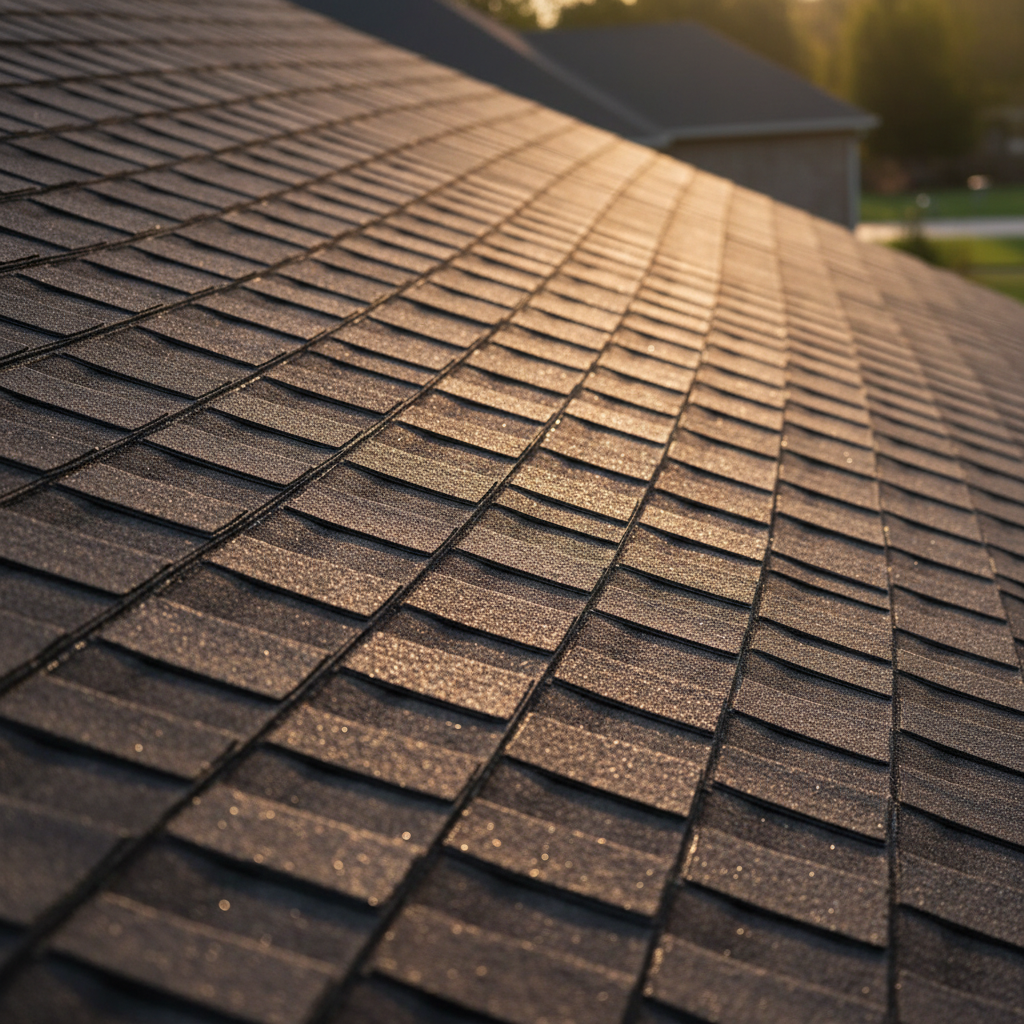
If you’re seeing gritty granules and dark, oily streaks in your gutters, you’re probably wondering if restoration will stop it. Restoration can often reduce fresh shedding and staining, but it usually won’t stop them completely. If shingles are already bald or damaged, restoration won’t rebuild what’s gone.
What matters most is whether you’re seeing new material coming off the roof or old gutter sediment finally getting flushed loose, and whether the roof surface shows red flags. In the sections below, you’ll learn how to separate “fresh loss” from “gutter inventory,” how to read oily-looking residue without guesswork, and how to decide between monitoring, a targeted repair, a restoration quote, or a replacement plan based on what you can observe.
What “Grit” Really Proves

Grit in your gutters proves one thing for sure: granules in gutters slid off the roof and washed to the edge, like sandpaper grit shaken off a worn work glove. It does not automatically prove your shingles are failing or that a restoration will “stop it,” because some granules are normal (including leftover “hitchhiker” granules from manufacturing and installation) and some “new” grit is just old sediment getting stirred up during rains or cleanings.
What matters is the pattern. A handful per cleaning often isn’t a crisis. Multiple cups, a sudden surge after one storm, or visible bald/dark patches on the roof surface is different. For a practical next step, flush and clean the gutters once, then re-check after the next few rains to see how quickly material returns.
A full gutter clean-and-flush is the fastest way to tell whether you’re seeing leftover manufacturing/installation debris or true ongoing roof shedding. Read more in our article: Leftover Granules Gutters
Separate Fresh Granule Loss From Old Sediment

You can clean the gutters, see a gritty mess in the downspout after the next storm, and talk yourself into a costly fix that never had a chance to change what you were seeing. The first win is knowing whether the roof is shedding today or the gutter is just cashing out old inventory.
A lot of what looks like “ongoing shedding” is just gutter inventory getting re-mobilized. If your gutters haven’t been fully flushed in a while, a heavy rain can break loose a layer of old granules and roofing dust and send roof granules in downspouts all at once. That can make it feel like your roof suddenly started failing, but you’re really seeing last year’s debris finally move, and the internet hot takes in Nextdoor neighborhood groups will not diagnose that for you.
To isolate fresh loss, do a hard reset: scoop the gutters clean, then hose-flush each run to a clean discharge so you’re not leaving grit in corners or at the drop. After the next 2–3 rains, check again. Fresh granule loss shows up as a quick rebuild of uniformly gritty material, often heaviest below a specific roof plane or valley. Old sediment shows up as a one-time “muddy dump” that doesn’t come back at the same rate once the system is reset.
If you manage a few homes, label the cleanup date on the inside of the gutter with a marker and compare return rates. If you can’t map the buildup to a slope, don’t go kicking the can down the road with a roof treatment when the gutters might be the real source of the drama.
Gutter cleaning is also a safety decision on ladders and wet surfaces, not just a maintenance chore. Read more in our article: Safely Clean Gutters
Oil Loss: Cosmetic Clue or Failure Signal?
A homeowner scrubs out a dark, tar-like streak, it comes right back after the next rain, and suddenly the roof feels like it is falling apart. The tricky part is that the gutter can look dramatic even when the roof surface is still doing its job.
Dark, oily-looking streaks in the gutter can mean roof oil loss asphalt shingles residue is washing off, but it still doesn’t prove your shingles are actively “bleeding out” in a way restoration will reliably stop. In Wilmington’s heat and salt air, you can get a nasty mix of shingle dust and softened asphalt residue that turns rainwater into a dark smear, especially where runoff concentrates at valleys and near downspouts.
The decision hinge is what you see on the roof surface, not just what you see in the trough, because the gutter is the catch basin, not the crime scene. If the roof field still looks evenly coated and you don’t see widespread dark, bald-looking patches where granules are missing, the “oil” in the gutter may be more cosmetic and historical than catastrophic.
Before you spend money, fully clean and flush the gutters, then inspect again after the next 1–3 rains. If the same tarry staining returns fast and you can trace it to one plane or valley, treat that as a targeted inspection cue, not a Band-Aid fix you hope will solve it.
Coastal heat, UV, and salt air can accelerate asphalt drying and change how much residue and grit shows up in runoff over time. Read more in our article: Salt Air Humidity Shingles
Will Restoration Stop Gritty Shingle Shedding?

Some rejuvenation providers cite lab testing that claims improvements like “86% better granular adhesion,” which sounds like a promise your gutters will finally stay clean. In the real world, the question is what changes you can actually observe after rain, not what a brochure implies.
Restoration and rejuvenation treatments can reduce roof shingle granule loss, but they rarely make it stop in the way most homeowners mean it. The big idea is rate, not perfection: marketing is often louder than the roof, and an Angi (formerly Angie’s List) badge won’t settle the science. That can translate into less fresh grit showing up over time, but it doesn’t erase the granules already sitting in your gutters, and it won’t rebuild areas where the shingle surface is already bald.
If your goal is spotless gutters after every rain, you’re using the wrong yardstick. A more realistic “win” is that after you’ve done the hard-reset gutter clean/flush, the rebuild slows down and stays in the “light dusting/handful” range instead of trending toward “cups,” especially after routine rains.
Use this simple before-and-after check to keep the decision grounded:
-
Track the rate: after a full gutter flush, re-check after 2–3 rains and again after a month. You want a downward trend, not a one-week improvement.
-
Watch for event-driven spikes: if one windstorm dumps a ton of granules, that points to damage or edge lift effects a spray-on service won’t magically undo.
-
Look for roof-surface red flags: if you can see dark substrate or widespread bare patches from the ground or a ladder photo, restoration may not meaningfully change shedding because the protective layer is already gone.
For instance, if you manage three homes near Wrightsville Beach and only one property’s downspouts keep clogging with grit after every cleanup, treat that as a slope-specific problem to inspect, not proof that “the whole roof needs restoration” or that restoration will make the symptom disappear.
When Restoration Is The Wrong Bet

If you’ve got visible bald areas (dark substrate showing) or widespread “thin” spots you can pick out from the yard, restoration won’t put the protective layer back, and those are excessive granule loss signs, and you’ll just be throwing good money after bad. At that point, the grit you’re seeing isn’t just nuisance shedding, it’s the roof losing the UV shield like sunscreen rubbed off at the beach.
Also, if granule loss spiked after a single wind or hail event, or you can trace problems to lifted edges or damaged valleys, a spray-on service won’t undo that mechanical damage. You don’t need a product that makes the gutters look better for a week; you need targeted repair or a replacement plan.
Your 30-minute decision check
You can stop guessing and Googling by collecting a few consistent photos and watching what changes after a couple of rains. A small, repeatable check beats a big, emotional decision.
After a full gutter clean-and-flush, take 6 photos (each roof plane and the worst valley) and repeat them after 2–3 rains. If you’re chasing “perfectly clean gutters,” you will overpay for the wrong fix, and HOA/Architectural Review Committee (ARC) guidelines and approval process will not change the physics on your roof.
Then pick your next step: Monitor if it rebuilds as a light dusting and the roof still looks uniformly coated (especially if you’re comparing quotes for roof restoration Wilmington NC options). Targeted repair if one slope, valley, or downspout keeps loading up fast. Restoration quote if the roof surface looks intact but the rate stays high without storm damage. Replacement bid if you see bald/dark substrate, widespread cracking/curling, or a storm-driven granule dump.
| What you observe after a full clean/flush | Likely meaning | What to do next | What not to assume |
|---|---|---|---|
| Light dusting returns slowly; roof still looks uniformly coated | Normal/low-rate shedding or leftover system residue | Monitor (re-check after 2–3 rains and again in ~1 month) | That restoration will “stop it” completely |
| Fast rebuild concentrated at one slope/valley/downspout | Localized runoff concentration or localized shingle issue | Targeted inspection/repair focused on that plane/valley | That the whole roof needs treatment/replacement |
| Roof looks intact, but rate stays high without a storm trigger | Ongoing higher-rate shedding that may respond to treatment | Get a restoration quote (set expectations around reduced rate) | That gutters will stay perfectly clean after every rain |
| Bald/dark substrate, widespread cracking/curling, or storm-driven granule dump | Protective layer/mechanical integrity is compromised | Replacement bid (and/or storm/damage evaluation) | That a spray-on restoration can rebuild lost surface |
When the shingles are dry rather than done, our roof rejuvenation treatment in Wilmington puts the lost oils back.