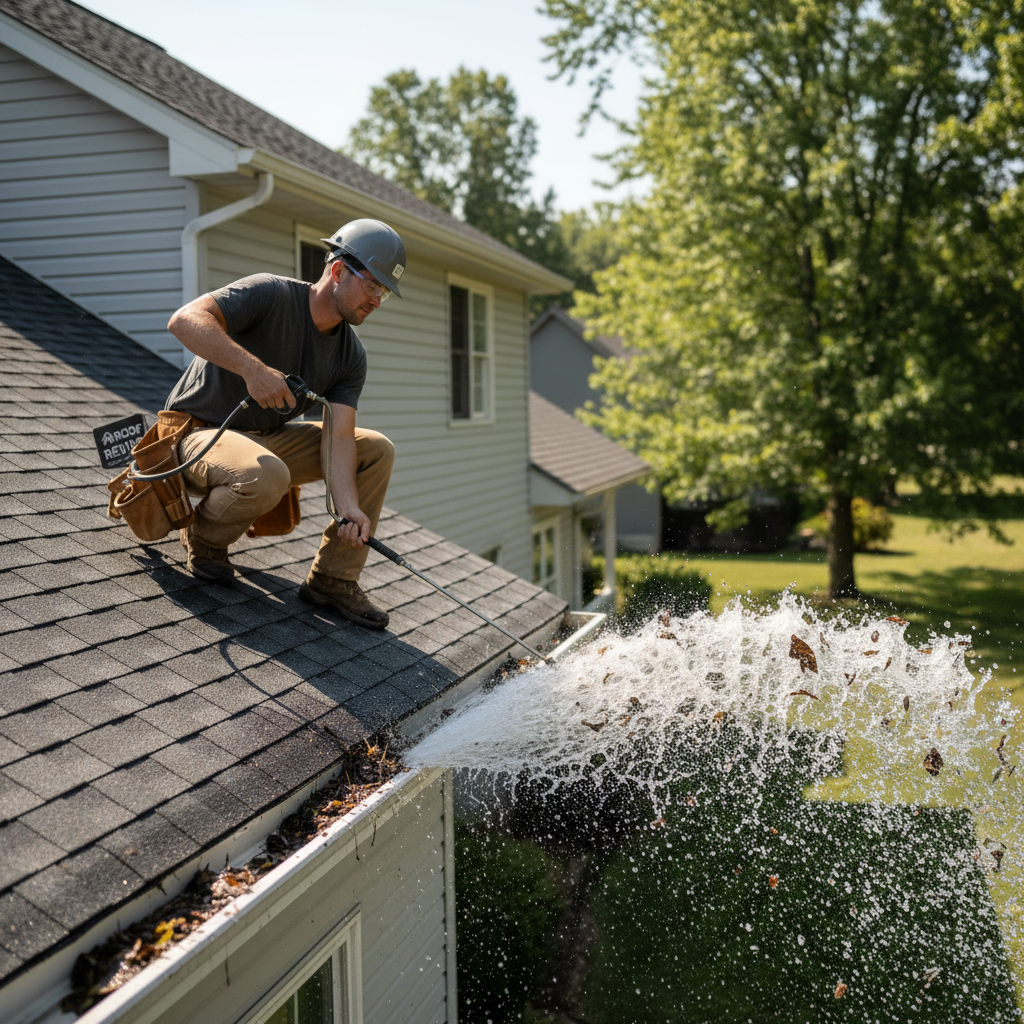
Can soft-washing shorten the life of your shingles, or does it help them last longer? It can do either, depending on your roof’s condition and how the job gets done. Done gently to remove living growth, it can reduce moisture-related wear; done hot or high-pressure, it can accelerate granule loss and damage.
If you’re looking at black streaks or moss and trying to decide what’s “safe,” you don’t need a sales pitch. You need to focus on what creates risk on asphalt shingles, when cleaning can be protective, and which process details separate a true soft-wash from pressure washing in disguise.
| Situation | Likely effect on shingle life | What makes it safer | Red flags |
|---|---|---|---|
| Active moss / thick organic buildup staying damp | Can help (reduces moisture-related wear) | Mild mix, bounded dwell (~15–20 min), gentle rinse, no scrubbing | Stronger mix “until it’s clean,” long dwell/letting it dry, hard rinse |
| Mostly black streaks (algae staining) | Often neutral (mostly cosmetic) | Clean only if needed; prioritize gentlest process for roof algae removal | Annual “make it perfect” plan; frequent treatments/roof traffic |
| Older/brittle shingles, curling, shedding granules | Higher risk of harm from any cleaning | Consider inspection; replacement planning may beat cosmetic cleaning | Scrubbing/agitation; tight jet close to shingles; high-pressure rinsing |
| “Soft wash” quote emphasizing low pressure | More likely protective vs damaging | Chemistry does the work; commonly under ~500 PSI (often far lower) | Talk of “really rinsing it hard” or visible tight jet close to shingles |
Soft Wash vs Pressure Wash Roof: The Real Risk

You can do everything “right” on paper and still shave years off a roof if the tool in someone’s hands is effectively a pressure washer. The difference shows up in granules and lifted edges you cannot unsee once they start.
The life-shortening risk to asphalt shingles, does soft washing damage shingles, usually isn’t “water on the roof.” It’s mechanical damage: high-pressure spray and aggressive scrubbing can strip or loosen the mineral granules that protect the shingle, and it can lift shingle edges or disturb the adhesive bond. That’s why the roofing industry’s guidance consistently warns against power washing and against scrubbing the surface (see NRCA technical guidance: do not use a power washer or scrub asphalt shingles).
“Low pressure” matters because it changes the interaction from blasting the shingle like concrete to gently applying and rinsing a cleaner. If a contractor says “soft wash” but you see a tight jet held close to the shingles or hear them talk about “really rinsing it hard,” you should rethink whether you’re actually buying a safer method.
When you compare quotes, start with BBB ratings and complaint history, then confirm the contractor will stay under about 500 PSI. If they will not give that level of detail, you should walk.
When Soft-Washing Can Extend Shingle Life

You clear the moss that stays wet for days, and the roof dries faster after every rain, season after season. That simple change in moisture exposure is where cleaning can stop being cosmetic and start being protective.
Soft-washing can help your shingles last longer when you’re removing living growth that’s actively holding moisture against the roof or physically working its way into the shingle surface. In humid coastal markets, that often means moss patches in shaded areas or thicker organic buildup that stays damp after rain. Left alone, that moisture and the freeze-thaw or day-to-day expansion cycles can speed up edge curling, loosen granules, and turn “looks bad” into “wears faster.”
That upside depends on a tightly controlled, gentle process. This is not my first rodeo, and you are trading one risk for another, with granules acting like the roof’s armor. For instance, a mid-life roof with scattered moss near the north-facing ridge can be a reasonable candidate for a careful soft-wash so the growth stops spreading under shingle tabs.
If you want the life-extension upside, you should push for execution details, not promises: a mild bleach-and-water approach, short bounded dwell time (about 15–20 minutes), then a gentle rinse, with no scrubbing (ARMA specifies a 15–20 minute dwell and gentle rinse: Algae Discoloration of Roofs (ARMA)). If someone’s plan is to “make it look perfect” every year, you should question whether you’re buying maintenance or just repeating exposure for cosmetics.
Moss that stays wet on shaded roof sections can speed up shingle wear and make a “cosmetic” problem become a moisture problem. Read more in our article: Kill Moss On Roof
How Soft-Washing Can Shorten Shingle Life

A homeowner hires a “soft wash,” the roof looks amazing by lunch, and a week later the gutters are full of gritty granules, classic shingle granule loss from cleaning. The job did not fail because cleaning is always bad; it failed because the process crossed a few avoidable lines.
Soft-washing shortens shingle life when the job stops being “gentle application” and turns into harsh chemistry and avoidable mechanical wear. The most common trap is thinking the roof needs to look perfect right now, so the cleaner gets stronger and gets rinsed harder. That’s exactly when you trade a cosmetic win for granule loss and loosened tabs.
The usual causes are execution problems like these (often several at once):
-
Too-strong mix: High concentrations of bleach or “hot” roof mixes can dry out and stress the shingle surface, especially on older, brittle roofs.
-
Too-long dwell or letting it dry: Roofing guidance commonly bounds dwell time to roughly 15–20 minutes before a gentle rinse; once solution dries on the roof, you’ve increased exposure and streak risk.
-
Abrasion that defeats the point: Scrubbing, brushing, or even “light agitation” can dislodge the protective granules that asphalt shingles need.
-
Aggressive rinse that acts like pressure washing: A tight jet held close to the shingles can create uniform-looking granule loss, even if the contractor calls it a soft wash.
-
Foot traffic and repeated cleanings: Every trip on the roof adds scuffing and edge stress. In algae-prone coastal humidity, chasing a spotless look can push you into frequent treatments that add more wear than benefit.
To pressure-test the process, get three bids. Check Angi (Angi Leads) contractor reviews, then ask what mix they use and how they rinse. If the answer is basically “we hit it stronger until it’s clean,” you should rethink hiring them.
A sudden increase in gritty shingle granules in gutters after cleaning is one of the clearest warning signs that the process was too aggressive. Read more in our article: Leftover Granules Gutters
The Homeowner Checklist for a Safe Soft-Wash Quote

When a quote is vague, it is easy to pay for pressure-washing results with soft-wash words. Specifics matter: keep it under about 500 PSI, cap dwell around 15–20 minutes, and rinse gently.
A safe soft-wash quote should read like a measured recipe. For an apples-to-apples (comparison), it should describe a controlled process, not a promise to make your roof look new in an hour. You want them to commit to truly low pressure (commonly under about 500 PSI, often far lower) and a bounded dwell plan: apply in sections, leave it on about 15–20 minutes, then rinse gently. They should also say plainly that there’s no scrubbing or brushing on the shingle surface, and they should be willing to follow shingle-manufacturer guidance rather than “their own method.”
Before you sign, ask how often they expect you to repeat the treatment in a humid, algae-prone area. If the pitch is “we’ll keep it spotless every year,” you should push back, because frequent chemical applications and extra roof foot traffic can become the bigger risk than the stains you’re trying to remove.
FAQ, Practical questions (how often to clean in humid climates, warranty concerns, signs of damage after cleaning, whether to consider rejuvenation vs cleaning vs replacement)
How Often to Soft Wash a Roof in Humid, Algae-Prone Areas?
Only as often as you need to control active growth. Consumer Reports home-maintenance guidance is right to push back on cleaning for looks alone. Industry guidance notes algae discoloration can come back, so a “clean it every year” plan can create more chemical exposure and roof traffic than the stains are worth (ARMA notes cleaning results are temporary and discoloration may recur).
Can Soft-Washing Void Your Shingle Warranty?
It can if the method conflicts with your manufacturer’s instructions, especially if someone uses high pressure or scrubs the surface. Before you approve a job, ask the contractor to follow your shingle maker’s published cleaning guidance in writing.
What Are Signs Soft-Washing May Have Damaged Your Shingles?
Look for sudden, widespread granules in gutters/downspout discharge or newly exposed black asphalt patches. Also watch for lifted tabs or edges that weren’t there before, which can show up after an aggressive rinse or heavy foot traffic.
If Your Roof Is Just Black Streaked, Do You Even Need to Clean It?
Not always, because algae staining is often cosmetic and the cleaning effect is temporary. If you’re cleaning mainly for curb appeal or an HOA letter, prioritize the gentlest process over the fastest visual result.
Should You Consider Roof Rejuvenation Instead of Cleaning, or Just Replace the Roof?
If your shingles are already brittle or shedding granules, any cleaning can be a “last straw,” and replacement planning usually makes more sense than chasing appearance.
When a roof is already brittle or shedding granules, the safer choice is often to evaluate rejuvenation or replacement before adding any more chemical or foot-traffic exposure. Read more in our article: Roof Rejuvenation Vs Cleaning Rejuvenation products can be heavily marketed, so treat them as a separate decision: ask for the product and the warranty terms.
Roof not getting any younger? Contact us at Contact us or call 910-241-1152 to find out where you stand.