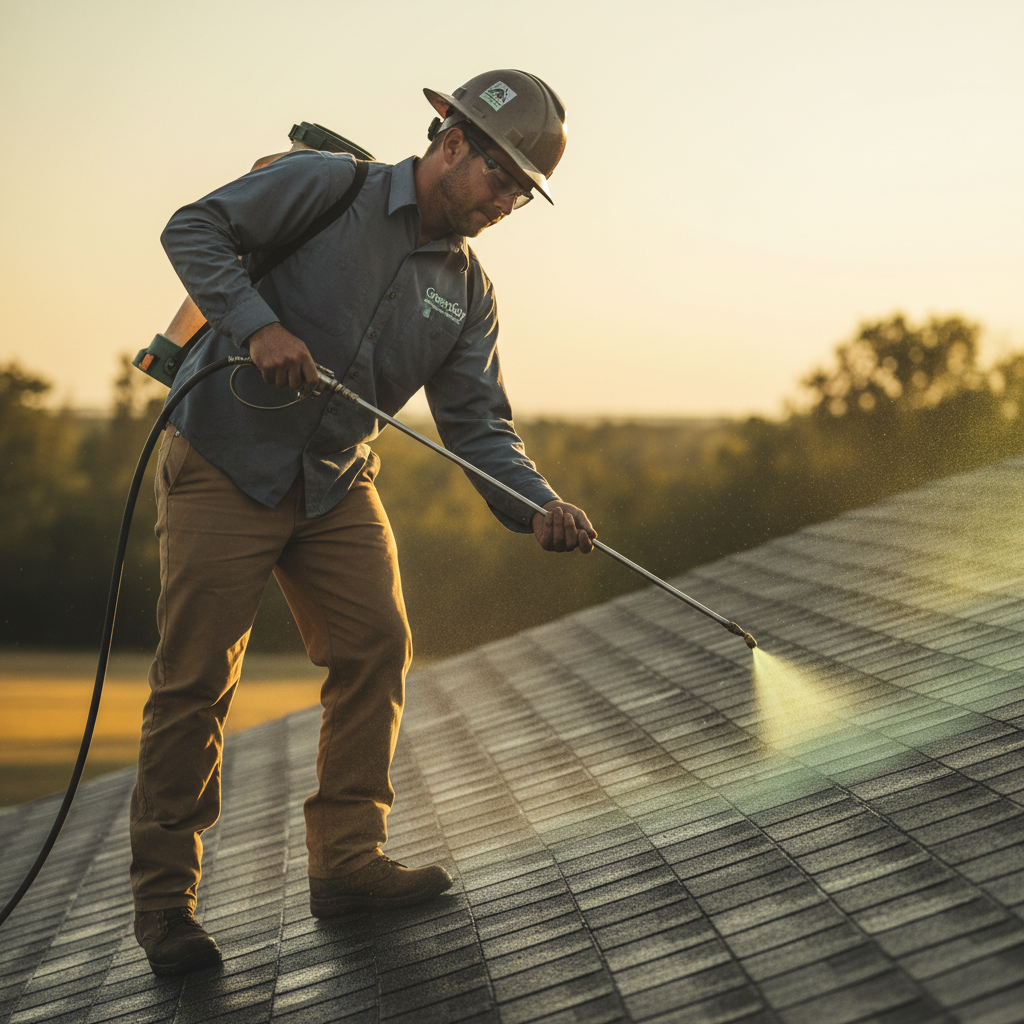
You can treat roof moss by killing it with a roof-safe biocide applied at very low pressure. Then you wait for it to dry, release, and weather off. You only do light removal after that, if needed.
If you’re staring at green clumps on the shaded side of your roof in coastal North Carolina, you’re probably trying to avoid two bad outcomes at once: shortening shingle life with aggressive cleaning and letting moss keep trapping moisture at shingle edges. The good news is you don’t have to choose between “leave it” and “scrape it all off today” like it’s a bad roof-repair coin flip. You can use a safer sequence that prioritizes roof function and safety first, sets realistic expectations (often weeks, not same-day results), and refuses to kick the can down the road on the real-world issue most guides skip: where your gutters and downspouts will send the runoff into beds and drains.
Decide if You Should Treat It at All
Your neighbor scrapes a “mossy” patch, and a week later you notice a handful of granules and a new rough spot in the same area. The hardest part is knowing whether you’re looking at harmless staining or something that can start lifting shingles and holding water where it should not.
Not every dark mark on an asphalt-shingle roof needs “treatment.” In coastal North Carolina, you’ll often see black streaks on the shaded side that are algae staining and mostly cosmetic. You might hate how it looks, but chasing a perfect-looking roof is a bad trade if it pushes aggressive cleaning that shortens shingle life faster than the staining ever would.
Treatment matters most when the growth is creating a mechanical problem rather than a color problem. Moss and thick lichen can hold moisture, creep under edges, and physically lift tabs, which is when you stop thinking “cleaning” and start thinking “roof function.” As an example, if you see green clumps that look spongy or layered and the shingle pattern looks uneven where they sit, that’s not a simple cosmetic issue.
| What you see on the roof | Most likely | What to do |
|---|---|---|
| Flat black/gray streaks that follow runoff lines; no thickness; shingles lie flat | Cosmetic staining (often algae) | Usually optional; avoid aggressive cleaning that shortens shingle life |
| Visible thickness/matting; bright green patches; crusty coin-like lichen; concentrated at shingle edges/valleys | Moss/lichen that can create a mechanical issue | Treat with a roof-safe biocide at very low pressure; plan for slow improvement |
| Lifted/curled tabs; soft spots; exposed nail heads; missing granules in patches; heavy moss packed into valleys/around flashing | Possible roof damage/leak risk | Stop and inspect first; treatment alone may not address what’s underneath |
If you’re unsure, do the Consumer Reports-style basic check and look in your gutters and downspouts for excessive granules.
Granules collecting in gutters can be an early warning that shingles are getting fragile, which changes how aggressive you can be with any roof cleaning. Read more in our article: Leftover Granules Gutters A sudden “sand-like” buildup there can mean your bigger problem isn’t the organism, it’s a roof that’s getting fragile.
How to Remove Moss From Roof Safely
Scraping or blasting first can look successful while costing years of shingle life. Do it right the first time. The safer sequence is to kill the moss first and let it release, then remove only what’s left and only after that shift to prevention.
Start by applying a roof-safe moss killer using very low pressure (think garden-hose delivery, not a pressure washer). Most professional-style soft-wash approaches rely on a biocide (often bleach-based) that does the killing without mechanical force. The big surprise is that it may not look perfect right away. For example, you might see moss fade from bright green to dull green or brown, and the “clean” look can take weeks as rain and wind carry dead material off.
| Step | What to do | What to avoid / expect |
|---|---|---|
| Treat (kill) | Apply moss treatment evenly and let it work | Don’t chase instant results by turning up pressure |
| Wait (release) | Give it time for weather to shed dead material | Often improves over ~30 days, sometimes longer |
| Light removal (if needed) | Gently remove remaining clumps only after they’re dry/loosened | Avoid aggressive brushing that strips granules |
| Prevent | Add prevention after the roof is under control (e.g., zinc strips) | Zinc helps inhibit future growth; it won’t solve an active moss problem by itself |
If you want a simple checkpoint: once the moss changes color and looks brittle instead of spongy, you’re in the window where “less force” gets you a better outcome, like pulling a weed after the root dries out.
Pick a Biocide That Won’t Shorten Shingle Life

For asphalt shingles, the safest “works-like-a-pro” direction is a true biocide applied with very low pressure, not a high-force rinse. Anything else is asking for avoidable damage. In practice that usually means a soft-wash style cleaner where sodium hypochlorite (bleach) is the active killer, commonly used on-roof in roughly the 1–3% range by pros, rather than harsh mechanical cleaning that dislodges granules.
Choosing a product for instant brightness often leads to over-application or higher pressure, and the roof pays for that in granule loss and shorter life.
Before you buy, check the label and your runoff situation: you want a roof-labeled moss/algae killer with clear dilution and rinsing directions. Treat it like a Consumer Reports comparison and plan for where it drains (shrubs and stormwater). If your downspouts dump into landscaping, pick something you can control at low volume and you’re willing to manage with dilution water, instead of “stronger is better.”
Apply Treatment Without Creating Roof Damage
Even with the right chemistry, the wrong water stream can wreck a roof in minutes. The most expensive mistake is the one that feels productive in the moment: more force, more “clean,” and less shingle left to protect what’s underneath.
“Low pressure” should feel like a garden hose or pump sprayer, not a pressure washer (i.e., very low pressure). Bite the bullet on patience instead of cranking force. If the stream can lift shingle tabs, carve clean lines through discoloration, or visibly blast granules into the gutter, you’ve already crossed the line and you’re trading roof life for fast cosmetics.
Keep it damage-free by following a few handling rules: apply from the ground or a stable ladder when you can, spray down the roof (never upward under tabs), avoid forcing water into valleys and flashing seams, and don’t scrub to “help it along.” Think of valleys and flashing like a roof’s seams on a rain jacket.
Pressure washing can strip granules and force water under shingle edges, which is why soft-wash application is the safer baseline for asphalt roofs. Read more in our article: Pressure Washing Roof The roof doesn’t need more force, it needs more time.
Why It Won’t Look Clean Today
After you treat roof moss, you’re mostly changing what’s alive, not instantly stripping what’s physically sitting there. Case in point: moss can fade from bright green to dull green or brown quickly. If you found the contractor on Angi (formerly Angie’s List), you still should expect the dead mats to need wind and rain to break them up and move them off, which can take roughly 30 days and sometimes closer to 60–90 (many roof-cleaning guides note this delayed clearing).
Chasing a same-day “after” photo nudges you toward re-spraying, scrubbing, or turning up pressure. That’s how you trade a cosmetic win for lost granules, lifted tabs, and extra chemical runoff where your downspouts discharge.
When Gentle Scraping Helps—and When It Hurts

Gentle scraping has a place only after the moss is dead and dry, and you’re just clearing loose debris from valleys and edges. On asphalt shingles, the moment you need “real effort” to lift a mat, you’re also likely lifting shingle edges or stripping protective granules. That’s where tools start to nickel-and-dime you in roof life faster than the moss would.
Use this simple rule: if you can’t remove it with almost no pressure, don’t scrape it. Treat it like sanding through paint. You cannot put the granules back. To illustrate this, moss that’s turned brown and feels brittle may flake away with light, flat contact, but thick green mats that feel spongy should push you toward treatment first or a pro, especially on older roofs or anywhere near flashing where prying can create leaks.
Prevent Moss From Coming Back Fast
You treat it once, it clears, and the roof stays boring for longer because it dries faster after every rain. That outcome comes from fixing the conditions that let moss take hold, not from finding a harsher product.
In coastal North Carolina, moss returns fastest where shade keeps the roof slow to dry, so prevention is about drying conditions rather than a stronger killer. Long-term results come from that shift in conditions. Trim back branches that keep the north slope wet and keep valleys and gutters clear so water doesn’t linger.
Once the roof is treated, add a prevention layer: zinc strips help inhibit future growth but won’t kill what’s already there, so they work best after you’ve knocked current moss back. It’s the same logic you see in Nextdoor neighborhood recommendations: stop the cause, not just the symptom. If you’re hoping for a one-and-done fix while the roof stays shaded and humid, you’ll end up re-treating anyway, so plan for a repeatable routine.
In shaded, humid coastal areas, trimming back overhanging branches can noticeably speed up roof dry-out and slow moss regrowth. Read more in our article: Trim Trees Protect Roof
DIY vs hiring a local soft wash roof cleaning pro
DIY makes sense only when the roof can tolerate a light-touch treatment and you can apply it without turning the job into a balancing act. Good enough for now is not good enough on a roof. The decision is less about whether you can buy a moss killer and more about whether your roof’s condition and drainage give you room for error, like walking a loaded wheelbarrow across wet grass. If you’re trying to treat a 15–25-year-old asphalt roof that already shows brittle tabs, exposed nail heads, or heavy valley buildup, you’re not “saving money” by doing it yourself, you’re accepting leak risk to avoid a service call.
| Factor | DIY fits best when… | Hire a local soft-wash pro when… |
|---|---|---|
| Roof condition | Light, surface moss; shingles lie flat; granule loss isn’t obvious | Moss has lifted edges, is packed into valleys, or the roof already looks tired |
| Height and slope | You can apply from the ground or a stable ladder at low pressure | You can’t safely/evenly reach problem areas without being on a steep, slick roof |
| Runoff sensitivity | You can control where it drains and dilute runoff as needed | Downspouts dump into shrubs, pavers, shared HOA drainage, or areas you can’t easily protect/dilute |
| Durability of outcome | You can wait weeks for results and follow a repeatable routine | Shade/humidity will remain; a pro treatment plus prevention plan beats repeated “quick fixes” |
A quick self-check: Can you apply evenly at garden-hose pressure, control where it drains, and then wait weeks for results without re-spraying? If not, hiring a local soft-wash pro is usually the safer path for both the roof and everything below it.
What It Should Cost—and What to Ask For

HomeAdvisor’s 2025 cost data cites about $100–$250 for moss and algae treatment add-ons, with zinc strip prevention often around $150–$400. When prices swing outside that range, it usually means the scope changed, not that someone found a magic shortcut.
Roof moss work is typically priced by scope rather than by “square feet of roof.” It’s also the clearest way to tie price to risk, access, and runoff handling. As a rough anchor, many cost guides put basic moss/algae/lichen treatment add-ons around $100–$250, while zinc strip prevention often runs about $150–$400 as an add-on. If a quote looks wildly cheap, don’t assume it’s a deal. It can be a pressure-wash-in-disguise, or it can skip the parts that keep moss from coming right back.
When you call a local roof-cleaning or soft-wash contractor for roof cleaning Wilmington NC, ask these scope questions so you’re comparing the same job. This is the same stuff people argue about in Home Depot / Lowe’s aisle conversations (sprayers and roof cleaners)
-
Are you doing low-pressure soft wash (garden-hose level) or pressure washing?
-
Are you including gentle manual removal in valleys/edges, or treatment only?
-
What’s the plan for runoff at the downspouts (shrubs, pavers, HOA drainage), and is protection/dilution included?
-
Do you expect it to look fully clean the same day, or improve over 30–90 days with weather?
-
If moss is heavy, do you recommend a second treatment in 4–6 weeks, and is that priced in?
FAQ
Will Moss Treatment Damage Asphalt Shingles?
It won’t if you stick to very low-pressure application and avoid scrubbing or pressure washing. Most shingle damage comes from mechanical force that dislodges granules or lifts tabs, not from a properly used roof-labeled biocide.
Will Roof Moss Killer Harm My Plants?
It can if you let concentrated runoff dump into beds under your downspouts. You reduce risk by planning where it drains and diluting rinse-off with water, and you should avoid treating right before a heavy rain.
Is It Safe If I Have Pets?
Treat it like any exterior chemical: keep pets inside and away from wet runoff areas until everything dries. Don’t let a dog drink from puddles near downspout discharge after you apply treatment.
How Soon Should I Retreat If It Still Looks Dirty?
Don’t judge success the same day. Roofs often keep improving over the next 30 days as weather sheds dead growth. If moss remains thick and attached after that window, you’re usually looking at a heavier infestation. It is like a stain that has soaked in. It may need a second treatment around 4–6 weeks after the first or a pro.
Do Zinc Strips Get Rid of Existing Moss?
No, they help prevent future growth rather than killing what’s already established. If you install them on a mossy roof without an initial treatment, you’ll still be staring at the same moss for a while.
Roof not getting any younger? Contact us at Contact us or call 910-241-1152 to find out where you stand.