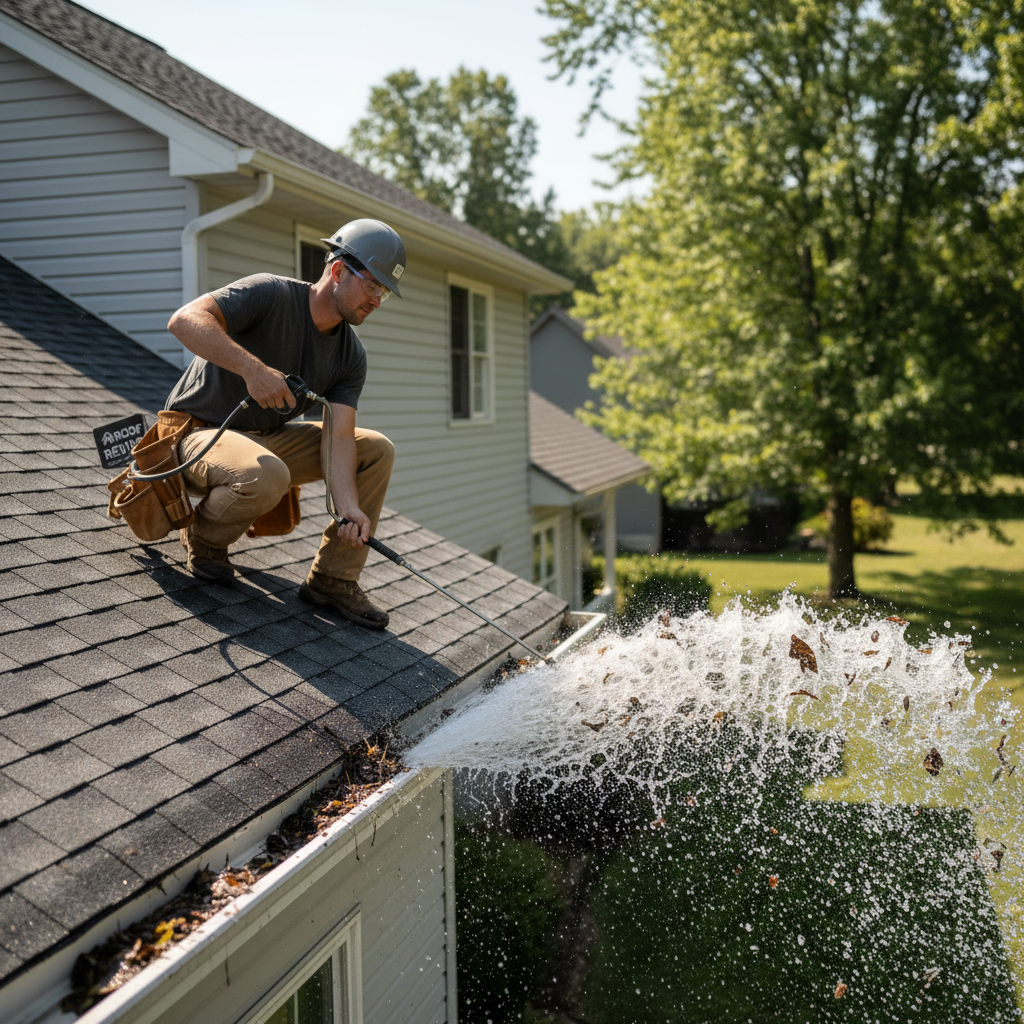
If you have an asphalt shingle roof, pressure washing is almost never appropriate as the cleaning method. The only exception is a controlled, low-pressure rinse after a roof-safe treatment or a manufacturer-approved method for a non-shingle roof.
That matters in Wilmington and coastal North Carolina because the same force that makes a roof look “like new” fast can also strip protective granules and push water where it shouldn’t go.
| Scenario / method on asphalt shingles | Appropriate? | What it looks like in practice |
|---|---|---|
| High-pressure “power wash” to remove streaks | No | Wand-and-force cleaning that relies on pressure to make the roof look clean quickly |
| Controlled, low-pressure rinse after roof-safe treatment | Yes (narrow exception) | Chemistry + dwell time does cleaning; rinse is a finish step at or below ~500 PSI at the tip |
| Manufacturer-approved cleaning on non-shingle roofs | Sometimes | Only if the roof manufacturer allows it and the contractor can state limits (pressure, tip, distance, direction) |
| Rinsing best practices (if rinsing is used) | Required | Wide fan tips, spray kept down-slope, described as “rinsing” rather than “blasting” |
| Typical homeowner pressure washer range | Risk factor | Roughly 1,900–2,800 PSI: already in the zone where margin for error disappears |
In the sections below, you’ll learn when “pressure washing” is just marketing language and what a roof-safe process looks like in plain terms (including how much pressure is used at the tip).
When Should You Pressure Wash a Roof (When It’s Appropriate)

On asphalt shingles, “pressure washing” is almost never the right cleaning method; it can strip protective granules and shorten roof life even if it looks effective. Industry and manufacturer guidance commonly lands on the same point: don’t use high-pressure power washing to remove algae staining from asphalt shingles (see ARMA’s Algae Discoloration of Roofs bulletin).
The narrow exception is when you’re talking about a controlled, low-pressure rinse step (think at or below ~500 PSI) after a roof-safe treatment has done the actual cleaning, or when you’re dealing with a non-shingle roof material where the manufacturer explicitly allows a specific cleaning approach. If someone is selling you “same-day like-new” results on shingles with a wand and force, the juice ain’t worth the squeeze. That’s a method choice, not a miracle.
What “appropriate” means in practice: the contractor can tell you the PSI at the tip and keeps spray down-slope.
Coastal roofs can also show heavy algae staining (those black streaks) that looks like “dirt,” but it’s usually a biological growth issue that responds better to treatment than to blasting pressure. Read more in our article: Roof Algae Black Streaks
Why “Pressure Washing” Goes Wrong on Shingles

You can do everything “carefully” and still end up buying a problem you do not see until the next storm. On shingles, the damage often stays hidden at first, then shows up as expensive repairs later.
Asphalt shingles aren’t a hard, uniform surface like concrete. They’re a layered system that depends on embedded granules to take UV beating and on shingle laps that shed water downhill. When you hit that surface with high pressure, that’s asking for trouble, is pressure washing a roof safe. High pressure can strip granules and weaken edge seals. The roof may look better that afternoon, but you’ve traded appearance for lifespan.
The second way this goes wrong is easier to miss. It matters in coastal North Carolina wind-driven rain. A pressure washer doesn’t just “clean”; it can force water up-slope and sideways under the shingle tabs, especially if the wand angle tilts upward to chase black streaks. Later, that water may present as swollen decking or a leak that mimics a flashing issue, even though the cause was the cleaning.
Here’s why DIY and many “quick clean” pitches go off the rails, including the kind you see on Nextdoor neighborhood recommendations: common homeowner machines run roughly 1,900 to 2,800 PSI. That is already where your margin for error disappears. If a contractor can’t tell you the actual pressure at the tip and how they keep spray down-slope, you’re not buying a controlled rinse, you’re buying a blast and hoping your shingles forgive it.
If you do end up with a leak after an aggressive cleaning, the first priority is pinpointing whether water intrusion is coming from flashing, penetrations, or shingle damage rather than guessing. Read more in our article: Roof Leak Repair
The Roof-Safe Alternative: Chemistry First, Rinse Last

You can get the roof to look cleaner without trading years of service life for a fast cosmetic win. The difference is letting chemistry do the work and treating water as a gentle finish step, not the main tool.
If you’re doing asphalt shingle roof cleaning, don’t turn a small job into a big one. You don’t “wash” streaks off. You treat them and let dwell time do the work, like letting a poultice lift a stain instead of grinding it in. Manufacturer and industry guidance warns against power washing for algae for that reason. The goal is to kill and loosen the growth without grinding the shingle surface to get instant gratification.
When anyone mentions rinsing, think low-pressure rinse, not cleaning by force: roughly ≤500 PSI at the tip and always down-slope. A good contractor can tell you their tip pressure and describe rinsing as a controlled finish step, not the main event.
A roof-safe clean should remove staining without accelerating granule loss, because granules are what protect shingles from UV and premature aging. Read more in our article: Roof Cleaning Without Removing Granules
How to Vet a Contractor Who Says They ‘Pressure Wash’

A neighbor hires the cheapest “roof wash” quote and gets a great-before photo, then finds a leak weeks later and cannot prove what was done. A few pointed questions up front make that outcome much harder to stumble into.
If a contractor leads with “we pressure wash roofs,” don’t debate terminology. Make them describe the method, because “trust me” is not a process. On asphalt shingles, industry and manufacturer guidance is blunt about not using high-pressure power washing for algae (for example, CertainTeed’s Algae Growth on Asphalt Shingles technical bulletin), so your job is to find out whether they mean a roof-safe treatment with a controlled rinse or a wand-and-force cleanup. If they can’t get specific, you’re not buying expertise, you’re buying a sales script that would fit right in on HomeAdvisor.
Use this quick filter on the estimate call, and treat vague answers as the answer
-
Ask what the cleaning action is. You want to hear chemistry and dwell time, then a rinse. If they describe “blasting the streaks off” or “scrubbing it clean,” move on.
-
Get a number: PSI at the tip on the roof. “Our machine is 4,000 PSI” tells you nothing except risk. For shingles, push for a controlled, low-pressure rinse step (often framed around ≤500 PSI), not consumer-range pressure.
-
Ask how they keep water from going up-slope. The right answer includes wide fan tips and keeping spray down-slope. If they say they’ll “angle it as needed to get it clean,” that’s how water gets driven under tabs.
-
Ask how they protect plants and control runoff. In Wilmington-area lots, runoff hits landscaping fast for eco friendly roof cleaning. They should describe pre-wetting, rinsing, and where the solution goes, not “it’s biodegradable so it’s fine.”
-
Ask about the warranty on the cleaning. Case in point: some power-washer-style cleans come with only 1–2 years of coverage. A short warranty can signal they don’t expect the result to last, or they’re limiting exposure.
One mindset shift that saves roofs: if they can’t tell you their pressure and process steps in plain language, you don’t have a “roof cleaning method” at all, you have a gamble.
FAQ: pressure washing roofs in Wilmington, NC (Purpose: resolve the most common lingering objections and edge cases (age of roof, algae vs mold, metal vs shingle, insurance/warranty, pricing expectations); Role: takeaway + objection handling; Depth: short)
If My Roof Is Old Anyway, Does Pressure Washing Still Matter?
Yes, it can matter even more. Older shingles already have looser granules and fragile seal strips, so high pressure can turn “near end of life” into “needs replacement now,” like tearing weathered sandpaper instead of cleaning it. If you’re trying to buy time, don’t let the cleaning method be what shortens it. You don’t want the cleaning method to be what shortens it.
Are the Black Streaks Mold, or Is It Just Algae?
Most black streaking on asphalt shingles is commonly tied to algae staining rather than “attic mold,” and industry guidance addresses it as an algae-discoloration issue. Either way, you don’t need blasting pressure to solve it; you need a roof-safe treatment and time.
What About Metal Roofs or Other Non-Shingle Materials?
Sometimes pressure is allowed, but only if the roof manufacturer’s cleaning guidance permits it and the contractor can name the limits (pressure and direction). Don’t let “metal is tougher” talk replace actual specs, because pressure can still drive water where you don’t want it or damage coatings.
Can Pressure Washing Void My Shingle Warranty or Cause Insurance Headaches?
If something goes wrong later, the uncomfortable question becomes whether you can defend the cleaning method with written guidance instead of a contractor’s reassurance. That paper trail matters when warranties and claims get picky.
Manufacturers and industry bulletins commonly warn against high-pressure power washing on asphalt shingles, so you don’t want a contractor doing something that conflicts with written guidance. If you ever have a future claim, you’ll be glad you chose a method you can defend as roof-safe.
What Should I Expect to Pay for a Roof-Safe Cleaning Around Wilmington?
Professional soft-wash roof cleaning is commonly cited at about $0.15–$0.68 per square foot, which helps you spot “too cheap to be true” bids. If the number looks like a bargain, it’s often because corners are being cut on the method.
From there, pricing shifts with roof complexity and with how much plant protection and runoff control your lot needs. If the bid is cheap and promises a same-day wand-and-force makeover, that price cut usually comes from the method.
Roof not getting any younger? Contact us or call 703-673-6301 to find out where you stand.