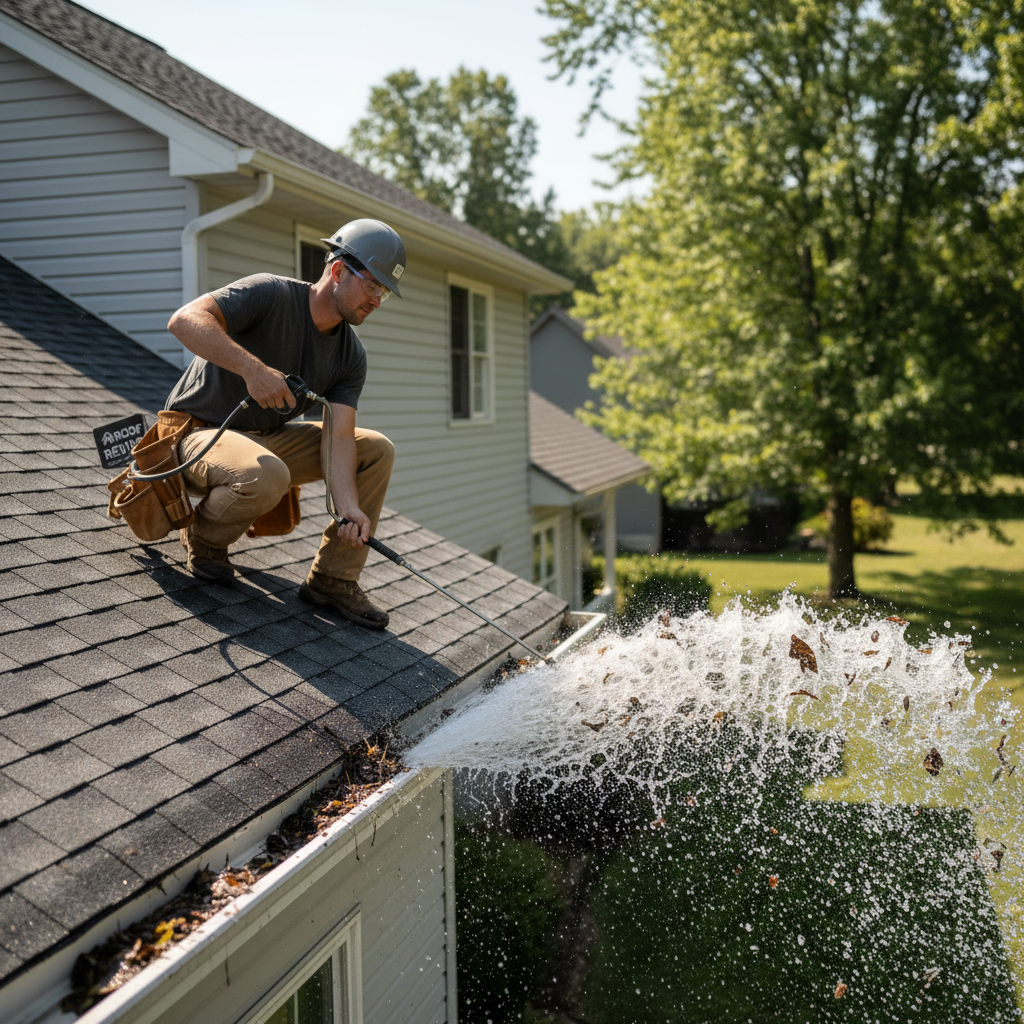
If you pressure wash asphalt shingles, you can ruin them. High pressure can strip protective granules and force water under shingles.
That’s why the confusing part isn’t the stains, it’s the language. One contractor says “power wash” and means “soft wash,” while another really does mean blasting the roof for same-day results. In coastal North Carolina, where algae streaks and moss show up fast on shaded slopes, you need a method that cleans without scouring the surface, not some Home Depot rental aisle experiment. In the sections below, you’ll learn what “pressure washing” can mean on a roof, when granule loss happens, why black streaks are often cosmetic, and what a safer soft-wash approach (with realistic timing) looks like before you shorten your roof’s life.
What “Pressure Washing” Really Means on a Roof

On an asphalt shingle roof, “pressure washing” can mean anything from a gentle rinse to a jet strong enough to strip granules, will a pressure washer remove roof granules. That’s why a simple yes or no answer misleads you. The risk changes with PSI and spray angle.
Your roof’s age and condition matter just as much. A 15-year-old Wilmington roof with sun-baked, brittle shingles can lose protective granules far faster than a newer one. In practice, don’t accept vague promises like “we’ll be careful.” That’s how crews “blast it off” and call it a win. Ask what PSI they’ll use at the tip and whether they’ll keep the spray aimed down-slope, not up under the shingle edges. Treat it like keeping sand out of a beach cooler.
How Pressure Washing Ruins Asphalt Shingles
It can look cleaner when you’re done while the damage shows up later, once granules start collecting in the gutters. The rough part is that the mistake often feels like success in the moment.
What ruins an asphalt shingle roof isn’t the algae stain you’re trying to remove, it’s what high-pressure water can do to the shingle itself (ARMA guidance: do not use a power washer on asphalt roofs). A strong spray can scour off the mineral granules that protect the asphalt from UV, pressure washing asphalt shingles damage often starts there. That leaves bare spots that age faster and shed even more granules in normal rain. If you see fresh “sand” collecting in gutters or at downspouts right after cleaning, that’s not dirt leaving your roof, it’s roof life leaving your roof.
Pressure also works against the way shingles are designed to seal and shed water. It can lift edges and drive water up under laps, exactly the direction your roof isn’t built to handle. If you’re thinking “it’s just water,” rethink that: once you disrupt the surface and seals, you can shorten the roof’s usable life even if you don’t spot a leak that day.
Granules showing up in your gutters right after a wash is one of the clearest signs the cleaning method was too aggressive. Read more in our article: Roof Granules Coming Off
When Stains Are Ugly, Not Dangerous

Owens Corning notes they have not seen evidence that algae deposits themselves reduce asphalt shingle performance, which is exactly why roof cleaning vs pressure washing can be the bigger threat than the streaks (Owens Corning algae technical bulletin). If it is mainly appearance, the risk calculus changes fast.
A lot of the black streaking you see on Wilmington-area roofs is algae discoloration, black streaks on roof removal can make it look like the roof is failing, but it usually isn’t a structural problem by itself. Manufacturers and the asphalt roofing industry warn against power washing even when the goal is “just to remove stains,” in part because you can fry the shingles chasing a cosmetic issue.
What should change your plan is evidence of moisture getting where it shouldn’t. For example, if you see shingle edges curling or water staining in the attic, treat that as a roof-condition issue first, not a cleaning project. When shingles lie flat and the issue is mostly discoloration, a low-pressure method is usually the better path than trying to force the color off. Think of it as gentle cleaning, not sandblasting.
In many Wilmington-area cases, those black streaks are algae staining that looks bad but usually isn’t structural damage by itself. Read more in our article: Roof Algae Black Streaks
Soft Washing Asphalt Shingle Roofs Safely
Soft washing is the safer pathway because you’re not trying to blast growth off the shingle. You apply an algae-killing cleaner, let chemistry do the work, and only rinse gently, if at all, roof cleaning without bleach is sometimes an option depending on the product. “Low pressure” should feel closer to a garden hose than a pressure washer that can peel paint. If a contractor can’t explain it that plainly, keep shopping. If it still sounds vague, keep looking.
Don’t judge success by same-day cosmetics. Case in point: on many asphalt roofs, the treatment keeps working as rain and dew cycles rinse the dead algae away. Visible clearing can take weeks, often around 30 days, like The Weather Channel hurricane season coverage, it is a waiting game. If you need instant brightening, you’re usually trading appearance for shingle wear.
Roof Rejuvenation vs Cleaning vs Replacement
A homeowner looks up at dark streaks and hears three different quotes: “clean it,” “rejuvenate it,” and “replace it,” all delivered with total confidence. The expensive mistake is picking the option that sounds decisive instead of the one the roof condition actually supports.
Cleaning makes sense when the roof is basically sound and you’re mainly fighting algae streaks or light moss. Rejuvenation fits when shingles look dry and aged but you don’t see widespread bald spots or repeated leaks, and you’re trying to buy a few more years before a planned replacement.
Use a simple decision filter: if you’re seeing significant granule loss in gutters/downspouts or recurring leak history, skip cosmetic fixes and budget for replacement. Don’t sink more cash into cosmetic fixes. If your horizon is 1–3 years, choose the safest cleaning; if it’s 3–7 years and the roof is still structurally solid, ask about rejuvenation and get expectations in writing. It’s a runway, not a forever plan.
A roof rejuvenation treatment is meant to restore flexibility and slow down drying on aging shingles, not to “clean” the roof by force. Read more in our article: Roof Rejuvenation
The short version for local homeowners: skip the pressure washer. Our soft-wash roof cleaning service in Wilmington gets the same clean without the shingle damage.
Hiring or DIY: the Risk Checklist
You want a process that leaves you with a cleaner roof and no new leaks and no landscaping damage to explain later, protect plants during roof washing is part of the method, not an afterthought. The best way to get there is to treat method details like nonnegotiables, not preferences.
If you’re deciding between DIY and hiring someone, use this as a quick go/no-go screen: if anyone plans to “clean it fast” with noticeable pressure, treat that as a red flag. Nextdoor posts are full of those regret stories.
| Checkpoint | Go (safer to proceed) | No-go (don’t proceed) |
|---|---|---|
| Roof condition | Shingles flexible; no obvious damage | Older/brittle shingles; cracking tabs |
| Granules | No unusual granules in gutters/downspouts | Granules collecting at downspouts/gutters; bald patches |
| Spray control | You can keep any rinse down-slope | You can’t confidently keep spray down-slope/away from edges |
| Runoff control | Runoff can be contained away from sensitive areas | You can’t control runoff to plants/ponds/septic areas |
| Method expectation | Soft-wash treatment; gentle rinse; results improve over weeks | “Clean it fast” with noticeable pressure; promises instant brightening |
The stain can be cosmetic; the damage from chasing same-day brightness is permanent.
Go no-go for DIY (and for any contractor) if you have an older, brittle shingle roof or you can’t confidently keep spray down-slope. Treat the method as nonnegotiable. If you do hire it out, ask for specifics, not labels: Will they avoid power washing and apply a soft-wash treatment, and does roof cleaning void warranty for your shingle brand if done wrong (see GAF’s algae staining technical bulletin)? If they won’t answer those plainly in writing, move on. Don’t keep kicking the can down the road.
Roof not getting any younger? Contact us or call 703-673-6301 to find out where you stand.Soft wash is the safer alternative we recommend. See our Wilmington soft-wash roof cleaning service.