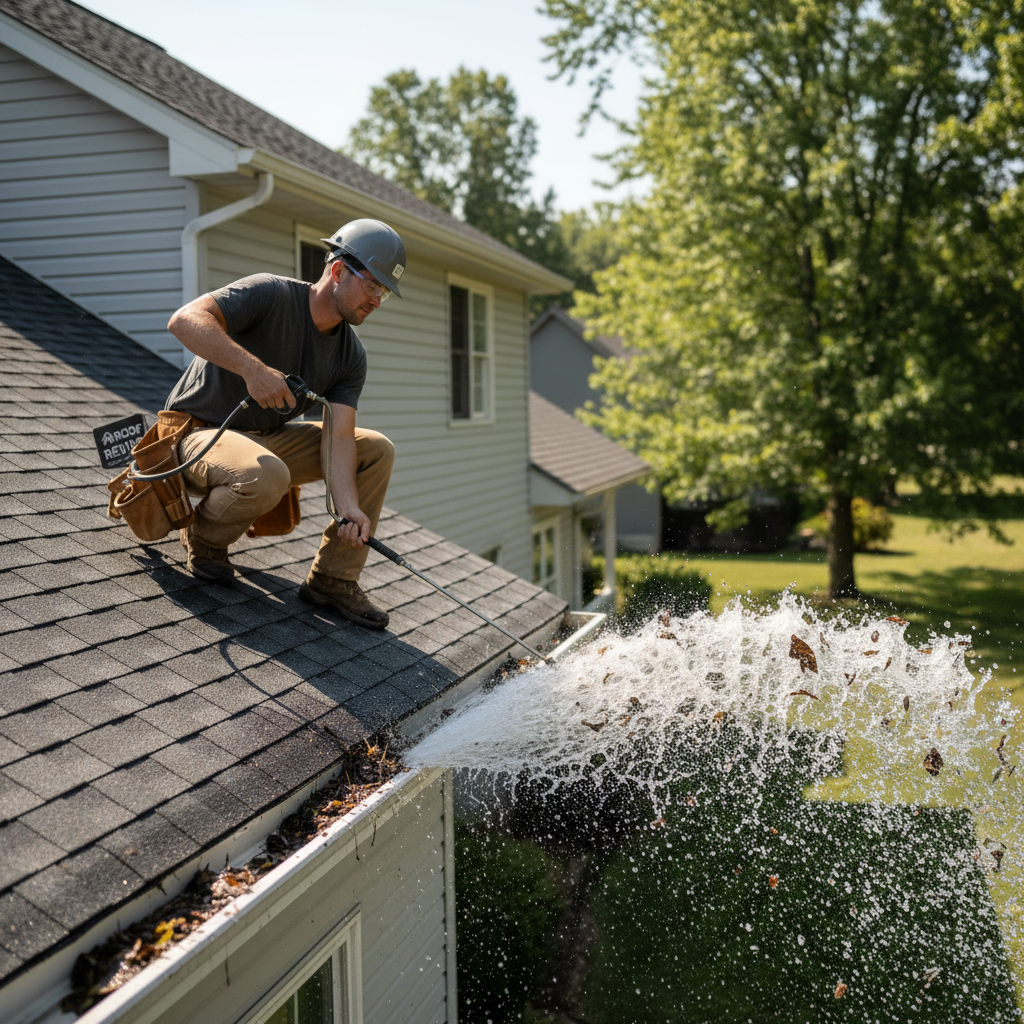
If you’re comparing roof-cleaning quotes in coastal North Carolina, you’ll hear “pressure wash” and “soft wash” used like they’re the same thing. They aren’t, and the difference matters on asphalt shingles.
Here’s the practical difference you can use to protect your roof: pressure washing tries to clean by force, while soft-washing cleans by chemistry and then rinses gently. Focus on what’s doing the work on the shingles, and the choice gets clearer: avoid methods that trade a quick cosmetic win for granule loss or water intrusion.
| Factor | Pressure washing (roof) | Soft-washing (roof) |
|---|---|---|
| What does the work | Force (kinetic energy) | Chemistry (kills growth) + gentle rinse |
| Typical pressure at shingle surface | Higher PSI (even when “turned down”) | Low pressure (often ~100 PSI or less at surface) |
| Shingle risk (asphalt) | Higher: granule loss, lifted tabs, water intrusion | Lower when done correctly |
| Algae result | Can remove stain but may leave organisms alive | Targets algae at the source; slower regrowth |
| Runoff / landscaping | High water volume; may still not kill growth | Biocide runoff requires plant protection and controlled flow |
| Best contractor question | “How will you avoid blasting water under shingles?” | “What’s your mix, dwell time, and rinse pressure?” |
Pressure Washing vs. Soft-Washing: The Real Difference

The difference isn’t the brand name of the equipment. It isn’t a contractor saying they’ll “turn the PSI down.” What matters is the cleaning mechanism acting on the shingle surface. Pressure washing uses kinetic force to blast staining off. On asphalt shingles, that is like sandpaper on a windshield. It can strip granules and push water where it shouldn’t go.
Soft-washing is chemistry-first: a roof-safe cleaning mix that kills algae at the source, followed by a gentle, low-pressure rinse (often under about 100 PSI at the surface). To illustrate this, if you’re dealing with those black streaks common in coastal North Carolina, blasting may remove the visible stain today, but leaving the organism alive can mean it returns faster. The safer question to ask a contractor is simple: “Are you cleaning by force, or by killing the growth and rinsing gently?”
Why Asphalt Shingles Fail Under High PSI

You hire a “roof wash,” the stains vanish, and everything looks fine until the next hard rain and you spot grit in the gutters or a new leak line in the attic. The scary part is the damage often happens fast and shows up late.
Asphalt shingles aren’t a hard slab you can “blast clean,” which is why is pressure washing bad for shingles is the right question. They’re a layered system: loose mineral granules on top of asphalt, with sealed edges designed to shed water downhill. When you hit that surface with high PSI, the water does mechanical damage first and cleaning second, and you often don’t see the harm until months later.
One failure path is granule loss. The spray can scour off the gritty coating that protects shingles from UV. For example, if you notice sand-like grit collecting in gutters after a “roof wash,” that’s not dirt, it’s roof life leaving the building.
Another is lifted edges and broken seals. A tech spraying upward under the shingle tab, or holding a tip too close, can pry at the adhesive strip and curl edges. Don’t let “we’ll run lower pressure” reassure you. Consumer Reports would call that marketing, not protection. If the wand is close and the spray angle drives water under the overlap, that’s a deal-breaker.
Finally, high PSI raises water-intrusion risk. The risk spikes on older, heat-brittle shingles and steeper pitches.
If you suspect water intrusion after a roof wash, quick action can prevent minor moisture from turning into a bigger repair. Read more in our article: Roof Leak Repair
How Soft-Washing Removes Roof Algae
Many best-practice definitions put true roof soft-washing in measurable terms: roughly 3%–5% active chlorine with application and rinse pressure at or below about 100 PSI at the surface. If a quote can’t speak in that neighborhood, it is easy to pay for a “soft wash” that is really just a gentler-sounding blast.
Soft-washing leans on a roof-safe mix to do the cleaning, then uses a gentle rinse to carry residue away. Those black streaks on asphalt shingles in coastal North Carolina aren’t just “dirt” sitting on top, they’re living growth, so roof algae removal has to be chemical-first. If a contractor relies on force to make the roof look better, you can get a quick cosmetic win while leaving enough organisms behind to recolonize faster.
In a true roof soft-wash, a diluted sodium-hypochlorite based mix, sodium hypochlorite roof cleaning, does the heavy lifting by disrupting cells. Dwell time lets it work. Kick the tires a bit on that step, because it is the roof-cleaning version of marinating, not torching. After that, the rinse should feel more like washing pollen off a window than blasting concrete. So when someone proposes “turning it down to 1,200 PSI,” treat that as a pressure-wash plan with softer wording, not a roof-safe soft-wash.
What you can do with this: ask the contractor to describe the process in order, not the equipment.
In coastal climates, the same black streaks often return when the underlying algae isn’t fully killed during cleaning. Read more in our article: Roof Algae Black Streaks You’re listening for “apply a roof mix, let it dwell, then low-pressure rinse,” and you want clarity that the goal is to kill the algae, not scour the shingle clean.
Coastal NC Tradeoffs: Runoff, Plants, And Regrowth

A Wilmington homeowner gets the roof brightened before company visits, then wakes up the next day to browned shrubs and salty-looking runoff trails down the driveway. In coastal yards and tight lots, the cleanup method has to account for where the chemistry and water actually go.
In Wilmington-area neighborhoods, roof cleaning Wilmington NC isn’t just about shingles. It’s about where the rinse water goes and what your roof will look like again in six to twelve months. Nextdoor neighborhood recommendations can be loud, but details still matter. A soft-wash uses a biocide, so runoff can scorch sensitive landscaping if the crew doesn’t pre-wet and rinse plants, and it can carry into storm drains if they don’t control the flow. Pressure washing can use a lot of water volume and still leave you with faster return if it only “lightens” staining without actually killing the growth.
What you can do: judge the plan by impact, not the label. Ask, “Where will the runoff go on my lot?” and “What should I expect for regrowth here near the coast?” If the answer is basically “we’ll blast it clean,” you’re buying a quick photo. That approach doesn’t buy you lasting results near the coast. That is do-it-right-the-first-time territory.
Plant protection is a core part of a responsible roof-cleaning plan because diluted roof mixes can still stress shrubs and lawns if runoff isn’t managed. Read more in our article: Protect Landscaping Cleanup
Roof-Cleaning FAQs
When Should You Clean Your Roof in Coastal North Carolina?
Clean when you see black streaking spreading, shaded slopes staying dark, or clumps of growth near shingle edges. In this climate, waiting until it looks “really bad” usually means you’re letting living growth build a stronger foothold.
What Should You Ask a Contractor to Make Sure It’s Soft-Washing?
Ask, “What’s your process, step by step, and what pressure hits the shingles during application and rinse?” Get a second set of eyes on it, like you would on a roof inspection checklist. You’re looking for a chemistry-first plan (apply a roof mix, dwell, then a very low-pressure rinse), soft wash roof safe for shingles, and a clear answer that they won’t use meaningful PSI to “strip” the roof clean.
What Does a Typical Roof Soft-Wash Cost?
Many standard residential soft-wash jobs land roughly in the $250–$600 range, depending on roof size and how heavy the growth is. Treat any quote like a scope document, not a number: make sure it includes runoff and landscaping protection, not just “wash roof.”
Is DIY Roof Cleaning a Bad Idea?
On asphalt shingles, DIY usually fails in two ways: you either apply too much force and damage shingles or you use too weak a mix and the streaks come back fast. If you do anything yourself, keep it to ground-level gutter cleaning and visual inspection, and leave roof chemicals and steep-slope work to insured pros.
“I Heard You Shouldn’t Run Bleach Through a Pressure Washer.” So What Are Pros Doing?
That warning usually targets homeowner-grade setups and bad habits like letting bleach sit in components, not the entire idea of chemical roof cleaning. A reputable company will use equipment and procedures designed for roof mixes, control where the solution lands, and thoroughly rinse and protect surrounding materials.
Roof not getting any younger? Contact us or call 703-673-6301 to find out where you stand.