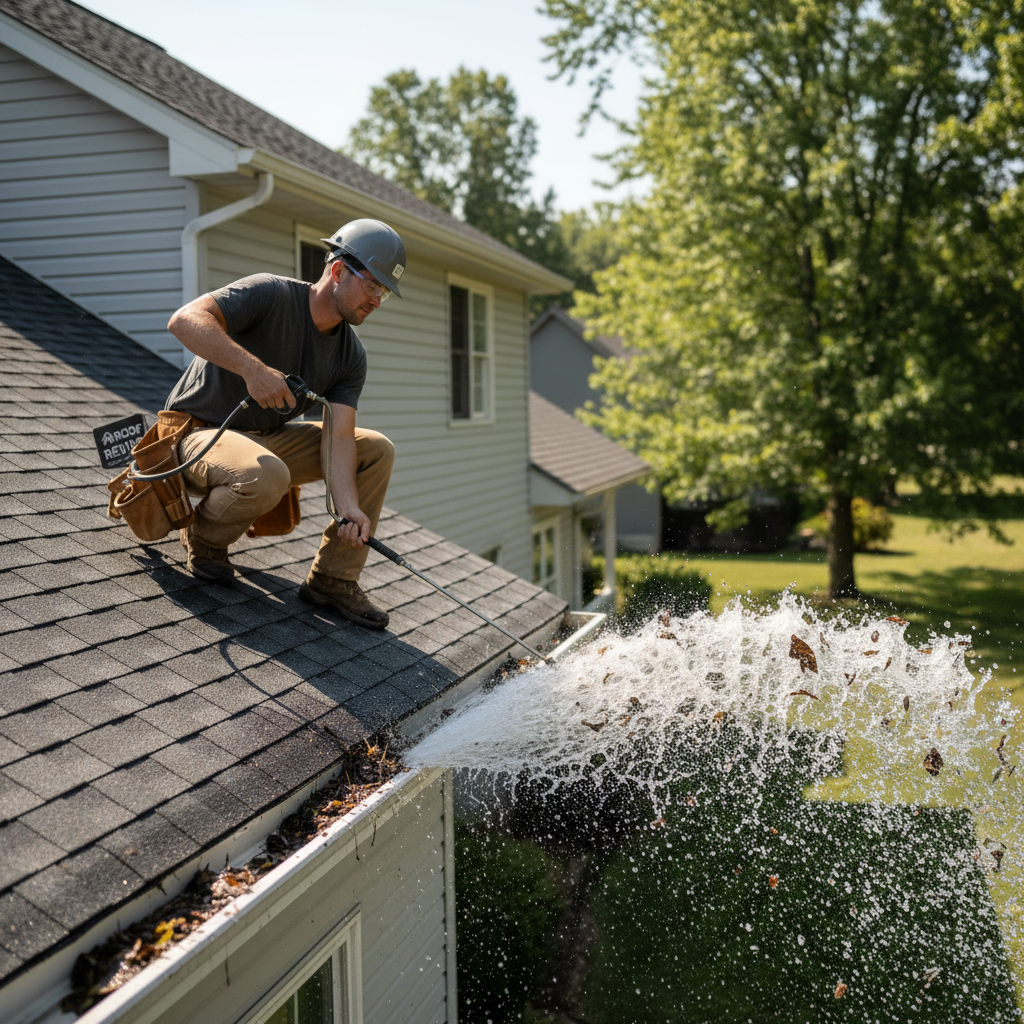
Roof washing is the safe, low-pressure way to clean a roof when it’s done as a controlled soft wash. It kills algae and organic growth without stripping shingle granules. Done wrong, it can shorten your roof’s life.
If you’re in Wilmington or anywhere along coastal North Carolina, you’ve probably seen the black streaks and heard “just pressure wash it,” so get a second set of eyes on it and remember your roof is your home’s weather skin. You’re right to hesitate. On asphalt shingles, the real win isn’t an instant, bright reveal. It’s removing the growth without breaking seal strips or scouring off protection. This guide explains what those streaks are, why pressure washing can create expensive problems, what “soft” roof washing means in practice, how long results tend to last here, and the questions to ask so you can hire a contractor whose method you can defend.
What Those Black Streaks Mean

Those black streaks on asphalt shingles are usually algae discoloration (often the blue-green algae Gloeocapsa magma), not “roof dirt” that needs to be blasted off, and Consumer Reports home maintenance guidance backs treating aggressive blasting as reckless because the goal is to kill growth, not scour shingles. In coastal North Carolina’s heat and humidity, it spreads and shows up as dark staining where moisture lingers, so the right approach is biocide and dwell time, not abrasion.
That matters because a roof can look much better after aggressive pressure and still be harmed, while a proper biocidal soft wash may fade the staining over time as weather finishes the rinse. If you see missing granules in gutters or active leaks, roof washing won’t fix that, and trying to force a same-day transformation can shorten the roof’s remaining life.
On most asphalt shingle roofs, algae staining is a biology problem first and a cosmetic problem second, which is why the most reliable fixes focus on killing the organism load rather than scrubbing the surface. Read more in our article: Roof Algae Black Streaks
Why Pressure Washing Fails Roofs
You hire someone who promises a same-day “like new” look, and the roof does look brighter by dinner. Wind and rain season then reveals what got loosened, stripped, or pushed backward under the shingles.
Pressure washing fails asphalt shingles for a simple reason: it treats your roof like concrete, and it’s like sandblasting a windbreaker. ARMA-aligned guidance is blunt that roof pressure washing is likely to damage asphalt roofing and shouldn’t be used for algae removal. On a shingle roof, the water jet can strip protective granules and break the seal strip that keeps tabs bonded in wind. You might not notice the damage the same day. You’ll feel it later as faster aging and more blow-offs in storms.
It also misses the real target. Those black streaks are living growth and staining, and pressure mostly removes what you can see on the surface while leaving viable organisms tucked into the shingle texture. A hard rinse can look great on day one, then the staining returns sooner than you expect because the organism load was never neutralized.
If a contractor leans on “we’ll make it look new today” and uses the words power wash or pressure wash for shingles, treat that as a competence signal in the wrong direction. You’re better off asking one clarifying question: “Are you applying a low-pressure soft wash and letting chemistry and dwell time do the work, or are you relying on water pressure for results?”
If a contractor is selling “safe pressure” on shingles, it helps to know exactly what can go wrong, granule loss, lifted tabs, and water intrusion often don’t show up until the next hard wind or rain. Read more in our article: Pressure Wash Asphalt Shingles
Roof Washing That’s Truly “Soft”

A neighbor books two different “soft wash” companies for two similar roofs and gets two totally different outcomes: one fades evenly with no collateral damage, the other leaves scorched shrubs and streaky patches. The difference is rarely the machine, it’s the method.
A real soft wash isn’t “low pressure washing”; it’s soft wash roof cleaning as chemical treatment delivered gently. Two contractors can both claim soft washing and still deliver very different outcomes because the risk profile is driven by mix strength and dwell time, not the PSI number on the machine. In practice, pros commonly use sodium hypochlorite mixes in a wide range (often roughly 1% to 6% by volume) and apply them at very low pressure, sometimes under 100 PSI, consistent with softwash roof cleaning guidance that emphasizes chemistry and dwell time over PSI.
Dwell time is what makes or breaks the result. If the mix is weak or gets rinsed off too fast, you’ll get uneven fading and quicker return. If it’s too hot or sits too long in the wrong places, you can bleach out discoloration inconsistently, dry out vulnerable areas, and burn landscaping. As an example, a homeowner-safe benchmark you’ll see repeated is about a 50/50 blend of household bleach and water (roughly 2.5%–3% active chlorine) with a controlled soak window and no scrubbing or blasting, as summarized in one roof-cleaning methods and safety overview.
Runoff control is where “soft” becomes either professional or careless: if you don’t manage runoff, you’re not a pro, especially in Wilmington-style lots where roofs drain straight into beds and sometimes stormwater. If your provider can’t tell you the mix strength, planned dwell time, and exactly how they’ll pre-wet and post-rinse plants and manage downspout discharge, they’re treating plant safe roof washing as “spray and pray,” and your shrubs will pay for it.
Is Roof Washing Safe Here?
Yes, roof washing can be safe in coastal NC, but only when it’s treated as controlled chemical application, not a cosmetic blast. Your risk checks: confirm low pressure on shingles and require a specific plan to pre-wet/post-rinse landscaping.
Humidity and salt air mean regrowth pressure stays high, so don’t judge safety by “how white it looks today.” Judge it by whether they document mix strength, dwell time, and runoff steps, because that’s what prevents shingle wear and dead plants.
How Long Results Last in Wilmington

In warm, humid regions, many softwash sources put typical algae recolonization in the ~18–36 month range even when the job is done correctly, including softwash guidance that cites this interval for warmer/humid U.S. areas. If someone sells you a forever-fix in this climate, you’re being set up for disappointment.
In Wilmington’s warm, humid, coastal conditions, roof cleaning isn’t a one-and-done fix. Even when the soft wash is done right, expect algae to start working its way back over time. A realistic range many pros cite for warmer, humid regions is roughly 18–36 months before you notice meaningful recolonization again, with faster return on shaded, north-facing slopes or under heavy pine and oak cover.
Choosing a method based on same-day perfection optimizes the wrong outcome, and “it looked great today” posts are a terrible durability metric. Ask for a specific retreatment interval recommendation for your roof, and get it in writing. That lets you plan, budget, and compare providers on durability instead of day-one cosmetics.
If you’re trying to time cleanings around regrowth, a schedule based on shade, tree cover, and coastal humidity usually beats a one-size-fits-all interval. Read more in our article: Roof Cleaning Schedule
Roof Washing vs Rejuvenation vs Replacement
| Option | Best for | When it’s a fit | When it’s not |
|---|---|---|---|
| Roof washing (soft wash) | Appearance + algae control | Shingles are intact; mainly black streaks/algae; HOA/curb-appeal issue | Won’t fix missing granules, lifted tabs, exposed fiberglass, active leaks |
| Roof rejuvenation | Extending remaining life | Roof is aging but still serviceable; you want to delay replacement (often ~6+ years), and if you’re not trying to break the bank, it can buy time like a patch before a full tear-off | Not a substitute for structural repair or leak/storm-failure issues |
| Replacement | Structural failure / end-of-life | Leaks, widespread granule loss, brittle/cracking tabs, soft decking, repeated blow-offs | Overkill when shingles are intact and the main issue is algae staining |
What to Ask a Roof Washing Contractor
When a contractor can answer these cleanly, you end up with a roof you can maintain deliberately, plus a paper trail that protects you if staining returns or plants take a hit, which aligns with softwash guidance emphasizing documented concentration, dwell time, and treatment date. When they can’t, you’re gambling on luck and a smile.
Generic questions invite generic promises, and documented methods matter more than Google Reviews when something goes wrong. The point here is to force specifics, because a soft wash vs pressure wash roof choice can still “look great today” while the contractor used the wrong method or rushed dwell time. You’re not buying a cosmetic reveal, you’re buying controlled application and property protection.
| Question to ask | What a good answer includes | Red flag |
|---|---|---|
| Are you using pressure on shingles at all? If so, what PSI range hits the roof? | Confirms low-pressure application on shingles; explains where any rinsing pressure is used and why | “We pressure wash shingles” / won’t state PSI or approach |
| What’s the sodium hypochlorite percentage at the roof surface (your final mix), and how do you adjust it for heavier staining? | States final mix strength at the roof surface; explains adjustments for staining severity | Won’t disclose mix strength; vague “proprietary” with no specifics |
| What dwell time are you targeting, and what makes you rinse sooner or let it sit longer? | Gives a target dwell window and clear decision points for rinse timing | “We just spray and rinse” / no dwell-time plan |
| Will you document the mix approach, dwell time, treatment date, and roof condition so I have a maintenance record? | Provides a simple record of method + date + observed condition | No documentation; only verbal promises |
| What’s your vegetation and runoff plan, specifically: pre-wet, post-rinse, downspout discharge control, and any neutralization you use? | Step-by-step plant protection + runoff routing/management; mentions pre-wet/post-rinse and discharge control | “Plants will be fine” / no runoff plan; ignores downspouts |
| How do you protect vulnerable areas like vents, flashing, and roof-to-wall transitions from water intrusion during application and rinse? | Explains how they avoid forcing water at penetrations/transitions; careful application and controlled rinse | Shrugs off intrusion risk; relies on forceful rinsing near details |
Roof Washing FAQs
Will Roof Washing Void My Shingle Warranty?
It can if someone uses high pressure or abrasive methods that remove granules or disturb the shingle surface. If you care about warranty risk, require a low-pressure soft wash approach and ask the contractor to document the method, including the solution approach and treatment date.
Will Bleach-Based Soft Washing Kill My Plants?
It can if the contractor treats landscaping protection as optional. You reduce the risk by insisting on a specific pre-wet and post-rinse plan for vegetation and clear direction for where downspouts discharge during and after treatment.
Is Roof Washing Safe Around Pets and Kids?
It’s safe when the contractor controls overspray and runoff. Don’t settle for good enough for government work when it comes to a chlorine film on patios or grass, and keep pets and kids away from the work zone until everything is fully rinsed and dry. Push for specifics on where the solution will flow and how they’ll prevent residue from being tracked onto patios and grass.
What About Runoff to Storm Drains or a Nearby Pond?
Runoff control is part of doing the job correctly, especially in coastal areas where stormwater drains quickly to sensitive waterways, and environmental guidance highlights aquatic-life and storm-drain risks from improper cleaning-chemical discharge. Ask how they’ll dilute and manage discharge so roof wash solution doesn’t head straight to the street or open water.
Should My Roof Look Perfect Immediately After Washing?
Not always, and chasing an instant “like new” look is how roofs get damaged. With soft washing, you often see improvement right away, but the full fade can continue as weather and rain finish the rinse over the following days or weeks.
Roof not getting any younger? Contact us or call 703-673-6301 to find out where you stand.Near the Cape Fear coast? Our roof cleaning in Wilmington handles the wash with shingle-safe pressure.