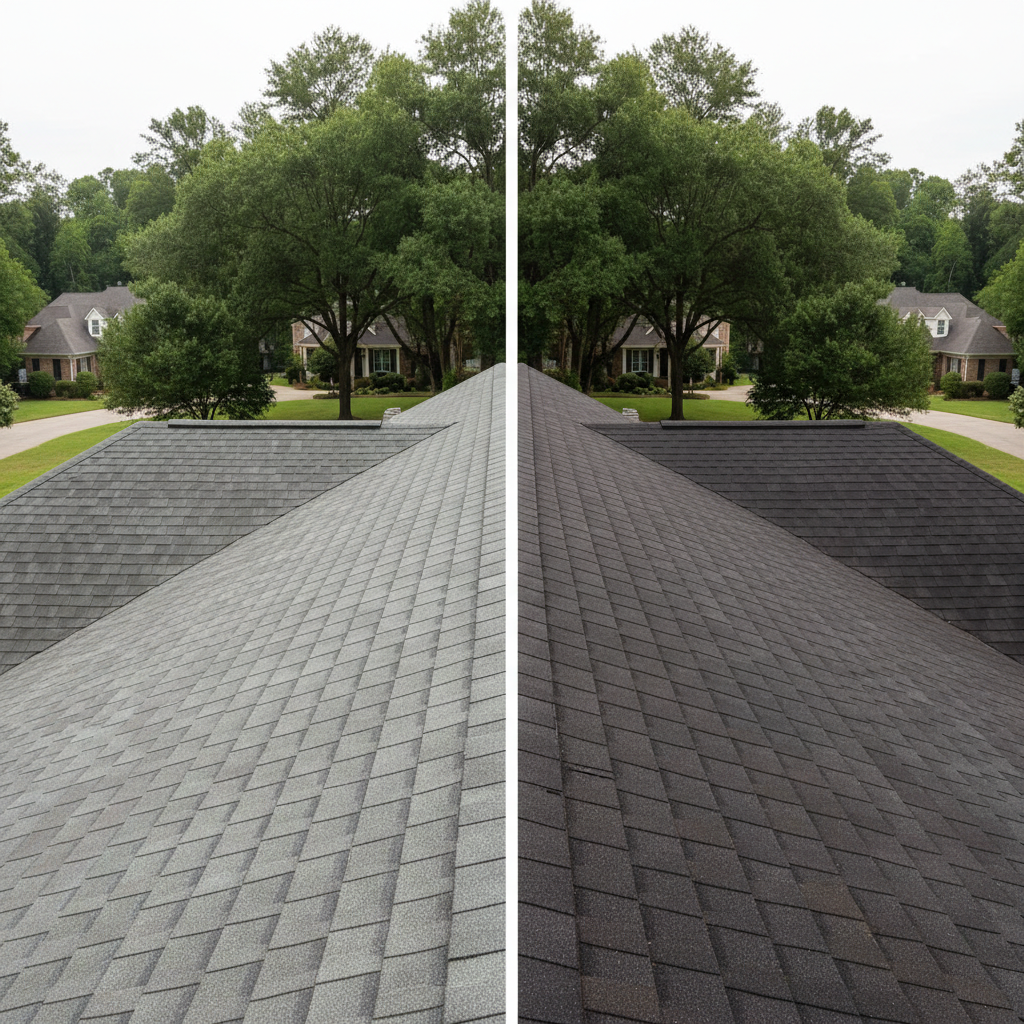
If you live in Carolina Beach, salt air can shorten an asphalt shingle roof’s real-world life and change how it fails. It tends to keep the roof surface wetter, speed up granule loss and UV aging, and corrode the metal parts (flashing and drip edge) that often leak first.
That’s why two roofs with the same shingles can age very differently here, and why “it looks fine from the yard” doesn’t always hold up after a wind-driven rain. In the sections below, you’ll learn what salt air does (and doesn’t do) and where the earliest problems show up on your roof. You’ll also learn how to decide whether maintenance or replacement is the most cost-effective next move in a coastal Carolina climate.
Why Carolina Beach Accelerates Shingle Aging

Some coastal sources estimate asphalt shingles run about 15–20% shorter near the ocean than inland (for example, how salt air affects different roofing materials). If you plan around inland expectations here, you can be late to the first real failure.
Salt air damage to asphalt shingles doesn’t “melt” asphalt shingles. What it does in Carolina Beach is stack multiple stressors on top of normal weathering, so the roof loses its protective granules faster and the asphalt binder ages sooner than you’d expect inland. In practical terms, that’s why you should kick the tires around ~15–20 years here. Think of it like light sandblasting, not the slower wear you’d expect inland.
The big coastal twist is moisture. Salt is hygroscopic, meaning it attracts and holds water (see salt air and hidden roof damage). That can keep your roof surface damp longer after dew or fog, and longer wet time supports algae staining while also speeding surface wear. Add intense sun and heat, and you get a one-two punch. UV and thermal cycling stiffen the binder while the roof swings wet to dry.
Wind makes it even more directional than most homeowners think. Wind-driven salt spray and fine sand act like a light abrasive, especially on the prevailing-wind side and along eaves and ridges where airflow is strongest. Case in point: it’s common for one slope to look “older” first, with more granule loss, fading, and staining, even when the rest of the roof still looks decent from the yard.
In coastal North Carolina, you’ll often see asphalt shingle roofs age faster than expected, especially on the windward slope closest to the ocean. Read more in our article: Asphalt Shingle Roof Lifespan Wilmington
The Failure Points Salt Air Hits First

A neighbor replaces a few “bad” shingles after a storm, and the next hard rain still finds the same ceiling spot. The leak was never the shingle field, it was the corroded metal detail beside it.
If you only judge your roof by how the shingles look from the yard, you can miss where coastal roofs usually start failing. With salt exposure, failures tend to start at the seams and transitions, not the wide shingle field. If you do not start there, you are guessing, even if Angi says the contractor is great. So the roof can still leak in a wind-driven rain even when it seems fine at a glance.
First, salt and humidity increase “wet time,” so algae and mildew staining tends to show up sooner and spread faster. That staining isn’t automatically a leak, but it’s a signal your roof stays damp longer, which accelerates surface wear and can make it harder for shingles to dry and reseal after cool nights.
Next comes loss of the shingle’s protective surface. As granules shed faster, the asphalt underneath takes more UV beating. The seal strips can lose reliability sooner. For instance, after a summer of heat cycling and a few nor’easters, you may notice more bare spots in gutters and a few tabs that feel easier to lift at the edges.
The biggest salt-air weak link is often metal, not shingles, think ocean air roof corrosion, so get a second set of eyes on it (details: how salt air impacts roof fasteners and flashing). The roof is a chain, and the details are the weakest link. Salt accelerates corrosion, and once metal pits or loosens, you get tiny gaps that turn into real leaks around chimneys and pipe penetrations. Treat it as a corrosion-resistant roof system, since the details determine whether performance outlasts appearance.
Most persistent roof leaks start at penetrations and flashing transitions (like chimneys and vents) rather than in the open shingle field. Read more in our article: Roof Leaks Chimneys Vents
Where to Look on Your Roof
In Carolina Beach, you’ll learn more from where the roof is aging than from the average look of the whole field. Start with the slope that faces the ocean or takes the prevailing wind, then check the high-wind zones: eaves and ridges. As an example, heavier fading or more granules at the downspout outlets usually marks the side taking the most salt spray and abrasion.
Then move to the leak-prone details that salt air weakens: pipe boots and flashing. Don’t talk yourself into “the shingles look fine” if you see rust staining or cracked boots. BBB ratings matter, but those interface failures are what turn wind-driven rain into an attic stain, period.
Maintenance, rejuvenation, or replacement?
You get to make the call before you’re forced into it, when it’s still a budget decision instead of an emergency. The goal is to spend once, not twice.
Use one filter, not “good enough for now”: age band and metal/detail risk. It is a three-legged stool. In Carolina Beach, you can’t price this decision by “looks fine from the yard,” because roof maintenance Carolina Beach NC has to account for corrosion at flashings and fasteners that can beat the shingles to failure.
| Age band | Typical conditions | Key coastal check | Default next move |
|---|---|---|---|
| Under ~10 years | No leaks; no widespread granule loss | Keep details watertight | Maintenance |
| ~10–15 years | Shingles intact and flexible | Metal components show minimal corrosion | Consider rejuvenation |
| 15+ years (or earlier if symptoms) | Any active leak; widespread lifting; heavy corrosion at penetrations, valleys, or eaves | Detail/metal risk is elevated | Replacement |
Rejuvenation can be a cost-effective option when shingles are still flexible and the roof’s metal details are in good shape. Read more in our article: Roof Rejuvenation Vs Replacement
What a coastal inspection should include

You accept a “looks good” verdict, skip the photos, and six weeks later a wind-driven rain prints a stain right where the flashing was pitted. The repair costs less than the interior cleanup, but it never had to happen.
A useful roof inspection Carolina Beach NC is not a driveway glance. Without photos and specific findings you can verify, that verdict doesn’t carry much weight. You want someone to evaluate the parts that usually fail first here, because roof flashing corrosion salt air can leave a roof looking “fine” while still being one corroded flashing away from the next wind-driven rain finding your ceiling.
Ask your inspector or estimator to document (photos help) these items
-
Metal condition: drip edge, step/counterflashing, valleys, and vent flashings for pitting, rust bleed, loose edges, and failed sealant
-
Fasteners and penetrations: exposed nail heads, pipe boots, fan/vent bases, and any places hardware shows corrosion or backing-out
-
Ventilation and moisture signs: intake/exhaust balance, bathroom fan duct terminations, and attic staining or damp insulation that keeps shingles “wet” longer
-
Directional salt-spray exposure: which slope faces prevailing wind/ocean and whether that side shows measurably higher granule loss or edge lifting
-
Repairability vs. replacement triggers: how many areas need detail work (boots/flashing/valleys) versus widespread shingle brittleness, lifting, or granule loss that makes spot repairs short-lived
Our free roof check in Wilmington covers exactly these problem spots and hands you the findings in writing.