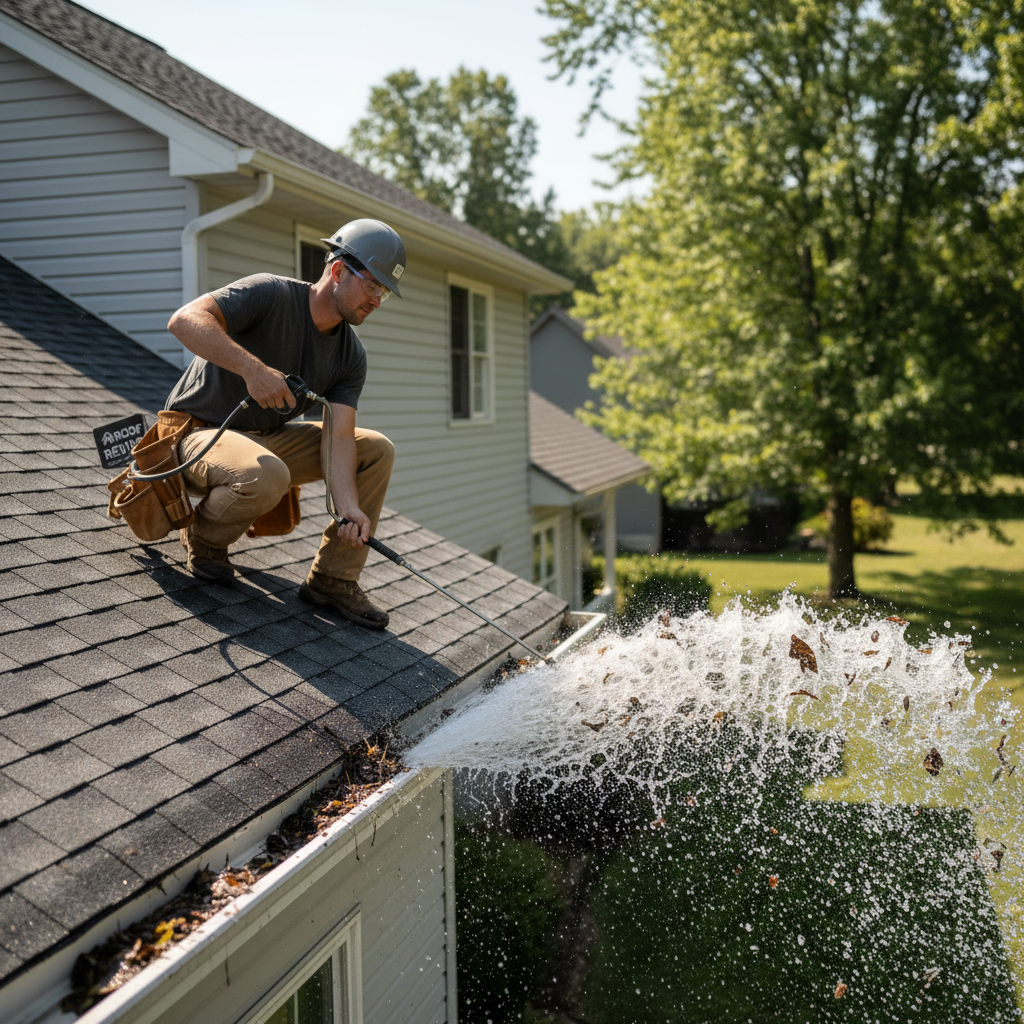
If you have asphalt shingles, pressure washing is usually a bad idea. You can strip off protective granules and force water under shingle edges.
You’re probably here because you’re staring at dark streaks or organic growth and getting mixed messages from ads and quotes, especially from companies promising a “same-day” transformation. This guide explains what causes the damage people warn you about, how to tell if a roof was cleaned too aggressively, and what safer options look like in the real world, including soft washing and low-pressure rinsing. You’ll also learn what to ask before you hire, so you protect your roof’s remaining lifespan and reduce runoff problems around siding, gutters, and landscaping.
When Pressure Washing Becomes Damage

You point the wand at a dark patch, the streak disappears, and it feels like a win. Then you realize the only reason it changed that fast is because something on the roof came off with it.
Once the stream is strong enough to strip granules or shove water under shingle edges, pressure washing has already become damage, and there’s no risk-free way to do it. That can happen fast with a rental unit from The Home Depot rental center (often roughly 1,900–2,800 PSI), which is the wrong pressure washer PSI for roof shingles. In my view, using that kind of force on shingles is flat-out reckless, especially with a tight tip up close. That “instant improvement” is often the granule layer coming off with the grime.
Granule loss is one of the fastest ways a “clean” roof turns into premature aging and higher replacement risk. Read more in our article: Roof Granules Coming Off
Angle and distance matter because shingles are designed to shed water flowing down like rain, not a jet forced up or sideways into seams. If the plan involves working close or spraying upward, you’re no longer cleaning. You’re sandblasting the roof’s raincoat, and you should do it right the first time.
What Pressure Does to Asphalt Shingles

A homeowner hires the “instant clean” crew and the roof looks photo-ready by lunch. By the next season, the shingles age faster and a small leak shows up where nobody thought to look.
Asphalt shingles aren’t just “dirty on top.” They rely on a thin layer of embedded granules to take UV abuse and protect the asphalt beneath. High-pressure spray can knock those granules loose in seconds, especially on older roofs where they’ve already started to shed. The roof may look cleaner because you blasted off the dark film and grit. But that cosmetic win can turn the roof into a money pit, like grinding the tread off your tires to make them look new.
Even when no leak shows up right away, that same force can compromise watertight overlaps and create leaks later. A strong jet can lift shingle tabs and force water sideways or upward into laps. That’s when “no leak today” turns into damp decking or rusty nails, and it may conflict with manufacturer warranty guidance. Sometimes the first clue is a ceiling stain months later, after the crew has moved on.
Flashing and penetrations are another weak point. To illustrate this, a wand aimed at a chimney edge or a vent boot can drive water under metal edges or into aged sealant. If you’re evaluating a cleaner, ask how they prevent upward spray at seams and how they’ll avoid direct pressure on flashing and pipe boots.
How to Spot Pressure-Wash Damage
If your roof was “cleaned” and you’re trying to confirm it was gentle, look for signs of roof shingle damage from washing, evidence that protective material moved or shingle edges got disturbed. A roof can still look great from the street while you’ve lost years of service life.
Quick checks you can do
-
Granules in gutters/downspouts (sand-like grit after the job)
-
Bald spots where shingles look darker, patchy, or asphalt-like
-
Uneven sheen or striping that matches wand passes
-
Loosened or lifted shingle edges/tabs, especially on older slopes
-
New leaks or stains in the attic/ceilings after the next hard rain
If you start seeing granules in downspouts after a cleaning, it’s often a sign the shingle surface was scoured instead of gently treated. Read more in our article: Granules In Gutters After Treatment
Safer Alternatives to Clean Shingles
That common 1,900 to 2,800 PSI consumer range is why many manufacturers and reputable cleaners caution against using these machines on asphalt shingles, including guidance that says do not power wash. If you still want a cleaner roof, pick a different approach instead of trying to dial the pressure into something “safe.”
If you want a cleaner-looking roof without gambling on granule loss, you’re choosing between a soft-wash treatment and a true low-pressure rinse, the practical soft wash roof vs pressure wash decision.
| Option | Best for | What it does | Key tradeoff / risk |
|---|---|---|---|
| Soft-wash treatment | Algae/light organic growth; longer-term control | Uses low-pressure chemical application; weather helps fade staining | Results may take 30–90 days; avoid “instant perfection” promises |
| True low-pressure rinse | Loose debris after treatment; mild buildup | Gentle downward rinsing to remove residue/debris | Should not rely on force to erase dark streaks |
| Leave it alone (for now) | Cosmetic discoloration; sensitive landscaping/runoff concerns | No cleaning this season; reassess later | Appearance won’t improve quickly; weigh runoff/plant protection if you later treat |
The key is to judge each option by the outcome you actually need (appearance or moss control) and the constraints you can’t ignore (sensitive landscaping or runoff paths).
Soft washing aims to kill algae and light organic growth with chemistry delivered at low pressure, then lets weather finish the job. Timing is the catch, since the staining may need 30–90 days of weather to fade even after it’s killed. When a bid promises instant, uniform perfection on asphalt shingles, read it as a red flag rather than a benefit (soft-wash results are often described as taking 30–90 days to fully weather off). Consumer Reports would call that kind of promise marketing, not maintenance, and I agree.
A low-pressure rinse can make sense when you’re mainly trying to remove loose debris after a treatment or a mild buildup, but it shouldn’t rely on force to erase dark streaks, think low pressure roof cleaning or not blasting. As an example, if you’re seeing pine pollen film or residue after a coastal wind event, gentle downward rinsing can help, while “blasting the stains off” is exactly how you shorten shingle life.
Leaving it alone is often the right call when the discoloration is cosmetic and your property makes chemical control risky. Case in point: if you have delicate foundation plantings or runoff that dumps into a pond, you may decide the roof doesn’t need to look perfect this season. Your practical filter: ask where the solution and rinse water will go and whether they’ll set expectations for a slower fade instead of chasing instant results.
In coastal North Carolina, algae and black streaks are common and usually need a kill-and-weather-off approach rather than a force-based “instant clean.” Read more in our article: Roof Algae Black Streaks
Questions to ask before hiring

You can end up with a roof that looks better and still keeps its remaining life, but only if the contractor can describe a repeatable process instead of a before-and-after pitch for roof cleaning Wilmington NC. A few pointed questions are often the difference between a careful treatment and a cosmetic strip-down.
A roof-cleaning quote seems simple until you see it’s really a method decision, not a makeover purchase. Push back on any “same-day perfect” pitch for asphalt shingles, especially for roof algae removal where safer methods take longer. That standard trades lifespan for shine, and it usually just delays the real problem.
Ask these questions and listen for specific, repeatable answers: What exact method will you use on asphalt shingles, and do you explicitly avoid pressure washing them? If you’re soft washing, what does “low pressure” mean in practice and how do you prevent upward or sideways spray at laps and flashing? What products will you apply, how will you protect plants and manage runoff, and where does the wash water go on your property?
Then cover the decision-stuff that protects you later: How long should it take to look better, including the possibility of 30–90 days? What is your retreatment or touch-up policy if staining lingers? Can you provide current proof of liability insurance and workers’ comp, and will your process stay within shingle manufacturer guidance so a contractor can’t nickel-and-dime you later over “excluded” damage?
Roof not getting any younger? Contact us or call 703-673-6301 to find out where you stand.