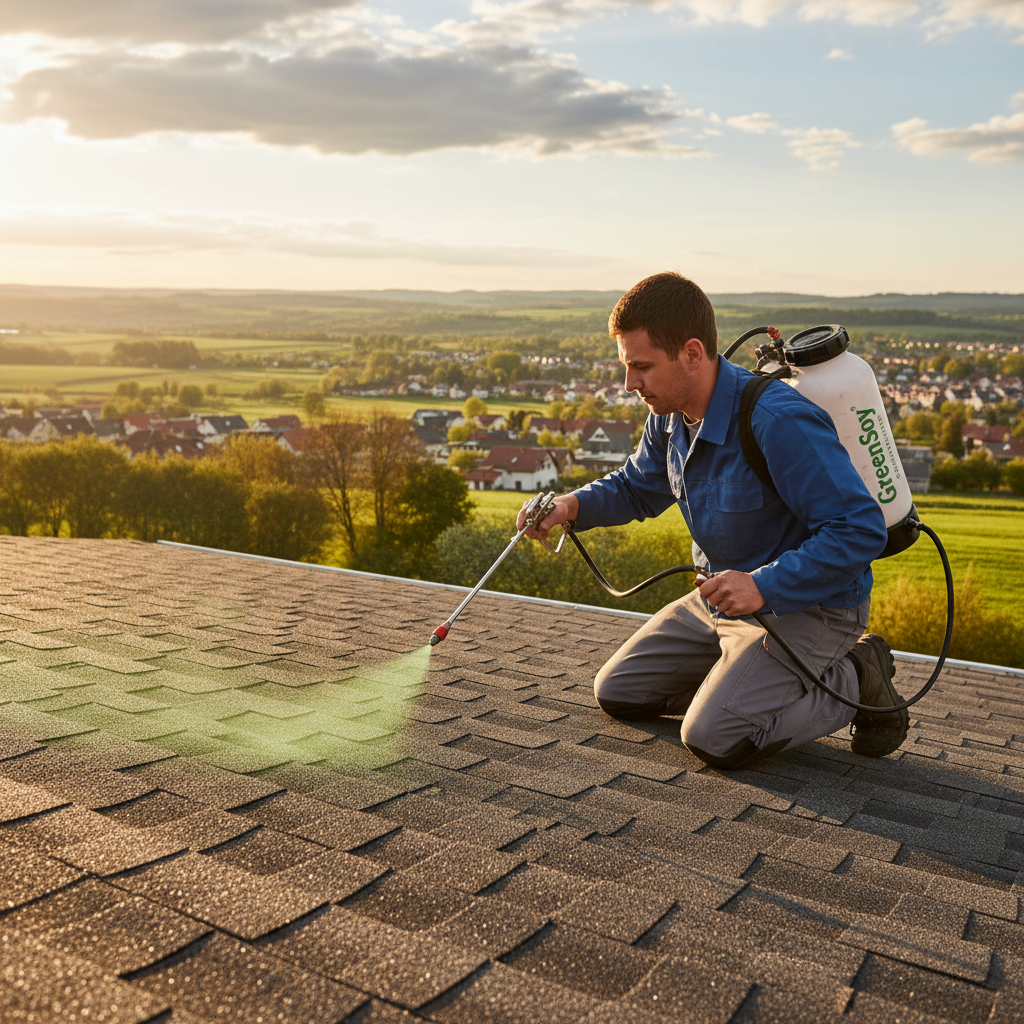
You’re told your roof is “aging,” but it still looks fine from the driveway. Then you get two very different recommendations: a roof cleaning quote and a roof rejuvenation quote that sounds like it might buy you years.
In plain terms, roof cleaning (usually a low-pressure soft wash) removes algae and organic growth on top of the shingles, while roof rejuvenation is a treatment aimed at the shingles themselves to help aging asphalt stay more flexible and slow wear. If you don’t separate those two goals, it’s easy to pay for a better-looking roof and still miss what shortens roof life. That is just kicking the can down the road, especially in the sun and salt air around Wilmington, where algae is just the smoke and shingle aging is the fire.
Roof Cleaning: What It Solves

Roof cleaning (typically a low-pressure “soft wash”) targets biological growth on shingles, especially gloeocapsa magma roof algae that causes black streaks in humid coastal areas like Wilmington. The goal is to kill and rinse away growth and staining so the roof looks better and sheds water without that slimy film holding moisture.
What it doesn’t do: roof rejuvenation vs roof cleaning is exactly this, cleaning doesn’t recondition dried-out asphalt or fix leaks and flashing problems. The visible change can take time. Those dark streaks can fade over 30–90 days after treatment, so give it time instead of judging the result the same afternoon, no matter what you read on Nextdoor neighborhood groups.
On coastal roofs, algae staining can be a symptom of a bigger moisture-retention cycle that keeps shingles wet longer after rain and dew. Read more in our article: Roof Algae Black Streaks
Roof Rejuvenation: What It Changes

In accelerated weathering testing, untreated shingles lost 5.4% mass after 1,500 hours and 9.1% after 3,000 hours, while treated shingles were around 0.5% (per PRI Asphalt Technologies’ accelerated weathering report). That difference is why legitimate rejuvenation claims should be backed by material science, not a before-and-after photo.
Asphalt shingle rejuvenation is a different category than cleaning because it’s aimed at the shingle material, not the organisms on top of it. The pitch, when it’s legitimate, isn’t “make the roof look new”; it’s “help aging asphalt stay more flexible and slow down wear.” On a sun-and-salt-air roof in coastal North Carolina, that matters because brittleness and granule loss are what move a roof from “aging” to “failing,” even if it still looks decent from the driveway.
A good way to separate marketing from mechanism is to ask what’s supposed to change in measurable terms, because good/better/best talk is just paint on the trim if the shingle itself doesn’t change. In accelerated weathering lab testing for a bio-based rejuvenator, treated shingles showed far less mass loss than untreated shingles after long exposure (a proxy for material and granule loss), and low-temperature flexibility improved (for example, from about -22°F pre-treatment to about -31°F after application). That’s a reason to stop using “it looks cleaner” as your decision standard. That standard is flat-out wrong, because a roof can look better without meaningfully resisting the next few seasons of wear.
Granule loss and shingle brittleness are two of the clearest signs that an asphalt roof is moving from normal aging toward failure. Read more in our article: Normal Shingle Wear Vs Damage
When You Need Cleaning, Rejuvenation, or Both
You don’t pick between cleaning and rejuvenation based on which one “sounds like it adds years.” You pick based on what problem you’re actually trying to solve on your roof right now: biological growth on the surface or aging in the shingle material itself. In coastal North Carolina, you can easily have both at once. That is why these services get blended together in estimates, and Angi (formerly Angie’s List) can make that bundling look more straightforward than it is.
Start with the simplest tell: if you’re seeing black streaks or green patches, you’re looking at an algae or organic-growth problem. Cleaning (soft washing) targets that. Don’t expect a same-day cosmetic transformation; the streaks often fade over the next 30–90 days. Judging it the same afternoon can push you into paying for harsher cleaning than you needed and taking on more risk than you intended.
Rejuvenation makes sense when the roof is past “new,” but not yet showing signs of failure. If the shingles are still intact and lying flat, but you’re getting the early signs of drying and wear, a conditioning treatment may be aimed at slowing that slide.
| If your main situation is… | What you’re trying to solve | Best fit | Notes |
|---|---|---|---|
| Staining/growth is the main issue; shingles otherwise look uniform, flat, and not bald | Biological growth on the surface | Cleaning only | Soft wash targets algae/organic growth (cosmetic + moisture-holding film). |
| Roof is relatively clean, but you’re worried about age-related brittleness and wear progression | Aging in the shingle material | Rejuvenation only | Aims at shingle flexibility/wear slowing, not just appearance. |
| Visible algae pressure and an aging roof where the goal is to reduce ongoing wear, not just improve curb appeal | Both surface growth + material aging | Both | Often paired in coastal North Carolina when both problems are present. |
The Costs, Risks, And Warranty Traps

If you push for a same-day “like new” look, you can end up approving hotter chemistry and messier runoff. The catch is that a cosmetic win can quickly create landscaping damage or warranty gray areas.
The real cost isn’t just the invoice, it’s what you might trigger if the job gets “turned up” to satisfy same-day visual results or big life-extension promises. Let’s not throw good money after bad, especially when warranty fine print is the tripwire. Hotter chemistry and poor runoff control can burn landscaping and stain concrete. And if someone sells you on “it looks brand new” as proof it’s protected, you can end up paying for cosmetic improvement while the roof’s real failure points (flashings, penetrations, underlayment) keep aging untouched.
On warranties, slow down: roof warranty and cleaning often comes down to shingle makers’ specific guidance for approved methods and mixtures (see the Asphalt Roofing Manufacturers Association guidance on algae discoloration and cleaning), and spray-on treatments can create gray areas if a future claim hinges on whether the roof was maintained per manufacturer instructions. Before you approve anything, ask what will be applied and what documentation you’ll get that shows the work followed the shingle manufacturer’s requirements rather than a contractor’s preferred recipe.
Manufacturer warranty language often hinges on using approved cleaning methods and keeping documentation that shows what was applied and how it was done. Read more in our article: Shingle Warranty Cleaning
Questions to Ask Before Hiring
A homeowner gets two quotes that look similar until one contractor can explain the mix and manufacturer guidance and the other can only promise a prettier roof. That difference shows up later in cleanup and callbacks.
If a contractor can’t answer these clearly, you’re buying a sales pitch, not a roof-maintenance plan. That is a bad deal, and Better Business Bureau (BBB) ratings/complaint profiles won’t save you from warranty or cleanup problems you didn’t budget for.
Ask
-
Are you quoting cleaning, rejuvenation, or both, and what problem on my roof does each one address?
-
What should I expect for timeline and appearance after cleaning (including the 30–90 day fade period)?
-
What exactly will be applied, and how does it align with my shingle manufacturer’s guidance?
-
How will you control runoff and protect plants, downspouts, and concrete?
-
What roof conditions would make you recommend replacement instead of treatment?