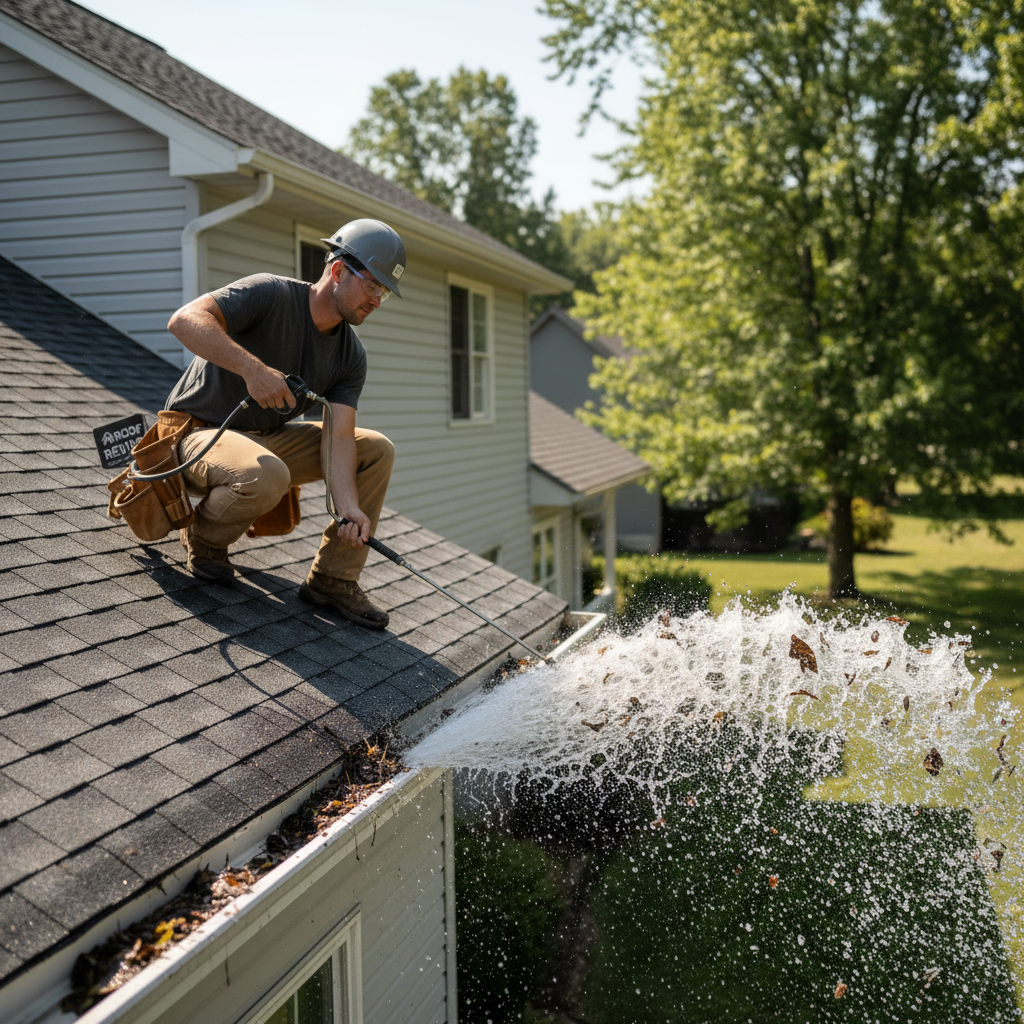
Can you pressure wash your roof to keep it looking clean, or will that ruin it? In most cases, pressure washing an asphalt shingle roof will ruin it. It can strip protective granules and disturb shingle seals.
If you’re looking at black streaks or moss in Wilmington’s humidity, the bigger question isn’t whether water can “clean” it. It’s whether the method you use removes what protects the shingles or forces water where rain normally wouldn’t go. Below, you’ll learn what pressure washing damages (including the signs to check if you already did it) and why roofs here re-streak so fast. You’ll also learn what “soft wash” should mean in plain terms and how to decide whether cleaning will protect roof life or just speed you toward repairs or replacement.
| Option | What it relies on | Typical outcome on asphalt shingles |
|---|---|---|
| Pressure washing | Water force | Higher risk of granule loss and disturbed seals; can look cleaner while aging faster |
| True soft wash | Treatment + very low pressure application + dwell time + gentle rinse | Kills growth causing streaks while reducing risk of surface damage |
| Wait / spot-treat | Monitoring + targeted attention to shaded areas | Avoids over-cleaning when staining is light or confined |
| Replacement planning (not cleaning) | Inspection + quotes | Better use of budget when the roof is near end-of-life or already failing |
Pressure Washing: What It Ruins

You can finish a roof “cleaning” and still have done the kind of damage that only shows up later, when tabs start lifting or grit starts piling up in the gutters. That delayed payoff is what makes high-pressure mistakes so expensive.
Pressure washing rarely causes an instant, dramatic failure on day one. Instead, it compromises the layers that keep shingles durable (granule displacement and disturbed seal behavior). It strips and loosens what makes asphalt shingles last, so you can blast it clean and still sandpaper off the roof’s armor.
The common damage signatures are
-
Granule loss (the sand-like coating): you’ll see extra grit in gutters/downspouts or bare, darker patches where UV hits harder.
-
Lifted shingle edges and disturbed seals: the adhesive strip that helps shingles stay flat can weaken, which makes wind-driven rain more likely to get under tabs.
-
Scouring at laps and edges: blasting across seams can erode the shingle surface and create “washed” lines where water doesn’t normally attack.
If you already pressure wash roof areas, check gutters for heavy granules and look for tabs that don’t lie flat. If you find either, don’t try a second pass to “finish the job,” because that’s often when hidden damage becomes obvious.
Excess grit in gutters after a wash is one of the clearest signs you’ve accelerated shingle wear. Read more in our article: [Roof Granules Coming Off]
Why Wilmington Roofs Re-Streak Fast

A homeowner gets a roof that looks brand-new on Saturday, then by late summer the dark lines start ghosting back in on the shaded slope. In coastal humidity, the difference between removing color and stopping growth shows up fast.
In Wilmington and nearby beach communities, the mix of humidity and shade means the organism behind those black streaks comes back fast, especially after roof cleaning Wilmington NC homeowners schedule for curb appeal (humidity/rainfall increases recurrence pressure). Mechanical cleaning can look great briefly, but the streaks often return once the underlying growth keeps going.
That’s where appearance-only cleaning backfires: treating your roof like a driveway, Home Depot rental center style, is a bad idea and it sets you up for repeat cleanings. On asphalt shingles, that repeat cycle is often what turns “just ugly” into “shorter life.”
Those black streaks are typically algae, and unless the organism is killed, discoloration often returns quickly in humid, shaded areas. Read more in our article: [Roof Algae Black Streaks]
Soft Wash Roof Cleaning, Defined
Most homeowner pressure washers run around 2,000 to 3,000 PSI, which is far beyond what shingles are meant to take. Roof cleaning that lasts leans on chemistry and dwell time, not brute force.
Soft washing means you’re treating the roof, not blasting it, think low pressure roof cleaning, not high-force rinsing. A real soft wash uses very low pressure (often under about 500 PSI, sometimes far less) to apply a biocidal mix. Then you do it the right way, letting it dwell like a deck cleaner that has to soak in before a gentle rinse. The goal is to stop the organism first. Then you rinse with minimal force.
Don’t let the phrase “low-pressure wash” end the conversation. If they’re relying on water force to make the roof look instantly new, you’re still in pressure-washing territory.
A quick credibility check: ask, “About what PSI are you applying, and are you killing the growth with a roof-safe mix or just rinsing it off?” If the answer is vague, or they won’t talk process metrics at all, treat “soft wash” as marketing, not a method.
When Cleaning Is Worth It

Cleaning is worth it when you’re using it to protect remaining roof life, not to make an aging roof look new for a season. On an asphalt shingle roof, the same staining can mean “early algae that’s easy to treat” or “a roof that’s already shedding its surface,” so you want a quick triage before you spend money or touch it.
Start with three signals: age and shingle condition. That triage matters more than any Consumer Reports-style product list. For example, a 10 to 15-year-old roof with flat tabs and intact granules can be a good candidate for a true soft wash. You’re stopping growth before Wilmington’s humidity turns it into a repeat problem.
Use this simple decision split
-
Clean now if the roof is mid-life and sound: tabs lie flat, you don’t see widespread bald spots, and the issue is mostly black streaking/algae rather than thick moss mats. Next step: get a soft-wash scope in writing (low pressure, dwell time, plant protection) and take “before” photos for your records.
-
Wait or spot-treat if it’s mostly cosmetic and stable: light streaking on a younger roof, or staining confined to one shaded slope. Next step: monitor after the wet season and focus on prevention (trim shade, improve airflow) instead of chasing a perfect color match.
-
Plan replacement, not cleaning if the roof is near end-of-life or failing: widespread granule loss (grit in gutters), curling/cupping, brittle edges, or multiple prior repairs. Next step: spend your dollars on quotes and an inspection; cleaning can expose weak areas and accelerate the moment you’re forced into a bigger job.
If you’re unsure what you’re seeing, take a few close-up photos from a ladder at the eave (not walking the roof) and compare “stain sitting on top” versus “surface missing.” That one check often saves you from paying for a cleaning that only changes the color while the roof keeps aging underneath.
A reputable roof cleaning scope should spell out low-pressure application, dwell time, and how plants and runoff will be protected before any solution is applied. Read more in our article: [Roof Cleaning Overspray Protection]
DIY vs Hiring a Pro

You get the job done without tearing up shingles or scorching landscaping. That outcome is mostly about process control and safety, not effort.
DIY roof cleaning is rarely about elbow grease, it’s about controlling risk and following roof cleaning safety precautions. The moment you’re on a slope managing hoses and overspray, that’s a can of worms. It can feel like carrying a full bucket across an ice rink, and it’s easy to trade a cheaper Saturday for granule loss, wet under-tabs, or an ER visit. If you’re thinking “it’s just water,” you’re missing how quickly small process errors turn into damage or injuries.
Hiring a pro costs more upfront, but you’re mainly paying for roof-access safety and low-pressure application (pre-wetting/rinsing plants, keeping mix out of beds and drains). If you DIY, your real budget should include replacing burned landscaping and disposal headaches. It should also include the chance you create obvious damage later.
FAQ
What PSI Is Safe for an Asphalt Shingle Roof?
If you’re trying to “clean” by water force, you’re already in the danger zone for asphalt shingles. True roof soft washing applies at very low pressure (often under ~500 PSI, sometimes far less) because the goal is to apply a treatment, not blast the surface.
How Strong Is the “Bleach Mix” in a Real Soft Wash?
Many roof soft-wash approaches use sodium hypochlorite in roughly the ~1% to 6% range, typically with a surfactant so it clings long enough to work. The exact mix matters less than the method: you want controlled application, dwell time, and thorough plant protection and rinsing.
Can Pressure Washing Void My Roof Warranty?
It can, and saying otherwise is wishful thinking, even if it sounds like a Bob Vila weekend tip (warranty/inspection concerns). If an inspector sees damage signatures consistent with high-pressure washing, like excessive granule loss or lifted/damaged tabs (will pressure washing damage shingles), a warranty claim can get denied even if the roof doesn’t leak that day.
How Often Should You Clean a Roof in Coastal North Carolina?
In Wilmington’s humidity and rainfall, black streaking can return faster than homeowners expect, especially on shaded slopes, so you should think in terms of periodic treatment, not a one-time “reset.” If you feel like you’ll need to blast it every year or two to keep it photo-perfect, that’s a sign you’re trading appearance for roof life.
If I Already Pressure Washed Part of the Roof, What Should I Do Now?
Stop and inspect for fallout. Check gutters/downspouts for lots of granules and look for tabs that don’t lie flat along edges and seams. If you see either, don’t do a second pass, and consider getting a roofer to evaluate whether you disturbed seals or accelerated wear.
Roof not getting any younger? Contact us or call 703-673-6301 to find out where you stand.