You don’t need a roof moss killer that works “fast.” You need one that works without costing you shingles or a trip to the ER.
Around Wilmington, the pattern is familiar: damp north-facing slopes, green patches spreading across shingles, and online tips that assume you’ll climb up and scrub. This guide focuses on roof-approved options you can apply from the ground or with low pressure. It also helps you set realistic expectations for how long results take and avoid common gotchas like runoff into beds and metal compatibility issues, so let’s not turn this into a whole thing.
Start With a Roof-Safety Triage
Roof-moss DIY often goes sideways in the same moment: a quick check becomes a slip on a slick, shaded slope. If any of these boxes light up, the smartest move is to stop before the cleaning even begins.
| Check | If yes | What to do |
|---|---|---|
| Roof is steep/high, or surface is slick with growth | Fall/slide risk is high | Stop DIY; get a roof inspection or soft-wash pro |
| Shingles are brittle or curling | Surface can break underfoot; damage risk increases | Stop DIY; get an inspection/estimate |
| You would need to walk the roof to reach the moss | Access becomes the main hazard | DIY only if you can apply from the ground; otherwise hire out |
| Visible shingle cracking/cupping | Roof may be failing; cleaning can accelerate loss | Stop DIY; get an inspection |
| Loose granules collecting in gutters | Shingle wear already present | Stop DIY; get an inspection |
| Active leaks/wet decking signs in the attic | Structural/moisture problem | Stop DIY; address roof condition first |
| Any area can’t be safely reached without walking it | You can’t apply safely with low pressure from ground | Stop DIY; get a pro |
Choose the Best Roof Moss Killer by Constraints
Miss one key constraint and you can still choose the wrong product, even if everything else looks “right.” A few minutes of checking beats buying twice or creating runoff damage you cannot undo.
If you’re seeing curling tabs, cracking, or lots of loose granules, that’s often a roof-condition problem first and a moss problem second. Read more in our article: Normal Shingle Wear Vs Damage
A “roof moss killer” isn’t a category you can treat as interchangeable, and I’m not trying to reinvent the wheel. Skipping the roof-use scope can leave you with a product that either won’t work on shingles or creates avoidable risk for your materials and runoff paths. You’ll make faster progress by letting three constraints narrow your options before you compare brands.
| Constraint | What to verify | Why it matters | Example mentioned |
|---|---|---|---|
| Label-Allowed Roof Use (Non-Negotiable) | Label explicitly allows use on a pitched roof and on composition/asphalt shingles | Avoid products that are ineffective on shingles or not roof-approved | Some zinc sulfate monohydrate products have roof-specific directions |
| Runoff Reality (Your Yard and Water Decide) | Where rain will carry product: gutters/downspouts → beds/driveway/swale; choose dilution/plan accordingly | Runoff can damage landscaping or stain/affect downstream surfaces | Potassium salts of fatty acids noted as less harsh chemistry in some guidance |
| Metal Compatibility (The Overlooked Coastal Gotcha) | Identify copper gutters/downspouts/flashing in the runoff path; check label/guidance | Zinc sulfate can corrode copper; mixed metals can change what’s safe | Avoid zinc sulfate around copper gutters or flashing |
Zinc Sulfate: Effective, but Metal-Sensitive

Zinc sulfate (often zinc sulfate monohydrate) is a label-supported choice for pitched asphalt shingles when you’ll apply it with low pressure and let weather handle the removal.
But don’t treat it as a default. That’s wishful thinking, and a quick Consumer Reports sanity check beats trusting the label claims. Any copper in the runoff path puts you in the danger zone, because zinc sulfate can corrode it. Before you buy, walk the perimeter and check eaves and valleys; choose zinc sulfate only when the label allows roof use and your metals make it compatible.
Bleach-Based Mixes: Fast Results, Higher Collateral Risk
If you want the roof to look better by the weekend, this is the tempting path. It is also the one most likely to leave you explaining dead shrubs or streaked concrete after the next rain.
Bleach-based roof mixes (typically sodium hypochlorite) can deliver the quickest visible change, which is why they’re so tempting when green patches seem to be spreading by the week. The tradeoff is collateral damage: the same chemistry can hit landscaping, painted surfaces, and even shingles if the mix is too hot or the application gets aggressive.
To illustrate this, picture a Wilmington home where the downspouts dump right into a mulched bed of azaleas and hydrangeas. A “successful” roof treatment can still become a mess if the next rain pulls bleachy runoff through the gutters and straight into those beds, or streaks a light-colored driveway. If you go this route, don’t treat the product as the whole solution, treat runoff control and low-pressure application as the job.
Soap-Based Options for Eco-Leaning Homes
If your top priority is a less harsh roof moss killer, look for products that use potassium salts of fatty acids (soap-based actives). They can make sense when you’re dealing with lighter moss or film-like growth and you’re trying to reduce the “blast radius” that comes with stronger oxidizers, especially on Wilmington-area homes where runoff can hit shrubs or a shell driveway fast.
The tradeoff is that you don’t get instant results. You typically need thorough coverage and you may need a repeat treatment, and the “removal” often looks like moss browning out and gradually weathering off instead of vanishing overnight. If you choose this route, pressure-test your expectations. Choosing a milder option can be worth it, but it won’t turn into a one-afternoon transformation.
| Option type | Best fit | Main cautions | What results tend to look like |
|---|---|---|---|
| Zinc sulfate | Roof-labeled product; pitched asphalt shingles; low-pressure application; you plan to let weather do removal | Metal-sensitive: avoid if any copper is in the runoff path (gutters/downspouts/flashing) | Gradual kill and weathering off rather than instant “clean” |
| Bleach-based (sodium hypochlorite) | When fastest visible change is the priority | Higher collateral risk to landscaping/painted surfaces; shingle risk if over-concentrated or applied aggressively; runoff control is critical | Quick visible change, but runoff can create downstream damage |
| Soap-based (potassium salts of fatty acids) | Lighter moss/film-like growth; less harsh chemistry preference; runoff concerns | May need repeat treatment; not instant curb-appeal; still manage runoff | Browning out and gradual shedding over time |
Application Is the Real Risk Lever

You can win the moss battle and still lose the roof if you chase “clean” with force. Once you grind off shingle granules, the damage is permanent and the fix is not a reapplication.
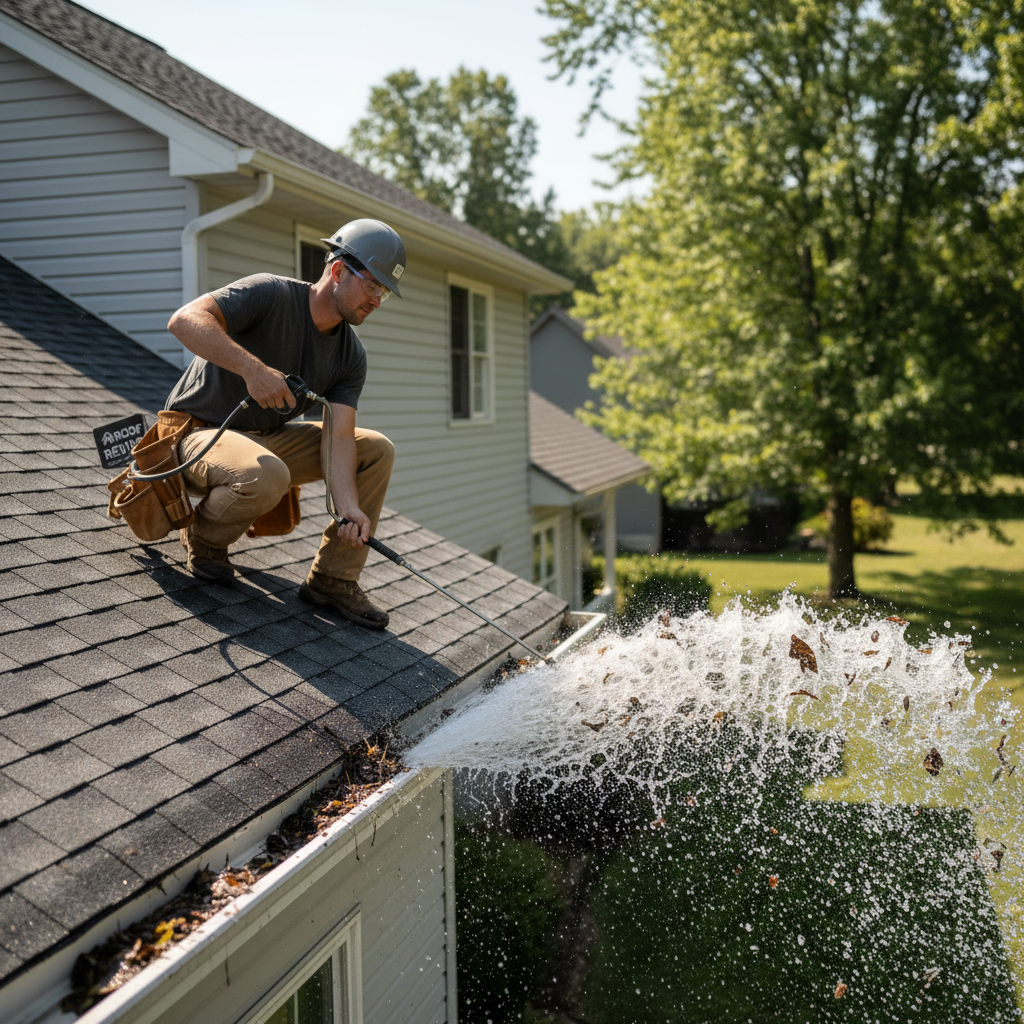
Even with the right product, forcing results can destroy an aging shingle roof. Skip pressure washing and any stiff scraping that pulls granules or lifts tabs if the goal is roof cleaning without pressure washing. Those granules don’t come back once they’re stripped, so the first attempt has to be gentle. Treat this as chemical cleaning with low pressure: apply from the ground with a roof moss killer spray using a hose-end sprayer or long-reach applicator, aim for even coverage, then let dwell time and rain do the removal (see roof softwashing guidance).
Think in weeks, not a weekend makeover. As an example, thick moss may need more than one treatment, and the visual change often shows up in phases (green to brown, then gradual shedding). If you insist on instant “clean,” you’ll usually pay for it in shingle wear.
In coastal Wilmington conditions, salt air and high humidity can accelerate shingle aging and make organic growth return faster on shaded slopes. Read more in our article: Salt Air Humidity Shingles
Set the Timeline: Killing vs Removing

A roof moss killer can do its job and still leave a green, fuzzy patch for a while. “Killed” means the moss has stopped growing and will start browning out; “removed” means it has physically let go and washed away. On an older asphalt shingle roof in Wilmington, that second part often depends on rain cycles and sun exposure, so judging success after a day or two is a bad idea. It sends you straight to aggressive brushing or blasting, and even the loudest Nextdoor threads can’t make that smart.
If the moss turns dull, browns, or dries into a crust, treat that as progress and let weather do the heavy lifting. Only touch it once it’s already loose; then stick to low-pressure rinsing after a few good rains or clearing clumps that are damming water in valleys or along gutter lines.
Roof Moss Prevention That Works on Coastal Roofs
Even good prevention has a reach limit. Industry guidance commonly notes a ridge strip may only inhibit growth roughly 10–15 feet downslope, so many roofs need more than a single line at the peak to matter.
On coastal roofs, prevention is mostly about staying ahead of moisture and “roof compost,” not finding a magic product, because your gutters are basically a rain conveyor belt. If you keep valleys and gutters clear (especially after storms) and trim back shade where you can, you cut the damp zones where moss re-establishes fastest.
Zinc or copper strips can help, but they’re inhibitors, not a remover, and their reach is limited. Because a ridge strip often only affects roughly 10–15 feet downslope, a single peak line can leave lower sections unprotected. Also treat strip lifespan as site-specific: salt air and rainfall patterns can swing performance from short-lived to multi-year. The practical cadence is simple: clear debris seasonally, watch north-facing/shaded slopes after wet stretches, and plan on periodic touch-up treatments instead of expecting a one-and-done fix.
The easiest prevention wins are usually gutter cleanouts and trimming shade so roof areas dry faster after rain. Read more in our article: Prevent Algae Moss Return
Roof Moss Killer FAQ
Do You Usually Need More Than One Treatment?
Yes, especially if the moss is thick or the roof stays shaded and damp. If you see browning but not full shedding yet, a second application per the label can be normal, not a sign you “picked the wrong product.”
Is Roof Moss Killer Safe for Pets and Plants?
Assume runoff is part of the job, since what you spray will travel through gutters and downspouts into beds and lawn. Keep pets away until the product dries, and choose a plan that avoids dumping concentrated runoff onto sensitive shrubs.
Can I Use Zinc Sulfate If I Have Copper Gutters or Flashing?
Don’t. Guidance warns zinc sulfate can corrode copper, so if you see copper in the runoff path (gutters, downspouts, flashing), switch to a different roof-approved option.
When Should You Stop DIY and Get an Inspection or Estimate?
If you’ve got active leaks, widespread granule loss, or curling or brittle shingles, you’re past the “just spray it” stage. At that point, stop DIY and use Angi (Angie’s List) or read local contractor reviews before calling anyone for a roof cleaning estimate. In Wilmington’s wet, salty conditions, an inspection can tell you whether you’re preserving roof life or just masking a bigger problem.
Roof not getting any younger? Contact us or call 703-673-6301 to find out where you stand.For a done-for-you option, our soft wash roof cleaning in Wilmington pairs the right killer with shingle-safe application.