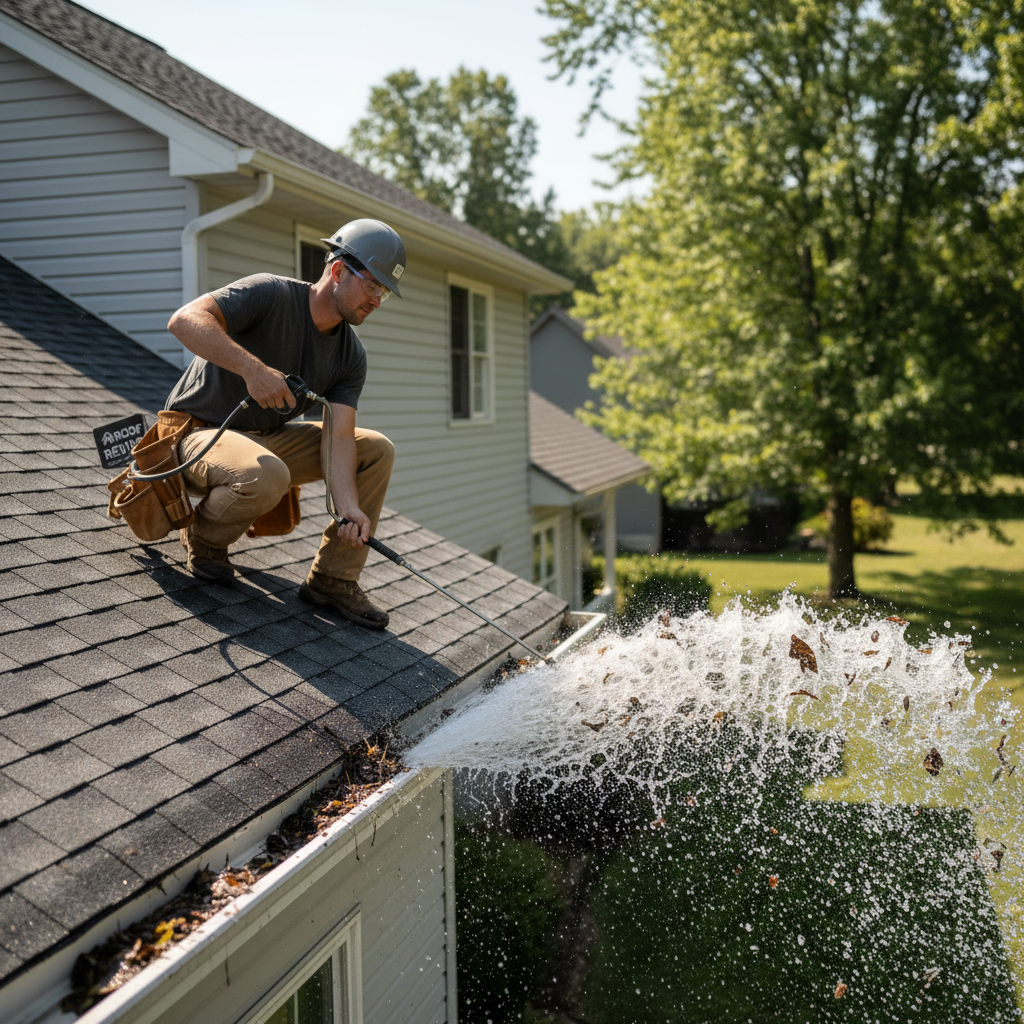
You don’t search “roof cleaning company near me” because you feel like upgrading curb appeal. You search because you see streaks or growth spreading, and you don’t want the wrong crew to damage your roof or scorch your landscaping.
This guide helps you hire with confidence in coastal North Carolina, where humidity and salt air change what “good” looks like. You’ll learn what “near me” should mean and how to tell safe cleaning from risky shortcuts.
What “Near Me” Should Mean

A “roof cleaning near me” search shouldn’t reward the closest truck. It’s the company that can respond quickly, serves your neighborhood (Wilmington to Wrightsville Sound to Carolina Beach), and works every week in the same humid, salt-air conditions that make algae and lichen come back fast.
A provider who routinely cleans roofs under live oaks and Spanish moss in Porters Neck will price and plan differently than someone who mainly works inland. They’ll expect heavier organic load and manage plant and runoff rinse carefully. Before you book, ask: “What’s your typical lead time here?” and “How often do you work in my exact area?” If you’re still choosing by miles, you’re picking off the wrong menu.
Decide What Problem You’re Solving

A homeowner spots black streaks, gets a quote the same day, and books the fastest fix. Two weeks later they learn the “stains” were the least important part of the story.
Before you compare “roof cleaning company near me” quotes, define the problem you’re paying to solve. Different problems call for different levels of intervention, especially for roof moss removal. Those black streaks are often algae staining that’s mostly cosmetic (roof algae removal), while moss can physically hold moisture and creep under edges.
Separate surface grime from signs of failure. If you’ve got water spots in the attic or drip marks near vents, cleaning won’t solve your real risk. A reputable company will say it upfront. It should match Google Maps / Google Business Profile reviews.
In coastal NC, black streaks are often algae rather than “dirt,” and the right cleaning approach depends on what’s actually growing on your shingles. Read more in our article: Roof Algae Black Streaks
Questions That Expose Real Roof-Cleaning Quality
You can do everything “right” on price and reviews, then watch your shrubs brown out because one crew cut corners on controls you never saw. The goal is to make those shortcuts impossible to hide before anyone steps on your property.
Plenty of companies say “soft wash,” but that label alone doesn’t tell you whether shingles and landscaping will be protected when you’re comparing soft wash roof cleaning near me. What separates crews is how they control mix strength and dwell time. It is the guardrail that keeps runoff from turning your beds into a chemical tide. For instance, two crews can both promise a “no pressure wash” clean, yet one will still overdo mix strength or skip plant protection and leave you with browned shrubs and streaky results.
If a contractor can’t clearly explain how they avoid damaging shingles, that’s a sign they may be using techniques that strip granules or shorten roof life. Read more in our article: Pressure Washing Roof
| Question to ask | What a solid answer includes | Red flags |
|---|---|---|
| Are you applying any pressure to the shingles at all, or strictly a chemical application and gentle rinse? | Clear “no pressure” policy on shingles; explains application method and controlled rinse | Vague “we soft wash” with no details; mentions blasting/problem spots with pressure |
| What do you do to protect plants and manage runoff, especially around mulched beds and downspouts? | Pre-wet/cover plan; runoff control around downspouts/beds; rinse protocol | “Plants will be fine”; no mention of downspouts/runoff or post-rinse |
| How do you control mix strength and dwell time on the roof so you don’t over-treat or under-treat? | Mix discipline, measured process, and dwell-time control; explains adjustments for conditions | Won’t discuss mix/dwell at all; “we just know”; overly aggressive approach |
| What will you provide as proof of work when I can’t see the roof up close, and what does your ‘spot-free’ or regrowth warranty actually cover, and for how long? | Before/after photos; written warranty terms; defines coverage window and limits | No proof offered; warranty language is unclear or sounds like a blanket promise |
Coastal NC Risks to Pressure-Test

When a crew plans for coastal conditions, you avoid cooked plants, streaked siding, and early regrowth. In this climate, the difference is usually planning, not promises.
Coastal North Carolina isn’t a generic roof-cleaning environment, and treating it like one leads to preventable damage for coastal roof cleaning. Shade from live oaks keeps shingles damp longer, and algae comes back faster. Add salt air and you’re not just paying for “clean,” you’re paying for a crew that won’t scorch your landscaping or stain your siding.
When you compare bids, pressure-test for the coastal failure points: ask how they’ll handle downspouts and rinsing around beds, and what regrowth window they set expectations for. If they talk like Wilmington, Wrightsville Sound, and Carolina Beach are inland, they are guessing. Nextdoor neighborhood recommendations will usually sniff that out fast.
Coastal salt air and humidity can accelerate shingle wear and regrowth, so maintenance timing and expectations should be set differently than inland homes. Read more in our article: Salt Air Humidity Shingles
How to compare roof-cleaning estimates
Some national pricing references put soft-wash roof cleaning around $0.20–$0.30 per sq ft, while other guides cite a wider $0.50–$1.50 per sq ft range. If you only compare the final total, you are almost guaranteed to compare different scopes.
A roof-cleaning estimate only becomes comparable when you translate it into $/sq ft and pin down what’s included. Depending on the source, soft-wash cleaning ranges from $0.20–$0.30 per sq ft to $0.50–$1.50 per sq ft depending on region and constraints for roof cleaning prices. That spread is exactly why the lowest total can be the riskiest choice. Let’s not throw good money after bad by ignoring the hard sections of your roof.
To make quotes apples-to-apples, ask each company to write the roof size they’re pricing and the price per sq ft.
| Quote input (get it in writing) | Why it matters in coastal NC |
|---|---|
| Roof size used for pricing (sq ft) | If contractors assume different sizes, totals and $/sq ft aren’t comparable |
| Price per sq ft ($/sq ft) | Normalizes bids and reveals when a low total is just missing scope |
| Story count and access constraints | Drives setup time and safety approach; affects real labor time |
| Roof pitch/steepness | Changes difficulty and time on the roof; can change method limits |
| Landscaping/downspout management plan | Runoff control is a major damage risk around beds and siding |
| Shade/live-oak coverage and severity on worst slope | Heavier organic load often needs more careful application/rinse planning |
In coastal NC, the most legitimate drivers are the ones that change access and time, such as story count and pitch. If two estimates don’t agree on those inputs, they’re not really bids for the same job.
When to add roof rejuvenation

A neighbor pays for rejuvenation hoping to dodge a replacement, then finds out the “proof” was mostly marketing and the warranty was narrower than it sounded. If you treat the evidence like a contractor bid, the decision gets a lot clearer.
Roof rejuvenation is typically a follow-on to a proper roof cleaning when shingles are aging but still intact and you’re trying to delay replacement. As an illustration, if the roof is 12–20+ years old and you’re seeing general dryness and faster staining but not obvious failure, rejuvenation can be a rational maintenance add-on, not a miracle fix.
Don’t let “lab tested” drive the decision. See a local consumer lens on interpreting rejuvenation claims and commissioned testing: roof rejuvenator sprays, what a cautious homeowner should know. Better Business Bureau (BBB) business profiles matter more than a glossy PDF. In this category, some results are commissioned by manufacturers. Ask who ran the testing and what, specifically, was measured. Push for specifics like independent testing and decision-relevant metrics, then read the warranty language closely. Case in point: some warranties are effectively “spot-free for 24 months,” not “your roof won’t regrow algae or age normally.”
Book with confidence: the 24-hour checklist
If you’re ready to book, stop “shopping” and start confirming. A roof clean happens mostly out of sight, so your goal in the next 24 hours is to lock down scope and method in writing, not just a low total.
Confirm before you schedule
-
Written scope: roof type/size used for pricing, $/sq ft, and what’s included (gutters/downspouts, stubborn shaded slopes)
-
Method: no pressure on shingles, clear mix discipline, plant and runoff protection plan
-
Proof and payment: before/after photos, simple invoice, card/check options (no cash-only or bank-transfer pressure)
-
Warranty language: what “spot-free” or regrowth coverage actually lasts (often 12–24 months) in the roof cleaning warranty
Expect day-of: pre-wet/cover sensitive plants and a thorough rinse.
Roof not getting any younger? Contact us or call 703-673-6301 to find out where you stand.