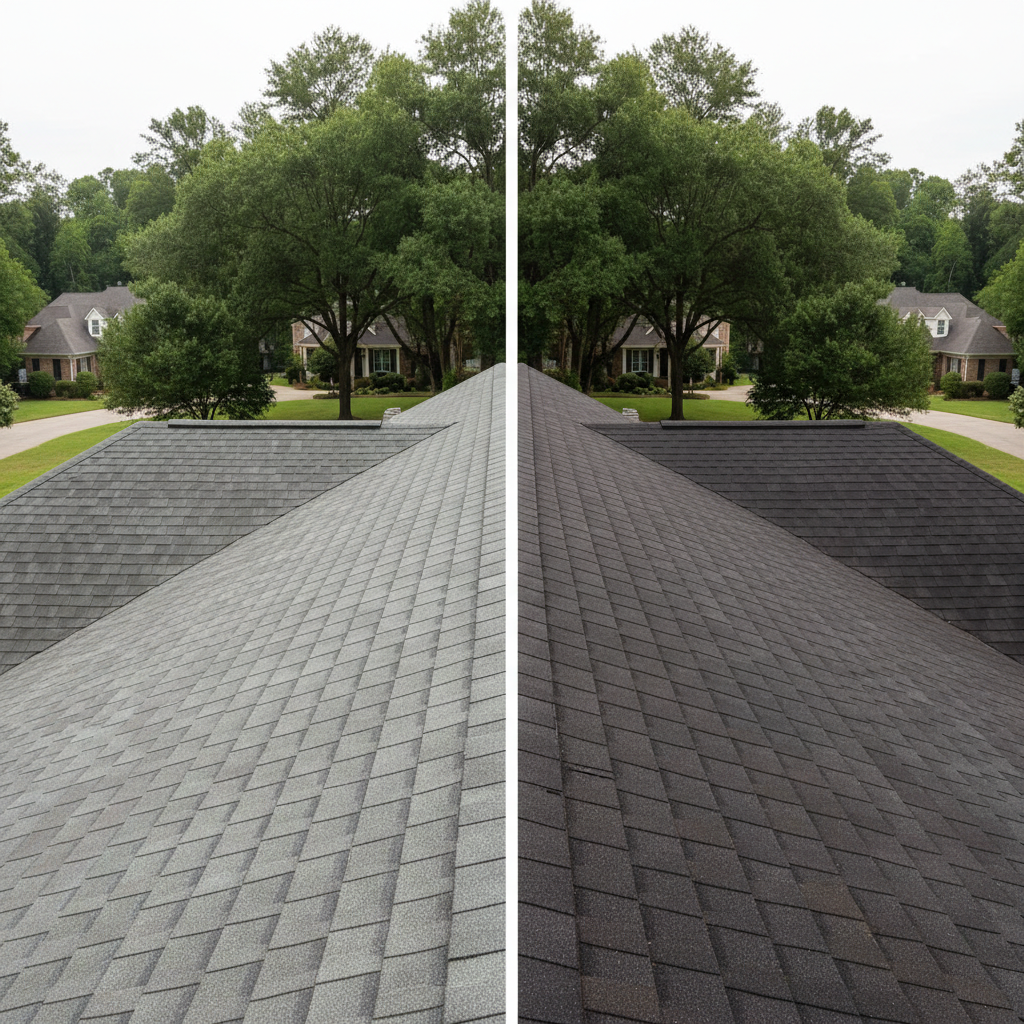
You’ve probably seen “25-year” or “30-year” on shingles, then watched a neighbor replace theirs way sooner. In coastal North Carolina, asphalt shingle roofs typically last about 15–20 years, with closer to 25 years only in less-exposed spots with high-quality shingles and solid ventilation.
That difference between the label and real life usually comes down to salt-laden wind and storm-driven rain. They wear down your roof’s safety margin long before you notice a leak. Instead of treating your roof like it has a fixed expiration date, you’ll get better answers by thinking in exposure tiers and looking for early storm-fragility signs that tell you whether to maintain or plan a replacement before the next system rolls through.
The Real Lifespan Range in Coastal NC

Around Wilmington and nearby beach communities, the “20–30 years” on shingle marketing often becomes a shorter planning window. Near the coast, the typical asphalt shingle roof lifespan is 15–20 years, stretching toward ~25 only with higher-quality shingles (often architectural) and strong ventilation.
The trap is trying to kick the can down the road. In coastal NC, salt air and wind make aging more like a sandbar at low tide. The roof might not leak today, but its storm tolerance can drop fast after the mid-teens. Practically, once you’re past ~15 years, you should shift from “How long can I wait?” to “What would I do if a tropical system hits this season?” and plan an inspection and budget accordingly.
Salt air and persistent humidity can accelerate granule loss, corrosion, and premature shingle brittleness even when a roof looks “fine” from the ground. Read more in our article: Salt Air Humidity Shingles
Your Exposure Tier Changes Everything
Two homes can reroof in the same year on the same street, yet one still gets hit with early failures. Exposure, not luck, often decides which one fails first.
“Coastal North Carolina” isn’t one roof environment, and Nextdoor advice won’t change that. Week-to-week salt wind and moisture load determine your roof’s roof life expectancy coastal climate. Same-age roofs can age at different speeds, and pretending otherwise leads to bad timing.
A simple way to calibrate your expectations is to place yourself in an exposure tier
-
Oceanfront or first few blocks from the beach: plan on the short end of the range; you’re more likely budgeting around the mid-teens to low-20s because the roof lives in constant salt and wind.
-
Sound-side, marsh, or close to the Intracoastal: still “coastal,” but usually a step less severe than oceanfront; many roofs land in the upper-teens to low-20s if everything else is solid.
-
Inland Wilmington and a few miles off the water: you may get closer to the high-teens to ~25 years, especially with architectural shingles and good upkeep.
If you’re using a neighbor’s roof age as your benchmark, make sure their exposure tier matches yours, or you’ll make the wrong call.
What Aging Looks Like Before Leaks

In coastal NC, a roof can look rough long before it leaks, and that visual noise can push you into the wrong decision. Black streaks from algae are often a cosmetic issue (and sometimes a sign the roof stays damp or shaded), not proof the shingles are “done.” A little granule shedding is also normal, especially early on, but it becomes a real warning when you see bare, shiny asphalt showing through or you find piles of granules consistently at downspouts after every hard rain.
The more important pre-leak clue, signs asphalt shingles need replacing, is whether the roof is holding on by a thread. If you’re seeing frequent creased or lifted tabs after windy days, cracking at shingle edges, or exposed nails, you’re no longer judging “looks.” You’re judging risk, like sailcloth that’s starting to fray. Don’t wait for the first ceiling stain to tell you the truth; ask for a roof inspection that specifically calls out granule loss patterns by slope and wind damage.
Knowing the difference between normal aging and storm-related damage can prevent you from replacing a roof early, or missing a problem that’s about to leak. Read more in our article: Normal Shingle Wear Vs Damage
A Simple Decision Rule: Maintain, Rejuvenate, or Replace
You want a plan, roof rejuvenation vs replacement, that feels obvious after the inspection, not a debate every time the forecast lights up. The right call is the one that reduces storm risk without spending replacement money too early. One measurable factor that can shorten shingle life is attic ventilation, often evaluated against building-code guidance like IRC R806 ventilation ratios.
Roof rejuvenation can be a good fit when shingles are aging but still structurally sound, and the decision usually depends on brittleness, granule retention, and overall roof condition. Read more in our article: Roof Rejuvenation Vs Replacement
| Scenario | Typical indicators | Best default action | Why |
|---|---|---|---|
| Under ~12–15 years and no fragility signs | Not seeing creasing/lifting after wind, cracking edges, exposed nails, or failing pipe boots/valleys | Maintain | Protect remaining life by clearing debris, managing moss/algae, and fixing small detail issues |
| ~12–18 years, moderate exposure, shingles still feel intact | Moderate exposure tier; condition still intact on inspection | Rejuvenate (only if inspection confirms candidate) | Buys time, but does not reset the clock |
| Past ~15 years in oceanfront/near-ocean exposure, or showing fragility | Repeated wind-lift, widespread granule loss, or tired penetrations/valleys | Replace | “It hasn’t leaked yet” is not a useful standard. Mike Holmes would call that throwing good money after bad when storms can turn borderline into interior damage fast. |
What to Do This Month to Buy Time (or Confirm It’s Done)
Some coastal guides put the realistic replacement window as low as about 12–22 years depending on exposure and shingle type, which means small delays can get expensive fast. If you are on the edge, the next storm is a stress test you did not schedule.
If you’re trying to squeeze another season or two out of an aging shingle roof in coastal NC, treat it as storm-risk management instead of a warranty-chasing exercise. Get ahead of the problem, like you would before a named storm. By the time you get a leak, wind-driven rain has already exploited the weakest detail and the cheapest fix window has passed.
This month, schedule a wilmington nc roof inspection that explicitly checks penetrations and water-collection areas (pipe boots, flashing, valleys, and around chimneys), plus wind-prone edges and ridges for lifting or creasing. Then do a quick attic reality check on a humid day. If it smells musty or you see damp insulation or staining, fix that and verify intake and exhaust ventilation are actually clear. Finally, clean gutters and downspouts, remove roof debris, and trim back limbs that drop leaves or rub shingles, because chronic wetness and abrasion shorten life fast near the coast.
Roof not getting any younger? Contact us or call 703-673-6301 to find out where you stand.Rather than guess, let our local roof rejuvenation service document where your roof really stands.